
Humans construct physical reality through the narrow window of our senses. Our eyes see only the tiny sliver of the electromagnetic spectrum between about 400 nm and 700 nm, and our other senses similarly detect just narrow bands of stimuli. The figure below illustrates that the visible band is only a tiny slice of the full EM spectrum. All the cosmic X‑rays, radio waves, ultraviolet and infrared energies pass us by unnoticed, yet our physical theories often take these “invisible” interactions as fundamental. In effect, our physics is built on the foundation of what we can perceive.
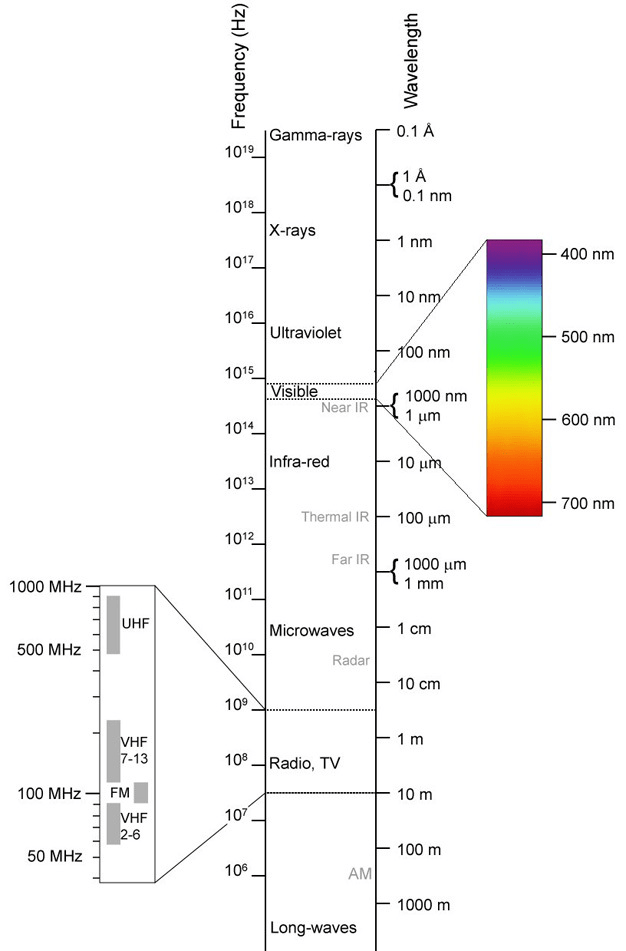
Figure: The electromagnetic spectrum, from radio to gamma rays. Humans see only the narrow visible band (about 400–700 nm); other animals and devices detect the rest (inset).
Our sensors filter raw reality into discrete impressions. For example, we perceive brightness and sound logarithmically rather than linearly. The classic Weber–Fechner law states that our subjective sense of intensity grows as the logarithm of the physical stimulus. In plain terms, doubling the intensity of light or sound does not make it feel twice as bright or loud – it just adds a constant amount to our perception. This nonlinearity means that we are acutely sensitive to small changes when stimuli are faint, but we quickly saturate as they grow strong. In effect, our brains warp sensory scales (for example, each color or octave spans a huge range of frequencies) so that a linear shift in sensation covers an exponential range of reality. Any entity whose senses were otherwise tuned – say, linearly or with a different bias – would literally see and hear the world in another key.
Biology seriously constrains what counts as “real.” Every species constructs a unique Umwelt – a subjective world shaped by its sensory organs and brain. Jakob von Uexküll famously proposed that “every living creature inhabits a world of its own”. Our human Umwelt excludes UV, infrared, ultrasound, infrasound, pheromones, electric fields, and more. Other animals fill some of those gaps: for instance, bees see ultraviolet flower patterns invisible to us; snakes have infrared “heat pits” that map warm-blooded prey; elephants communicate with infrasound and sense seismic vibrations with their feet; even catfish “taste” chemicals over their entire bodies. Each sensory modality adds a dimension to an animal’s ontology.
- Light and Color: Humans have three types of color cones (red, green, blue) tuned to 400–700 nm. Bees have three types too, but they see UV and lack red. The diagram below compares the human versus bee visible spectrum. (Bees’ vision spans roughly 300–650 nm, letting them see ultraviolet patterns on flowers.)
- Sound and Vibration: Humans hear roughly 20 Hz–20 kHz, but many animals hear far beyond. Dogs hear up to ~40 kHz (why dogs respond to ultrasonic dog whistles) and bats echolocate at 20–100 kHz. Certain insects and rodents can perceive ultrasonic or infrasound frequencies out of our range.
- Smell and Chemistry: We have a few million olfactory receptors, but mammals like dogs have hundreds of millions. A dog’s nose can detect scents diluted to parts per trillion; we can’t. Consequently, a dog’s “olfactory umwelt” is enormously richer, akin to having vision across 5–6 extra “color” dimensions.
- Electric and Magnetic Fields: Sharks, platypus, and some fish have electroreceptors; many birds (and perhaps mammals) sense Earth’s magnetic field for navigation. These are real physical fields that we cannot innately sense at all.
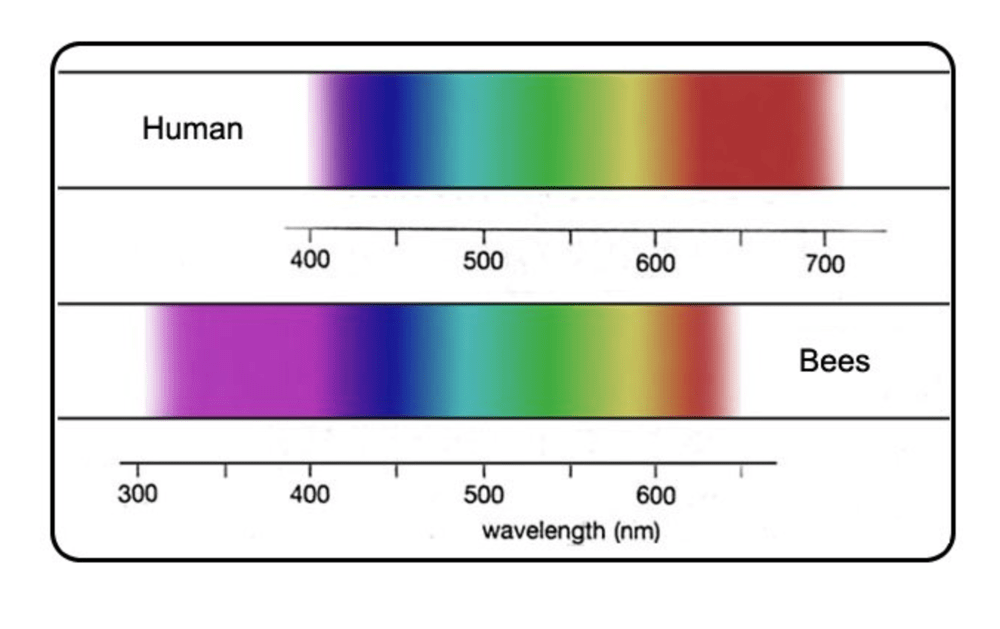
Figure: Human vs bee vision. Humans (top) see roughly 400–700 nm, whereas bees (bottom) extend into the ultraviolet (~300–650 nm). Bees thus perceive flower patterns (below) invisible to us.
Because of these filters, no animal – including humans – has privileged “direct access” to reality. Each organism experiences only the stimuli its sensors transduce, meaning it builds a model of the world colored by its biology. Kant even proposed that space and time themselves might be forms of human perception rather than mind-independent entities. In Kant’s words, “space and time are only sensible forms of our intuition, but not determinations given for themselves”. In other words, even the geometric stage on which physics plays might be an artefact of our brains’ wiring. These philosophical insights remind us that all our concepts – from particle to field, from mass to charge – come through a human prism.
The Brain’s Filters: Conceptual and Mathematical Boxes
Beyond raw sensation, cognitive biases and neural architecture shape how we conceptualize reality. Our brains naturally group continuous stimuli into discrete chunks or categories. For example, we see motion as objects moving against a background, time as a flowing sequence, and space as filled with countable things. Even toddlers have a “naïve physics” of solid, countable objects (Aristotelian in flavor) long before they learn Newton’s laws. Decades of cognitive research show that people tend to apply certain default “folk physics” ideas – like expecting objects to move in straight lines or come to rest unless something pushes them. These intuitive categories influence our science. We came to physics expecting particles, waves, fields, and forces because that matches our mental schema; discovering quantum mechanics and field theory was so unsettling because it violated those ingrained schemata.
Discrete vs. Continuous. Our maths also frames reality in boxes. Classical physics found continuum equations of motion, but quantum mechanics introduced fundamental discreteness (energy quanta, atomic structure). Thermodynamics took discrete molecules and derived continuum heat equations. In fact, as historian Annick Lesne notes, “discrete and continuous features coexist in any natural phenomenon, depending on the scales of observation”. In one model you might count individual atoms; zoom out and you use fluid equations. Mathematicians have long debated if space, time, or matter are truly discrete (made of indivisible bits) or continuous. The lesson is that our “conceptual boxes” often trade fidelity for tractability. When dealing with galaxies we smooth matter into fields; when dealing with atoms we count particles. The choice reflects our cognitive strengths rather than an absolute truth.
Nonlinear perception: Our brains map stimuli nonlinearly. We perceive music and color in octaves and wavelength bands, not raw frequencies. We remember logarithmic memory scales (decibels, Richter scale) because magnitudes span many orders. Time feels subjective: a minute waiting feels longer to a child than to an adult. Psychologists have shown that subjective time is elastic and varies with attention, age, and neural processing speed. For instance, tiny fast-brained animals like flies or bees experience far more “moments” per second than we do. One analysis estimates that songbirds and honeybees experience about 2–10 times as many subjective moments per objective second as humans. Thus a bee’s life might seem dramatically “slower” in their own frame: a bee could watch a hummingbird beating its wings as if in slow motion, while we only see a blur. If an alien had a brain ten times faster, their physics might be organized around events we consider effectively instantaneous.
Fractal and scale-free structure: Recent neuroscience finds that the brain’s wiring is fractal-like and scale-invariant. In other words, neural circuits repeat patterns across scales, much like coastlines or clouds. This suggests our brains naturally process information hierarchically across scales, potentially attuning us to detect self-similar patterns in the world. It might even mean our thinking is predisposed to chunk things recursively or see emergent properties (e.g. patterns of shapes repeated at different zoom levels). Some researchers speculate this fractal organization might give the brain creative computational power beyond standard digital computers. If our cognition leverages fractal hierarchies, it might favor describing nature in terms of scaling laws and renormalized approximations. Other intelligences with different neural architectures could frame reality in entirely different mathematical languages – perhaps using ultra-metric spaces, hyperbolic geometries, or other exotic frameworks that our biology never leads us to consider naturally.
Language and metaphor: We build abstract concepts through metaphor. Lakoff and Núñez, for example, argue that because we have no neural mechanism to directly perceive infinity, we must use metaphors (like the “infinite series” or the “limit process”) to conceive it. Similarly, the notion of an unbounded universe or fractal dimension is not intuitively given to the mind but constructed from grounded experiences. If another species had neural circuits attuned to higher-dimensional geometry or hyperbolic space, maybe “infinity” would seem as obvious to them as counting is to us. Thus even the very logic and mathematics we take for granted may be a byproduct of our species’ sensorimotor background, rather than universal truths “out there.”
Worlds Apart: Diverse Umwelten and Alien Physics
If each creature has its own Umwelt, could there be entire “physics” to match each Umwelt? In principle, yes. Imagine an organism that sees only polarized magnetic fields: for it, magnets and dipole orientations might be as fundamental as our electric and gravitational fields. Or a deep-sea creature that “hears” through pressure changes and bioluminescence might treat shockwave and light patterns as primary data, constructing a science very unlike ours. Keith Dreyer argues that even artificial intelligences might develop unique Umwelten: an AI “perceives” vectors of data or latent variables, potentially rendering human concepts (like tables, intentions) irrelevant.
Different physics from different minds: Concretely, what might alien physics look like? It could differ in fundamental ways:
- Different base quantities: We use length, time, mass, charge. An alien species might have detected an extra fundamental “dimension” in nature. For example, if they evolved sensing patterns of causality or purpose, they might speak of “teleonomic” fields. If they had extra spatial senses (like detecting 5D embedding), their geometry of space could be non-Euclidean or involve additional coordinates.
- Alternative mathematics: Perhaps their mathematics uses arithmetic that isn’t base-10 or base-2 but something radically different (e.g. p-adic number systems if their neural noise were p-adic in nature). If their brains naturally segmented amplitudes multiplicatively, they might think first in logarithms or exponents. Some theories (like p-adic physics in string theory) are fringe to us but might be obvious to a mind built differently. A neural network tuned to parse fractals might have calculus built on fractal dimensions from the ground up, rather than integer dimensions.
- Different symmetry groups: Our physics is guided by rotational and Lorentz symmetry because we live in a roughly isotropic space-time. An alien evolving on, say, a Möbius-strip planet, or perceiving a time that loops, might have discovered completely different symmetries. Some theorists even wonder if our “constants of nature” might be as much cognitive constraints as physical: perhaps beings with faster perception would treat the speed of light differently in their equations.
- Non-linear time perception: We experience time linearly at human scales, which shaped Newtonian time. But as we know from relativity, that is not fundamental. Could an evolved being native to relativistic or quantum extremes conceive time non-sequentially? One could imagine a species with an internal clock triggered by some looping neural feedback, so that “past,” “present,” and “future” are perceived non-linearly or even simultaneously. For such minds, a block-universe view (where all times exist) might be self-evident, not counterintuitive.
Example speculation: Think of an alien with a “nonlinear brain” whose internal processing treats multiplicative changes as additive. Just as we struggle to intuit exponential growth (e.g. population doubling) or fractal depth, an organism tuned to those patterns might find linear phenomena bizarre. Its intuition might naturally grasp power laws and infinite recursion without metaphors. Perhaps it would describe a sequence of events in “log-time” steps, or use a geometry where distances shrink infinitely but never vanish (resembling hyperbolic spaces). In effect, it would have a shape-of-time and space concept unfathomable to our neurology.
Concrete cognitive examples: In human science, relativity and quantum mechanics already stretched our “naïve” intuition: simultaneity became relative, and particles can be in superposition. For an alien mind, phenomena that we had to learn mathematically might be directly perceived. For instance, a creature living at near-light speeds (or in strong gravity) might see the universe where “time and space are already mixed” as naturally as we see a day-night cycle. Its everyday physics might include a natural sense of 4D spacetime. Or an intellect with dozens of photoreceptor types could see a spectrum as rich as a rainbow palete beyond our imagining, perhaps dividing reality into a dozen color-typed forces.
Multiple “objective” worlds: Uexküll emphasized that from the scientist’s external viewpoint there is one world, but “from the inside” each subject has its own world. If humanity ever encounters extraterrestrials or advanced AIs, we may find that their operational “laws of physics” differ not in outright physical contradiction (those are universal) but in which aspects of that physical substrate they foreground. For us electrons and photons are the bread and butter; for a silicon-based mind perhaps charge and electromagnetism are downplayed while computational entropy is key. In other words, different intelligences might draw different “maps” of the same territory.
Time, Infinity, and the Fringe of Perception
Finally, let us push into the more speculative frontier. If sensory and neural constraints shape our familiar physics, removing or altering those constraints leads to bizarre possibilities.
- Shape of Time: Humans perceive time as one-dimensional and flowing forward (thanks partly to memory encoding). But some philosophers and physicists allow that time might have a richer structure (cyclic, branching, or fractal). Could an intelligence actually perceive time as something other than a simple order? Consider a being whose brain can detect “temporal frequency” beyond our sense of change: it might see periodic or recursive time directly. Or a creature with multiple interacting “clocks” (like circadian rhythms, lunar cycles, neural oscillations) might experience temporal layering. Their narrative of events could be nonsequential, like watching layers of a story simultaneously.
- Non-linear (warped) cognition: We already noted that perception of size, sound, brightness, even emotion is non-linear. Extrapolating wildly: a “nonlinear brain” might treat variables like energy or distance on a different scale (e.g. perceiving energies on a logarithmic or arbitrary scale instinctively). Some computer scientists explore neural net activations that respond to fractal inputs; an alien nervous system could be naturally fractal, perceiving patterns that to us are chaotic. This could make them see hidden correlations (like resonance patterns) that we miss.
- Perceiving Infinity: Humans never directly perceive infinity; we handle it by abstraction. As Lakoff & Núñez note, “we have no cognitive mechanisms to perceive infinity”, so we rely on metaphor. But what if an intelligence could perceive something akin to infinity or the continuum? Perhaps by extending some sense sensor (like as the way some animals sense an endless gradient, e.g. bees see continuous gradients of odor or color). A mind that could innately experience unending sequences might treat mathematical infinity not as a limit but as an actual entity. Their geometry or arithmetic could include points at infinity as naturally as negative numbers are to us.
- Continuum vs discrete: What if an entity had sensors that intrinsically sample all scales? For us, atomic discreteness and spacetime continuity had to be discovered. A civilization with high-frequency detectors (say, neutrino or gravitational wave sensors as natural organs) might see “quantum foam” or spacetime fluctuations directly. They might think at the Planck scale and find our macroscopic continuum theories coarse. Conversely, a creature that perceives only very coarse, emergent phenomena might see particles and waves as illusions atop a deeper “continuum of process.”
While these ideas border on metaphysics, they follow logically from the premise that perception shapes ontology. If different brains carve reality differently, there may be multiple equally self-consistent “physics” from the inside. Our human physics feels universal because it successfully predicts observations made by human-scale instruments. But an entirely alien experiment – say, swimming through a supernova or calculating with a qubit-neuron – might look nonsensical to us but perfectly natural to another mind.
Conclusion: Beyond Human Physics
Our journey above suggests that physics is as much a product of our mind as of the universe. We organize the world into atoms, fields, spacetime, and laws because that framework fits our evolved sensors, our mental arithmetic, and our conceptual legacies. The categories and mathematics we use are powerful abstractions, but they are not guaranteed to be the only ones. History has shown that expanding our perspective (through better instruments or revolutionary theories) can radically change the “boxes” we use.
If other intelligences evolved under different conditions, their science could be equally rigorous yet incomprehensible to us. Like two people viewing a painted scene under different colored glasses, they might draw entirely different inferences about the canvas’s true nature. In the most radical view, one could imagine that every sentient vantage generates its own version of “reality.” Uexküll’s insight was that there are as many worlds as there are perceivers. In a pluralistic extreme, the “objective world” might be a many-faceted beast, with no single vantage granting full access.
Ultimately, we must ask: are the limits of physics “out there” in nature, or “in here” in us? Modern physics already grapples with the fact that an observer is part of the system (consider quantum measurement problems or relativity’s observer-dependence). Perhaps the deepest lesson is humility: our science is our best current model, but it may well be filtered through the narrow constriction of our humanity. The map is useful, but it is not the territory. By recognizing the contingency of our perspective, we can stay open to other maps – other ontologies – that could reveal truths invisible to human eyes. In this sense, to go beyond the discrete horizon is to acknowledge that reality may exceed the outlines we’ve drawn.
Sources: Human perceptual limits and their effect on ontology (visible spectrum, sensory Umwelten, Weber-Fechner law, time perception differences, fractal brain organization, Kant on space-time perception, cognitive limits with infinity, and the discrete/continuous debate). These highlight how sensory and cognitive filters might yield very different “physics” for other minds.
 Horizon Perspective News
Leave a comment