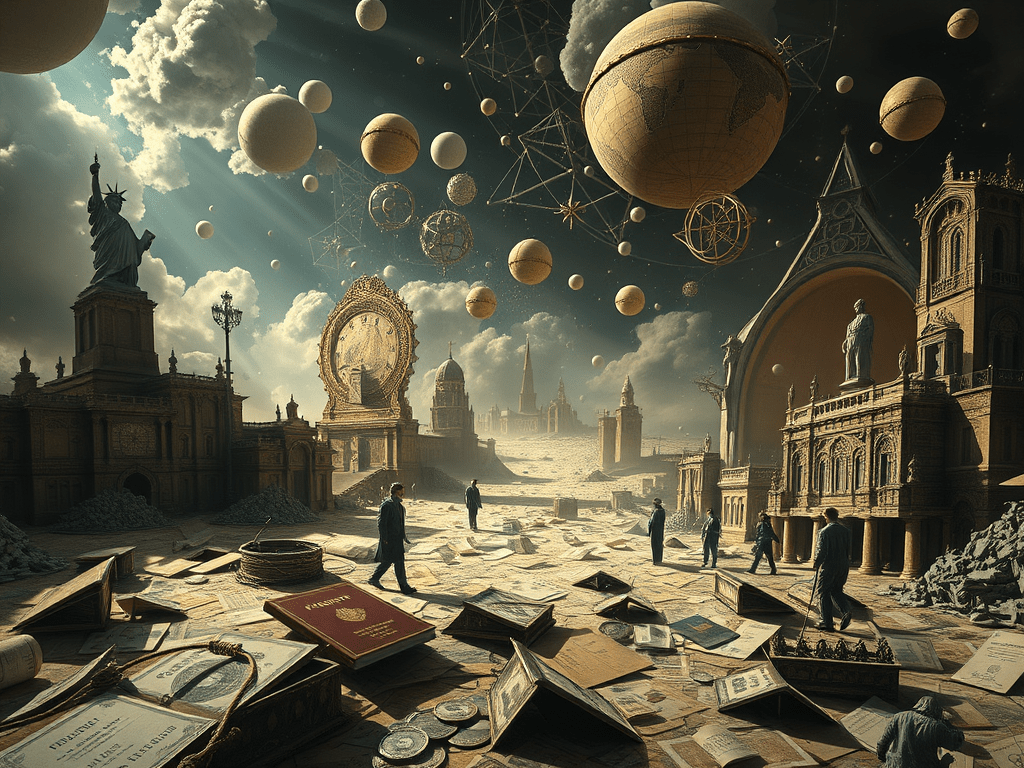
Introduction
Modern humans navigate a world built on intangibles. We carry passports that assert national identities, spend our days earning digital numbers we call money, obey laws written on paper, and find meaning in moral codes or religious narratives. Yet none of these things are tangible features of the natural world – they exist fundamentally as symbols, stories, and mutual agreements. This essay explores the provocative idea that nearly everything constituting modern humanity – from personal identity and morality to religion, economy, law, and nationhood – is a symbolic construction or collective fiction rather than an objective reality. In other words, human civilization may be playing out inside a shared symbolic hallucination.
First, we will examine evidence from anthropology, neuroscience, cognitive science, and sociology showing that human brains are wired to create, believe in, and act upon symbolic realities. Evolution endowed us with the unique capacity to invent and sustain shared fictions – from tribal myths to legal codes – that coordinate our behavior. Comparative examples from non-human animals will highlight how unusual our species is in this regard. Next, we pivot to a more philosophical mode, arguing that human civilization essentially exists within an emergent “Matrix” – not a literal computer simulation, but an elaborate mental landscape of symbols and imagined constructs that we treat as real. Dystopian literature and film have long envisioned societies built on illusion. We will draw examples from Aldous Huxley’s Brave New World, Stanisław Lem’s The Futurological Congress, and the Wachowskis’ The Matrix to illustrate how our own world mirrors the structures of illusion and belief depicted in those stories. In those tales, people live in false realities (whether by conditioning, drugs, or simulation); here we consider to what extent our current world is similarly propped up by collectively believed fictions. A key question is whether the emergent (rather than centrally controlled) nature of our real-world “matrix” makes it any more genuine or liberating. We will explore how this symbolic substrate underlies all systems of power, value, and meaning in human society, and ask what it means for us if we recognize the grand lie at the heart of our shared reality. Is enlightenment a path to freedom, to societal collapse, or simply the seed of a new myth?
Throughout, we will use academic research and theory to ground this exploration of humanity’s invented reality. The goal is not cynicism or nihilism, but a clear-eyed look at the astonishing power of the human imagination – for better and worse – in constructing what we experience as “real.” Understanding the nature of our collective fictions may be the first step toward consciously shaping them, or at least not being unwittingly trapped by them. Let us begin by examining the human mind’s capacity for symbols and stories, the very capacity that makes our shared hallucination possible.
The Symbol-Making Brain: How Humans Construct Reality
Humans are often described as the symbolic species, and for good reason. Anthropologists and cognitive scientists argue that the defining feature of Homo sapiens – the trait that allowed our ancestors to outstrip all other animals – is our capacity for symbolic thought and communication. We alone can imagine things that have no physical reality and get others to believe in them too. Yuval Noah Harari summarizes this in Sapiens, noting that while other animals communicate about concrete reality (food, predators, social rank), humans evolved the ability to talk about things that do not exist at all – tribal gods, nations, money, human rights. This cognitive leap, occurring roughly 70,000–40,000 years ago in what some call the “Cognitive Revolution,” unleashed an explosion of art, myth, and complex social organization. Archaeology shows the sudden appearance of cave paintings, figurines, and ritual burials in this period, suggesting that early humans were beginning to live in a world of shared symbols and abstract concepts far beyond immediate physical experience. In short, our ancestors began building a second reality in their minds – a world of meaning woven from language and art – overlaying the bare world of rocks, trees, and animals.
Evolutionary Origins of the Human “Matrix”
From an evolutionary perspective, the ability to form collective fictions was an immense adaptive advantage. It allowed large numbers of individuals to cooperate flexibly by sharing common beliefs. Whereas most social animals can cooperate only in limited ways (often based on direct personal familiarity or simple hierarchies), humans can unite by the thousands or millions around shared myths. Harari gives a vivid illustration: “You could never convince a monkey to give you a banana by promising him limitless bananas after death in monkey heaven.” Only humans will sacrifice real-world benefits based on belief in an imagined reward (or punishment) in an imagined realm. This quip encapsulates how our species transcended the immediate material constraints that bind other animals. We live by invented meanings.
Anthropologists stress that virtually all the building blocks of society – clan totems, moral codes, deities, legends of our people’s origin – are cultural inventions that gain power only because we collectively believe them. Classic works like The Social Construction of Reality by Berger and Luckmann (1966) describe how humans together create an “objective” social world through repeated interactions and shared habits of thought. Over time, these shared ideas harden into institutions and traditions that feel as given and real as the natural world. In effect, humans occupy a “world of symbols” layered on top of the physical world. Philosopher Ernst Cassirer went so far as to call humans “animals symbolicum”, suggesting that everything about human life is mediated by symbols and that we have no direct unmediated relationship with reality outside of these symbolic filters. From language and art to ritual and law, our evolutionary trajectory made us ever more dependent on collectively maintained mental structures.
Neurological evidence supports this view that our brains evolved unique circuitry for symbolic thinking. Cognitive neuroscientists have identified networks in the human brain that are specialized for abstract and symbolic representation, distinguishing us from other primates. For example, recent research proposes that a human-specific brain network enables what’s called “reversible symbolic reference”, the ability to let one thing (like a word or token) stand for another and to flexibly manipulate these representations. This is the foundation of language and symbolic thought. One study describes a fine balance in the human brain between concrete sensorimotor processing and “untethered neural associations” that allow for abstract ideas. In other words, evolution tinkered with our neural wiring so that we can easily jump off from raw sensations into flights of fancy – imagining unseen gods, envisioning tomorrow’s hunt, or pondering invisible forces like “destiny” or “value.” Our closest animal relatives, by contrast, seem mostly “grounded” in the present realities of their environment. Even the smartest chimp cannot discuss justice or the nation or the afterlife. The neural leap to symbolic cognition gave humans an unlimited canvas for make-believe – and we promptly populated our world with spirits, myths, and conceptual systems.
Interestingly, the very features of our brain that enable symbolic culture can also misfire in ways that highlight how constructed our reality is. For instance, the psychiatric phenomenon of schizophrenia has been interpreted by some researchers as a breakdown in the brain’s ability to tether symbols to shared context. One paper notes that in schizophrenia, there is an “unbalance toward too unconstrained connectivity,” such that symbolic activity floats free from embodied reality. The result is hallucinations and delusions – private realities not shared by others. This is a pathology, but it underscores by contrast how normal cognition is essentially a controlled hallucination, tied into the social world. Our everyday sense of reality, this study suggests, depends on an intersubjectively constructed balance – our brains aligning with the cultural context to decide which figments of imagination are treated as real and which are not. Healthy human minds continuously negotiate what to believe, in synchrony with those around us. This points to a profound truth: what we call reality is to an astonishing degree a product of collective agreement among brains.
The Brain as a Storyteller and Meaning-Maker
Neuroscience and cognitive psychology further reveal that human brains are hardwired for narrative, constantly spinning interpretations and stories to make sense of the world. We experience not an objective reality but a mental model of reality, built internally. As neuroscientist Anil Seth quips, “we don’t ‘see’ reality – we ‘see’ our brain’s model of the world.” Our perception is a generative act, with the mind filling in gaps and interpreting sensory data to fit expectations. For example, we have a blind spot in each eye where the optic nerve exits, yet we never notice it – the brain invents the missing bit of the scene to present a seamless visual field. In this sense, even at the level of raw perception, we are experiencing a kind of controlled hallucination created by the brain’s predictive models and assumptions about the world.
If our brains effortlessly conjure a coherent visual reality from partial data, it is not a stretch to see how they also conjure a coherent social reality from the chaos of human interactions. Psychologically, humans have an overwhelming drive for sense-making. We are uncomfortable with randomness or meaninglessness, so our minds knit events into patterns and causes. We create narratives about ourselves (“I am this kind of person because…”), about our communities (“we come from this ancestor, we are destined for this mission”), and about the world at large (“the universe was made by X for purpose Y”). Michael Gazzaniga’s split-brain research famously demonstrated the brain’s penchant for storytelling. In split-brain patients, the left hemisphere (which controls language) would concoct an explanatory story for an action initiated by the right hemisphere, even when that explanation was plainly false – and the patient would sincerely believe it. This “interpreter” function of the brain shows that the mind will invent reasons and narratives to make sense of its own actions and the world, whether or not those narratives are accurate. Our default mode is to believe the stories we tell ourselves.
Cognitive scientist Bruce Hood aptly calls the self an “illusion” generated by the brain’s storytelling efforts. In The Self Illusion: How the Social Brain Creates Identity, Hood argues that what we experience as a unified self is actually a construct – a narrative the brain assembles from disparate sensory inputs, memories, and thoughts. Sam Woolfe, describing Hood’s work, explains that just as the brain “fills in” an image like the Kanizsa triangle (where we perceive a triangle that isn’t really drawn, due to suggestive gaps), the brain also “fills in the gaps” to create a sense of self. Our identity is essentially a continuous story the brain tells, integrating our experiences into a seeming whole. “Our sense of a self is similarly a hallucination created through the combination of parts,” Woolfe writes in Philosophy Now. Different regions of the brain knit together experiences, thoughts and behaviors “into a narrative, and in this sense the self is artificial”. In short, the “I” that I feel to be my true essence is a kind of character being continually written and revised by neural processes. We need this illusion – it serves important functional and evolutionary purposes (for example, it helps with long-term planning and social consistency) – but it is revelatory to realize that the most intimate certainty, the feeling of selfhood, is a construct. If “I” am not entirely real in an objective sense, then how much of what I take for granted in society is real? The answer may be: almost none of it outside of our collective minds.
Crucially, the brain’s storytelling is not reserved for gentle fictions – it will fabricate even in defiance of immediate reality if needed. Neurologist Oliver Sacks and others have documented patients with brain injuries who confabulate richly detailed false narratives to explain their situation. In one case, patients paralyzed on one side denied their paralysis and concocted elaborate reasons for not moving the affected limb – the brain protecting its narrative of a capable self by refusing to accept contradictory facts. Neuroscientist V.S. Ramachandran similarly described stroke patients who insist nothing is wrong despite obvious disability. The brain is “determined to make up stories even in the face of obvious and compelling evidence,” as Woolfe puts it. If individual humans can live in personal delusions when it suits their mind’s narrative, we can begin to fathom how easily large groups of humans might sustain collective delusions when it suits a shared narrative.
Animal Reality vs. Human Reality: A Stark Contrast
Considering non-human animal societies provides a illuminating foil for human symbolic culture. Social animals like wolves, dolphins, or chimpanzees do have social structures, communication, and even rudimentary “traditions.” But these are grounded in the immediate physical and social reality – kinship, dominance, food sharing, etc. A chimpanzee troop may understand relationships of power (who can beat whom in a fight) and even a form of social “rules” (reciprocity expectations, grooming norms). Yet no chimpanzee society has anything remotely like religion, ideology, or law. Chimpanzees do not worship gods or ancestral spirits; they do not invent fictitious tribal identities or create token currencies to trade for goods. As Harari notes, only humans can unite in flexible large-scale cooperation among strangers by believing in shared myths. A chimpanzee may defend territory or follow a strong leader, but it will not march off to die for an abstract idea like “the Motherland” or “Islam” or “freedom” – notions that exist purely in the human imagination.
Even when animals exhibit behaviors that seem on the cusp of symbolism, they remain tied to concrete reality. For example, certain primates can use simple sign languages or learn that a token can be exchanged for food. But these abilities are limited and do not lead to open-ended cultural worlds. Experiments have shown monkeys can figure out basic token economies (trading coins for treats), and intriguingly, such monkey “markets” even develop quirks like theft or pricing strategies. Yet, a monkey society will not spontaneously start treating a particular pebble as sacred, or enforce a norm that “everyone must bow to the east at sunrise” – such arbitrary, purely symbolic customs are a human specialty.
The gap is perhaps best captured in a humorous thought experiment: you might train a clever monkey to bow before a fake idol to get a banana, but the monkey will be bowing to get the banana (a real reward). Only a human will bow to the idol out of belief in the idol’s intrinsic power or to gain an imaginary reward (like entry to paradise after death). Or as Harari quipped, no monkey will hand over a banana now in the faith of infinite bananas in heaven later. Humans routinely do the equivalent – sacrificing tangible resources and even lives in exchange for abstract “credits” that exist in narratives (like spiritual merit, glory for the fatherland, historical vindication, etc.).
Non-human animals, then, live in what we could call objective reality to a far greater degree: their concerns are mating, eating, fighting, and bonding with those they directly know. They may have emotions and even a sense of fairness or empathy, but they don’t enshrine these in elaborate symbolic systems. There is no “matrix” of constructed meaning enveloping a chimp community – no mythic charter explaining their origins, no legal code, no currency or contract, not even names in the human sense. By contrast, humans are born into a world where from day one they are assigned a name, a nationality, perhaps a baptismal religion, a gender role with certain expectations – none of which exist biologically but all of which profoundly shape their life. An anthropologist from Mars observing a human would quickly note that nearly all our motivations and daily activities revolve around invisible constructs. We spend far more time dealing with social facts (reputations, obligations, values, norms) than with brute facts like weather or predators. Humanity truly lives within a “world of made-up things” superimposed on the natural world.
In summary, our brains evolved to be meaning-generators, enabling us to construct a shared mental universe. We took a great leap away from the comparatively simple realities other creatures occupy. The basic wiring of perception already involves the brain’s interpretive hallucination; on that foundation, human culture built layer upon layer of collective hallucination – from personal identity to cosmological myth. This ability to create symbolic realities is at the core of what makes us human. It is the source of our greatest achievements (science, art, civil society are all born from shared imagination) and also our strangest delusions.
Having established that the human mind is primed to weave symbolic fictions, we now turn to the fictions themselves. Identity, morality, religion, economy, law, nationhood – these cornerstones of society feel solid and eternal, yet each is in truth a product of collective human imagination. Let us explore how each of these domains can be understood as a kind of “agreed-upon story”, a matrix of symbols that we treat as reality.
Society as a Collective Fiction: Identity, Morality, Religion, Law, Economy, Nationhood
“People easily understand that ‘primitives’ cement their social order by believing in ghosts and spirits,” Yuval Harari observes, “What we fail to appreciate is that our modern institutions function in exactly the same way.” Modern businesspeople and lawyers, he argues, “are, in fact, powerful sorcerers” in that they maintain collective belief in entities like laws, justice, human rights, corporations, which have no existence outside the stories we tell each other. This arresting comparison highlights a core thesis: the difference between a tribal shaman invoking forest spirits and a modern judge invoking The Law is one of style, not of fundamental nature. Both are using symbols and shared belief to achieve coordination and compliance. In Harari’s words, many of humanity’s most important advances have been “developments in myth” – cognitive innovations that exist in minds yet profoundly shape the physical world.
Let’s unpack some of these key “mythical” constructs of modern civilization and see how they fit the pattern:
- Personal Identity: We often regard one’s identity – ethnic, national, gender, professional, etc. – as a defining reality. Yet sociologists and psychologists note that identity is largely a narrative we adopt. We tell a story of who we are, drawing on cultural scripts. From childhood we absorb labels (“girl/boy”, “American”, “Catholic”, “middle-class”, “smart”, “shy”, and so on) and internalize a concept of self that aligns with societal categories. This identity feels deeply real, but it is essentially a construct of the mind reinforced by social feedback. Consider how someone’s identity can change dramatically with a shift in narrative – a religious conversion, a decision to live as another gender, an immigrant reinventing themselves in a new country. The very fact that identity can shift or be consciously reshaped (through “life narrative” therapy, for instance) demonstrates its constructed nature. Neuroscience adds that even the continuity of the self is illusory – as discussed earlier, the brain builds a narrative of self from moment to moment. In a literal sense, the “self” is a fiction – albeit a very useful one – maintained in the mind. When someone says “This is who I am,” they are reciting a story that both they and their community believe, not pointing to a fixed biological entity. Identity can thus be seen as a collective hallucination we maintain about each person.
- Morality: Moral values and norms feel to many of us like bedrock truth – some actions are just right or wrong. Yet anthropology reveals striking diversity in moral codes across cultures. What is a moral duty in one society might be a sin in another. For example, among traditional Inuit, it was at times morally acceptable (even necessary) to abandon an elderly family member who could not be cared for – a practice that to outsiders seems cruel, but in the Inuit context was seen as pragmatic and sadly virtuous. In contrast, in many agrarian societies caring for elders is a sacred duty. The !Kung San of the Kalahari view stinginess as deeply immoral – failing to share food is one of the worst offenses. Meanwhile, other cultures celebrate wealth accumulation or individual success, moralizing ideals of personal achievement over communal sharing. The Yanomamö of the Amazon have been noted for a culture where aggression and vengeance have moral sanction in certain contexts (raiding enemies, avenging insult), whereas Quaker Christians or Jain monks take non-violence as an absolute moral law. These examples show that morality is a cultural storyline, a symbolic framework each society builds to encourage behaviors that that society deems beneficial or meaningful. There may be some universal moral intuitions (like fairness or care for kin) rooted in evolution, but the specific moral codes we live by are products of culture – collective fictions about right and wrong. And importantly, people believe in their moral systems as if they were objective truth, often sanctifying them via religion (“divine commandments”) or philosophy (“natural rights”). In reality, moral codes are agreements – agreements so widely shared that they become invisible, like water to a fish, taken as reality itself. Yet take a person out of one moral matrix and drop them in another, and the “reality” of right and wrong shifts accordingly. Just as a language’s words only mean something because users agree on their meaning, so do actions have moral “meaning” only because communities agree on norms.
- Religion: Perhaps the most obvious domain of collective fiction is religion. By definition, religions ask people to believe in entities and realms that are empirically unverifiable – gods, spirits, an afterlife, karma, etc. What’s fascinating is how these imagined entities motivate very concrete actions. A believer may donate money, avoid certain foods, sing specific songs, hurt or even kill others, or die willingly – all for the sake of invisible supernatural constructs. To the believer, God or karma is absolutely real, as real as the sun or gravity in guiding their behavior. From outside any one faith, we can see the pattern: humans form strong intersubjective consensus around a set of symbols and narratives (a holy book, a set of rituals, a cosmology), and that consensus effectively creates a shared world that people inhabit. In that world, it makes sense to kneel towards Mecca or to baptize a baby or to consult an oracle. Religion can be seen as a mass shared hallucination – and we mean that in a respectful way, recognizing its power. It is a hallucination in that the content is imagined, but shared in that millions may partake in the same vision. Notably, the ability to share in religious fictions likely strengthened social cohesion in larger groups of early humans. By sincerely believing a myth of common origin or a punishing sky deity, individuals could trust and cooperate with strangers who shared that belief. Some evolutionary theorists propose that groups with strong shared myths outcompeted those without, leading to the near-universality of religious storytelling in human cultures. In our terms, religion is a symbolic matrix humans have lived in for millennia – one that provided meaning, moral order, and social unity, albeit at the cost of being detached from factual reality. And while modern secular people may chuckle at ancient mythologies, we should remember Harari’s admonition: our modern secular institutions are built similarly on fiction (a point we’ll elaborate with law and money). In many ways, money and nations are as fictitious as Zeus or Allah – the difference being that almost everyone today believes in money and nations, whereas not everyone believes in Zeus or Allah.
- Law and Justice: Law feels tangible when you see a police officer or a prison, but those are just physical manifestations of an invisible thing – the legal code and the authority we collectively vest in it. Laws are nothing more than words (symbolic rules) that we agree to treat as binding. Tear up the written statutes and they have no power – unless people continue to carry them in their minds. The entire idea that a government can proclaim a rule and that millions of humans will alter their behavior accordingly is astounding when you think about it. It works only because of a collective belief in the legitimacy of the law. John Searle, a philosopher who has analyzed social reality, gives the example of a piece of paper versus a dollar bill. Physically, they may be the same – just paper – yet if that paper has the markings of legal currency, people will do hard labor to obtain it, because we all accept that it has value. Likewise, the difference between an ordinary person demanding you stop singing in the street and a police officer invoking a noise ordinance is that we have all mentally agreed the officer and the law have authority. Searle describes this as assigning “status functions” by collective intentionality: we collectively agree that X (a person or object) counts as Y in context C – e.g. this document counts as “law,” this person in a robe counts as “judge,” this metal badge counts as “legitimate authority”. None of these things have inherent power; their power comes from our continued belief. If everyone woke up tomorrow and decided the Constitution of their country was just an old piece of parchment with no binding force, then instantly, it would have no force. Of course, such mass shifts of belief can happen (revolutions are exactly that: enough people stop believing in the legitimacy of the old regime’s laws), but in stable societies the belief is self-reinforcing. We train children to respect the flag, the law, the idea of justice. We hold ceremonies (courtroom rituals, national anthems) to continually reify the fiction – to make it feel real and sacred. As legal scholar Robert Cover said, “Law and narrative are inseparably related” – laws are embedded in a narrative about why they matter (justice, social order, divine will, etc.), and it is that narrative resonance that makes people obey. So our courts and codes, for all their pragmatic utility, are in the end elaborate stories we tell ourselves about right, order, and authority. They work as long as enough people believe the story.
- Economy and Money: Perhaps the most consequential fiction in our world is money. Trillions of dollars, euros, yen change hands in the global economy every day – but what is money? It’s not the coins or banknotes (those are tokens); over 90% of money exists only as numbers in computer databases. Money is “an intersubjective reality that exists solely in people’s shared imaginations.” It works because we trust that others also believe in it. A hundred-dollar bill has value only because everyone agrees it does. If tomorrow that consensus vanished, the bills would revert to being just fancy paper. Money is a classic example used by social scientists of an institutional fact: a thing that is only true because we collectively say it is true. Gold or salt might have some intrinsic uses, but the leap to currency – a universally accepted token – is purely a mental revolution. Searle notes that the difference between a blank piece of paper and a five-dollar bill “consists in” nothing physical, only the collective assignment of value. Moreover, modern economies run on even more abstract fictions like credit and corporations. A corporation such as Google or Toyota is, as Harari points out, indistinguishable from myth: it has no body or mind, yet the law treats it as a person, and thousands of employees coordinate their activities under the assumption that this imaginary entity “exists” and has goals. If all humans forgot about Google, the corporation would vanish instantly despite all its servers and products – those assets only cohere as “Google” through legal and mental frameworks. Credit, similarly, is trust in a fiction about the future – it requires believing in “the future returns” or that an institution will honor a contract years from now. Modern prosperity grew when society adopted the myth of endless growth and credit – a story that resources could be infinite and therefore lending makes sense. Harari compellingly argues that the Capitalist Revolution was at heart a revolution in imagination: people started believing in a narrative (the futurity and expandability of wealth) and by acting on that belief – by extending credit, investing in ventures – they made it real. In his words, “the astonishing thing is that the modern economy was built not on any real change, but on a change of mindset” – a mythical change. The implication is that economies run on faith as much as religions do. When confidence (a nice word for collective belief) erodes – say, people stop believing a bank is solvent – there is a run and the bank collapses. It’s a self-fulfilling prophecy dynamic. Thus, money might be the most potent fiction of all, one that billions of humans collectively enact every day to keep society functioning. It is very much a matrix of perceived values, swirling entirely within our minds and social agreements, yet it structures our lives powerfully.
- Nations and Collective Identity: Human history for the past few centuries has been dominated by the rise of the nation-state – another grand imagined entity. A nation is not its land (borders can change), nor its people (generations pass), nor its government at any given time. The nation is fundamentally an idea – a story of a people, often grounded in invented traditions, historical myths, and symbols (flags, anthems) that exist in imagination. Political scientist Benedict Anderson famously called the nation an “imagined community” – imagined because “the members of even the smallest nation will never know most of their fellow-members, meet them, or even hear of them, yet in the minds of each lives the image of their communion.”. That evocative description highlights how a nation’s reality lives in the shared imagination of its people. An American in Florida and an American in Alaska feel linked by “American-ness” even if they never meet, because both have internalized symbols like the flag, the Constitution, Uncle Sam, the English language, and perhaps a common mythical history of the Founding Fathers, etc. This mental link can be so strong that one will risk death for strangers under the banner of the nation. Nations often are personified (Mother Russia, Lady Liberty) and thought of as eternal, yet if people stop believing – as happened to the Soviet Union – a once-mighty nation can disappear like a dream upon waking. The borders on the map, the laws, even ethnic identities can all be redrawn when the narrative shifts. Nationalism in the 19th and 20th centuries was essentially the propagation of new myths: that this dialect group is actually “German” and part of a great German nation, that those tribes constitute “Nigeria” because a map now says so. The success of nationalism shows the human hunger to belong to grand stories. It also reveals the arbitrary nature of these constructs. If one had told people in 1400 that they should feel undying loyalty to a concept called “France” or “Japan,” it would have been puzzling – their loyalty was to a local lord or a religion. But by the modern era, these national ideas became some of the most real things in the world for people, rallying their emotions and loyalty. Again, none of this is to say nations are bad or good here – simply that they are fictions that we collectively perform into existence. They are as real as our belief in them. A border is just a line on paper or an invisible latitude/longitude coordinate until enough minds agree “this side is one country, that side is another.” At the same time, these lines and ideas have immense real-world consequences: wars, economies, identities all hinge on them. Truly, we kill and die for figments of our collective imagination.
This survey could extend to virtually any aspect of society: corporations, sports teams (why does one set of people passionately identify with Red Sox and hate Yankees? Colors and names, that’s all), marriage (a socially sanctified story about a relationship), art and literature (shared imaginings that evoke real emotions), etc. Everywhere we look we see that humans live by make-believe. But importantly, these are shared make-believes. They are not random private fantasies; they are institutionalized fantasies, made stable through culture. They are what philosopher John Searle calls institutional facts – things that exist within human institutions and nowhere else. The physical world has brute facts (mountains, rivers, atoms) that don’t depend on us. The social world is made of institutional facts (borders, governments, marriages, markets) that exist only because we collectively maintain them.
One might ask, “If these are all fictions, why don’t they crumble when faced with reality?” The answer is: because we continuously reinforce them and embed them in physical proxies. Money may be imaginary, but you can’t just ignore it – because everyone else will still treat it as real and you’ll starve. The fictions become self-stabilizing: as long as the majority believe, dissenting individuals are forced to go along or be marginalized. Moreover, our fictions are often encoded in tangible things – documents, monuments, rituals – that give them a veneer of objectivity. The flag is just cloth, but seeing it can swell the heart with real passion due to the narrative attached. A passport is paper, but try telling the border agent it’s a fiction. Thus, we live inside a robust matrix of symbols that is continually validated by both social consensus and physical artifacts (from currency notes to church buildings to courtroom robes). Our imagined order becomes as solid as steel… until, of course, it doesn’t – history shows that when collective belief shifts, empires fall, currencies collapse, and gods die. But invariably, new myths arise to take their place, because humans seem incapable of living without shared fictions.
Civilization’s Invisible Matrix: Dystopian Visions and Today’s World
At this point, one might feel a bit dizzy: if everything around us is largely an imagined construct, what is real? Are we all unwitting participants in some grand illusion? This existential question has been a theme in literature and film for ages. Writers have envisioned worlds where the line between reality and illusion is blurred or where people live in false paradises maintained by external forces. These dystopian or surreal narratives hold up a funhouse mirror to our own society. By studying them, we can gain perspective on the ways our world might be a kind of emergent “Matrix.” Let’s look at a few classics – Aldous Huxley’s Brave New World, Stanisław Lem’s The Futurological Congress, and the film The Matrix – and see how their depictions of illusory societies resonate with our reality.
Illustration: Are we living in an illusion? Our collective realities – like code seen through a lens – may be constructed by shared belief. Images of digital code and reflections evoke the idea of a “matrix” world built from symbols.
Brave New World: Utopia by Conditioning and Chemical Bliss
Huxley’s Brave New World (1932) is often cited as a chilling portrait of a society built on engineered contentment and superficial pleasure. In the World State of the novel, stability is maintained by eliminating strong emotions, individuality, and critical thinking – essentially by eliminating reality as we know it. Human beings are grown in bottles and psychologically conditioned from birth to accept their predetermined caste and to enjoy endless consumption and trivial entertainment. The populace is kept docile and happy by a state-provided drug called soma, which they consume whenever any pang of discomfort or dissatisfaction arises. As one character cheerfully explains, “And if ever, by some unlucky chance, anything unpleasant should somehow happen, why, there’s always soma to give you a holiday from the facts.”. Soma is described as “Christianity without tears” – a painless narcotic that provides transcendence and bliss with no hangover, thus obviating the need for religion or real spiritual fulfillment. The World State’s motto could well be “Ignorance is bliss,” since history, literature, and scientific inquiry have all been suppressed or bowdlerized to prevent anyone from experiencing existential angst or rebellion. “Universal happiness keeps the wheels steadily turning; truth and beauty can’t,” remarks World Controller Mustapha Mond. In other words, this society made a devil’s bargain: sacrifice truth for the sake of stability and comfort. The result is a kind of hallucinatory happiness, a civilization of people who are perpetually infants in adult bodies – satisfied, uncurious, and incapable of grief (or deep joy, for that matter).
Brave New World’s citizens live in a matrix of illusion, not via digital simulation but through psychological conditioning and chemical manipulation. They have been conditioned to love their servitude, to enthusiastically embrace the very system that strips them of freedom and authenticity. As Huxley later commented, the nightmare was not people being forced to live in misery (like Orwell’s 1984), but rather people engineered to love a meaningless, trivial life, never realizing what they’ve lost. They are surrounded by pleasures – feelies, scent organs, constant entertainment – which serve as distractions from any deeper reality. In one scene, a character literally begs to experience authentic human feelings and unhappiness, saying he wants God, poetry, real danger, and virtue – but the Controller insists he take soma instead and return to the “happiness” matrix.
Now, how does this relate to our actual world? We do not (yet) have literal soma, and we aren’t grown in bottles. But Huxley’s vision strikes uncomfortably close in certain aspects. Think of the myriad ways modern society dulls the edges of reality: ubiquitous entertainment (streaming media, video games, social media feeds curated to our tastes), readily available psychoactive substances (from alcohol and caffeine to psychiatric meds and recreational drugs), and a consumerist ethos that encourages constant pursuit of the next pleasure or product. It’s not a coordinated conspiracy – no World Controller artificially breeding us – but the emergent effect can be similar. Social critics often point out that in affluent societies, many people are so enveloped in comfort and distraction that they rarely confront the bigger questions of life. History is forgotten (in BNW they said “History is bunk” – consider how little historical knowledge many carry today). Spiritual or philosophical yearning is often channeled into softer, less disruptive forms (mindfulness apps instead of monastic quests; prosperity gospel instead of asceticism). We may not have a literal government distributing soma, but the pharmaceutical industry certainly supplies an array of mood stabilizers and stimulants, and we self-medicate with endless entertainment content. As one commentator put it, we have “amusing ourselves to death” – drowning in trivia while ignoring pressing realities.
There is also a subtler parallel: in Brave New World, the state conditions language and thought through hypnopaedic slogans (sleep-teaching). Phrases like “Everyone belongs to everyone else” or “A gramme is better than a damn” (promoting soma use over anger) are repeated until they are unquestioned truths. In our world, we similarly imbibe societal slogans and assumptions from a young age – about success, nationalism, gender roles, etc. We may not be literally sleep-taught, but the omnipresence of media and cultural messaging plays a comparable role. Huxley’s dystopia essentially put its citizens in a perpetual state of shallow satisfaction, preventing them from ever yearning for something more real. The danger he illustrated is that a society can lose sight of truth and meaning, trading reality for comfortable illusion. This resonates today when we consider, for instance, how digital realities (social media personas, virtual experiences) can substitute for face-to-face community or direct experience of nature – potentially leaving us increasingly detached from unmediated reality. While Brave New World was a top-down controlled illusion, our modern situation might be more of a bottom-up, market-driven rush toward self-soothing fantasy. In either case, the question arises: are we living in a bubble of illusion that keeps us docile consumers rather than active, free individuals?
The Futurological Congress: Hallucination as Government Policy
Polish author Stanisław Lem’s satirical novel The Futurological Congress (1971) offers an even more on-the-nose depiction of a society drowning in manufactured hallucinations. The protagonist, Ijon Tichy, finds himself propelled into a future where reality is literally mediated by psychoactive chemicals. In this future, everyone routinely consumes “mascons” – masses of tailored drugs – that induce realistic hallucinations or “psychochemical” experiences on demand. People basically live in a pharmacological dream. Instead of watching TV, they pop a pill and feel as if they are in the television fantasy world. It’s full sensory VR via chemistry. The twist Lem reveals is dark: not only are individuals escaping into personalized hallucinations, but the entire society’s apparent prosperity is itself a collective hallucination orchestrated by those in power.
Tichy eventually learns that what looked like a utopian city – clean, luxurious, peaceful – is in reality a dystopian ruin. The government (a “pharmacological dictatorship”) has been secretly drugging the population with another layer of chemicals that overlay a rosy illusion onto the decaying reality. Essentially, people see a nice park where there is actually a toxic wasteland, they see healthy, beautiful bodies while their real bodies are sick and malnourished. All unpleasant facets of reality – environmental collapse, overpopulation, resource scarcity – are masked by collective hallucination. A character named Symington, the de facto dictator, explains that “We keep this civilization narcotized, for otherwise it could not endure itself. That is why its sleep must not be disturbed.”. In a chilling confession, he describes how the world is in catastrophic shape (glaciers advancing, billions starving), but rather than fixing it, the regime simply hides it behind psychedelic dreams. The masses live content in a fake paradise while reality rots – all because, Symington rationalizes, the truth would cause panic and societal breakdown.
Lem’s vision is clearly a commentary on our propensity to ignore or paper over inconvenient truths. One cannot help but think of modern parallels: governments or corporations sometimes effectively “drug” the public with propaganda, consumer goodies, or digital distractions to keep them oblivious to crises – whether it’s ecological collapse, gross inequality, or erosion of democracy. For example, rather than address climate change head on, society often prefers to push it out of mind or entertain techno-utopian fantasies (like moving to Mars or geoengineering miracles) that feel like comfortingly “unreal” solutions. There’s an eerie resonance in Symington’s quote to our own world’s handling of bad news. We do have a sort of “pharmacological” coping mechanism: the widespread use of anti-depressants and anti-anxiety meds is sometimes pointed to as society treating the symptoms of an unhealthy culture without addressing root causes. Of course, those medications genuinely help individuals, but the collective picture is reminiscent of Lem – keep everyone calm and functional, even if the broader social conditions are deeply flawed, so that the system can chug along. In the novel, it’s literal hallucinogens; in reality, it could be metaphorical pills like relentless optimistic entertainment and consumerism that keep us from rioting over systemic issues.
Another aspect Lem highlights is the loss of ability to distinguish reality from illusion. Tichy undergoes multiple false awakenings, thinking he’s escaped a dream only to find it was yet another layer of hallucination. This layered deception breeds deep paranoia and confusion – he starts giving the doctors and staff nicknames like “Hallucination” because he suspects nothing is real. In our time, with talk of deepfakes, virtual reality, and ubiquitous misinformation, many people likewise feel unsure about what’s real. We have people believing wild conspiracies (living mentally in a different world) and at the same time genuine information is often met with skepticism because trust in reality is eroding. Lem’s satire exaggerates, but we can see a kernel of truth: if you flood a society with enough attractive illusions (be it propaganda about how great things are, or literal virtual experiences better than daily life), many will choose to live in those illusions and stop caring about reality. Indeed, The Futurological Congress depicts many people who prefer the fictional life. They willingly take pills to live out violent or depraved fantasies as well – an eerie foreshadowing of how modern people dive into violent video games or online echo chambers where they can indulge darker impulses. Lem poses the question of human nature: give us the tech to live in any illusion we want, will we lose ourselves to it? And if those illusions are controlled by hidden powers, do we effectively surrender freedom for pleasure?
The key parallel to our thesis is Lem’s underlying message: civilization could become a kind of Matrix if maintaining a pleasant illusion is valued more than confronting unpleasant truths. In his novel, it’s explicitly an illusion to “conceal the end of the world”. One cannot help but draw a parallel to how, say, consumer culture can feel like a party on the Titanic – as long as the music is playing (the latest iPhone, the next Marvel movie, the next holiday sale), people ignore the iceberg (environmental collapse, etc.). Lem’s work suggests that without a commitment to truth, humanity might hypnotize itself into oblivion. It’s a cautionary tale about collective escapism – taken to a sci-fi extreme, but pertinent whenever we see reality and narrative diverging in our own society.
The Matrix: The Desert of the Real and the Red Pill
No discussion of living in illusions is complete without The Matrix (1999), which popularized the very notion of our reality being a simulation. In the film, humans live an ordinary life in 1999 (so they think), but in truth every aspect of their experience is being generated by an artificial intelligence. Their bodies lie in pods, comatose, “living” in a computer-generated dream world”, as Morpheus famously explains. This dream world – the Matrix – is so convincingly realistic that only a tiny few ever realize the truth. Those who do, like Neo, describe the experience of awakening as profoundly disillusioning: the real world is a ravaged wasteland (the “desert of the real” as quoted from Baudrillard), and the comfortable life everyone knew was just a placid prison for the mind. The film gave us the enduring metaphor of the “red pill” – taking the red pill means choosing to see the truth, however harsh, rather than remain in blissful ignorance (the blue pill).
While The Matrix is a sci-fi action fantasy, it draws heavily on philosophical skepticism (Descartes’ demon, or the brain-in-a-vat thought experiment) and on social critique. The notion that what we take as reality could be a completely contrived facade resonates with the idea that society’s values and truths are human-made (and potentially manipulative) constructs. Of course, in the movie the false reality is engineered by malevolent machines. In our world, there’s no evidence we’re physically plugged into a literal simulation (though some technologists like Elon Musk or philosopher Nick Bostrom have speculated we might be – a separate fascinating topic!). However, as a metaphor, the Matrix captures something very real: most people live within the belief systems and structures that were pre-installed before they were born, and rarely question them deeply. We inherit a “Matrix” of culture and ideology. Consider how, depending on where one is born, one’s whole framework of understanding reality is pre-set – a North Korean child versus a Canadian child are effectively raised in different mental worlds (one a matrix of regime propaganda, the other a matrix of liberal democratic capitalism). Each thinks their reality is the reality. Only by stepping outside one’s bubble (the allegorical red pill) might one see the constructed nature of it.
The Matrix’s idea of people being used as batteries by an overseeing system also has its social analogies – some critical theorists argue that our systems (capitalism, etc.) “use” people to perpetuate themselves, keeping them docile with just enough satisfaction. Neo, once freed, remarks that people still plugged in will fight to protect the system that enslaves them because it is all they know. This echoes how individuals will defend cultural or economic systems even if those systems exploit them, simply because the alternative (the unknown real) is terrifying. The film asks, is it better to live in a pleasant lie or a hard truth? Cypher, a character who betrays the rebels, prefers the taste of steak in the Matrix to the miserable gruel in reality – even knowing the steak isn’t real. Many of us might relate: we cherish our convenient modern lives (built on many unseen injustices or unsustainable practices) and may not want to face the full reality if it entails sacrifice.
Our world isn’t controlled by a singular AI, but one could argue we collectively create an emergent Matrix. Each day, billions immerse in digital environments (social media feeds tailored by algorithms – a kind of mini-Matrix that shows each person what they want to see), or simply in the mental frameworks of their society. When we say someone is “woke” or “red-pilled” in modern parlance, we imply they’ve seen through some illusion – perhaps the illusion of a specific ideology or of consumerism or of propaganda. However, one must be cautious: often claiming to be “awake” is just subscribing to a different narrative (sometimes an even less reality-based conspiracy). This raises an interesting point: what if all we can do is trade one narrative for another? In The Matrix, Neo leaves the simulation for the “desert of the real,” which is objectively real albeit bleak. But in our case, if we “awaken” from the symbolic fictions of society, do we land in a truly objective viewpoint, or do we just adopt a new story (the story that “all is illusion” or some revolutionary ideology) which itself might be a kind of myth? We’ll revisit this in the conclusion.
One more aspect from The Matrix: the character Morpheus tells Neo that reality is simply electrical signals interpreted by your brain – meaning our sense data could come from anywhere. This is literally true in neuroscience (the brain is locked in a vault of the skull, only receiving electrical impulses). It’s a dramatic illustration of the earlier point that our reality is a brain-constructed model. The film took that notion to say: if someone controls the inputs (the signals), they control your reality. Translate that to society: if institutions control the information and symbols you receive (education, media, etc.), they effectively program your reality. Fortunately, in open societies we have many competing sources of info, so no single architect writes the code of the Matrix. Instead, we have a patchwork emergent simulation. There isn’t one puppet master but a cacophony of influences – yet one could argue that makes the emergent illusion more stable, because it’s not as simple as pulling a plug. You can’t free people by defeating a single Agent Smith. The “agents” upholding our collective fictions are all of us.
Emergent vs. Controlled Illusion: A crucial difference between our symbolic Matrix and the fictional ones (BNW, Lem, The Matrix) is that ours is largely emergent and decentralized. There isn’t a secret council that invented money or nations as a scheme to fool everyone – these things evolved through countless interactions. Does that make our “matrix” more real or more benign? In some sense, yes – emergent orders aren’t inherently sinister; they can be flexible and based on mutual agreement. No one is forcing you to believe in the value of money at gunpoint (though try opting out and see how far you get). We collectively choose to believe, even if unconsciously. One could say the emergent nature gives it a certain legitimacy (we all authored this reality, over generations). However, emergent systems can still become oppressive or divorced from actual human needs. Moreover, once established, these systems do develop self-perpetuating structures that can feel very much like top-down control. For instance, no single person created the global capitalist market, but now billions must play by its rules or face poverty – which is a kind of coercion, even if impersonal. Similarly, ideology can emerge organically, but then be harnessed by elites to maintain power (think of how national myths are often propagated by ruling classes to get the masses to enlist in wars, etc.).
So an emergent Matrix might lull us precisely because there’s no obvious wizard behind the curtain. We may think, “This is just how things are,” instead of questioning who benefits from the status quo. A centrally controlled illusion, once suspected, could be shattered by targeting its source (destroy the broadcast controlling the Matrix, as in the film’s finale). A decentralized illusion, however, has no single point of failure. It is maintained by the inertia of culture and the reinforcement of millions of participants. In that sense, it might be even harder to escape, because to do so one would have to convince a critical mass of people to simultaneously stop believing – otherwise the ones who do stop will be marginalized or dismissed. Consider: if one person stops believing in money, they’re just broke or called crazy; if everyone stops, money ceases to exist. The latter is nearly impossible to coordinate unless some catastrophic failure occurs (like hyperinflation causing collective loss of faith). Thus, the emergent nature of our symbolic fictions grants them a robustness. There’s no “red pill” event where suddenly all see the truth – since the “truth” (that these are fictions) is already known in a way, but it’s not useful to reject them unless done en masse. We are, to some extent, knowingly complicit in sustaining our own Matrix.
This raises a philosophical question: if everyone knows at some level that, say, money or laws are human constructs, but everyone behaves as if they are objective – does that blur the line between fiction and reality? One could argue that these fictions become “real” through our collective enactment. They might not be real in a physical sense, but they have real effects (money buys food, laws put you in jail). As one commentator said of Harari’s view, “fictional reality creates objective reality” – our fictions manifest in the concrete world through our actions. So perhaps our Matrix is more like a consensual dream. Unlike Neo, we don’t have an external “real world” to wake up to (aside from the indifferent natural universe which cares nothing for our human dramas). Our reality is the sum of our shared stories. That begs the question: is it even desirable to “wake up” from that? If we did, would we find meaning or just a void? Let’s examine the consequences of recognizing the grand lie.
The Power of Shared Myths: Control, Liberation, or Another Illusion?
All systems of power, value, and meaning in human civilization rest on this symbolic substrate we’ve been discussing. Kings ruled by claiming divine right – a story that granted them legitimacy. Priests, judges, and gurus derive authority from narratives about their special access to truth or law. Money markets move by the psychology of trust and fear. Everything is narrative, all the way down. Understanding this can be both empowering and unsettling. On one hand, it demystifies power structures – they hold sway because we grant them sway in our minds. As soon as we collectively withdraw belief (in a regime, a currency, an ideology), it collapses. History provides many examples: the “velvet revolutions” in Eastern Europe 1989 were essentially millions of people waking up one day and saying “We don’t believe the communist mythos anymore,” and largely peacefully, those regimes fell when the myth evaporated. Or consider how quickly the story around absolute monarchy died out; in a span of a few centuries, the once universally accepted fiction that “kings are ordained by God” lost its grip, and monarchs were reduced or eliminated. That shows that these symbolic power systems are in principle fragile – they exist in our heads and can be dispelled.
On the other hand, whenever an old myth crumbles, a new one tends to rush in. France executed its king and rejected divine right, only to enthrone the Nation and Reason as sacred (the French revolutionaries had new rituals, a “Cult of Reason,” etc., effectively new myths). When the Soviet myth collapsed, many Russians fell back on older myths of nationalism, religion, or embraced the myth of the free market. There is a pattern: mythologies are supplanted, not nullified. Perhaps this indicates a human psychological need for shared meaning that must be met, one way or another. If we “see through” one lie, we often end up believing another if it promises purpose or cohesion.
Is it possible to live with no overarching shared fiction? Some idealists say we should only believe in objective reality – but objective reality (as in brute facts of physics) offers no guidance for how to structure society or what our lives mean. The beauty (and danger) of symbolic fictions is that they can assign meaning and value where natural reality is silent. Nature doesn’t tell us murder is wrong; we created moral systems to preserve social order and empathy. Nature doesn’t produce human rights; we imagined them and now treat them as inviolable truths (and arguably, we’re better for it). So one must acknowledge: not all collective fictions are bad. Many are profoundly humane and have improved life (e.g. the fictional idea that “all humans are equal and have rights” – biologically not true, but normatively a wonderful fiction that we try to make real). The question “recognizing the lie at the heart of our shared reality – is it a path to liberation, collapse, or just another myth?” is thus complex.
Let’s explore each possibility:
- Liberation: In a personal sense, realizing that much of what constrains you is a human-made story can be liberating. It might free you from undue guilt or anxiety. For instance, someone who internalized a narrative “I’m a failure if I’m not rich by 30” might realize that’s just a societal story, not an objective truth of self-worth – freeing them to redefine success. On a societal level, recognizing collective fictions could empower reform. If enough people realize “hey, money is just a construct, let’s redesign how it works to be fairer,” that could be revolutionary. An awareness of the artificiality of borders and nations might foster more global cooperation (“we invented these divisions; maybe we can reinvent broader unity”). In a spiritual sense, many traditions (Buddhism, for example) teach that recognizing the illusory nature of the self and of worldly attachments leads to enlightenment or compassion. When the illusion is seen through, one might feel liberated from blind attachment to symbols (like status, wealth, etc.) and focus on more intrinsic values (like direct human relationships, or connection with nature). Neo in The Matrix, once free, can bend the rules of the system – a metaphor for the idea that understanding the social programming gives one power to change it. Thus, truth can be freeing, as long as one has something meaningful to do with that truth.
- Collapse: There’s a darker side – sometimes shared lies are the glue holding society together. If you rip away the illusion abruptly, chaos or nihilism can ensue. Nietzsche’s famous declaration “God is dead” spoke to this: as the old religious myths lost credibility in 19th-century Europe, he foresaw that the loss of a unifying value system could lead to existential despair and violence (indeed, the 20th century’s total wars and extremist ideologies were, in some interpretations, attempts to fill that void). In The Futurological Congress, when Ijon Tichy sees the horrifying reality behind the illusion, it’s almost unbearable – society truly could not endure itself without the narcotizing illusion, as Symington said. We might ask, if tomorrow everyone truly accepted that money, country, morality, etc., are make-believe, would we still get out of bed and go to work, pay taxes, treat strangers decently? Or would there be a collective nervous breakdown, with people either sinking into apathy (“nothing is true, why bother”) or selfish chaos (“might as well just do what I want since it’s all made up”)? There’s psychological research suggesting humans need a sense of meaning and that believing in objective meaning (even if it’s a cognitive illusion) has real benefits for mental health and social cohesion. For example, people with strong religious or national identities often have higher resilience and community support, whereas those who lose faith can undergo a crisis. The French sociologist Émile Durkheim noted that when social norms (the collective fictions of right and wrong) break down, societies experience anomie – a state of normlessness that can lead to higher suicide rates and unrest. So tearing the veil might lead to collapse if nothing else is there to catch us.
- Another Myth: The most likely outcome of recognizing one lie is that we adopt another story about it. For instance, one might replace the myth of religion with the myth of unfettered progress or the myth of political ideology. The human mind might not be capable of functioning without some narrative scaffolding. Even the decision to call all of society a “matrix” or “hallucination” is itself a narrative framing – a dramatic one that can spawn its own sort of movement (some subcultures now talk seriously about “escaping the matrix” in a quasi-conspiratorial sense, which can become a new dogma). There’s a danger that in declaring “everything is illusion,” one might slip into a solipsistic or cynical worldview that just becomes a self-fulfilling prophecy of disengagement or hedonism – itself a kind of philosophical myth (“nothing matters so do whatever”). Alternatively, one might mythologize the act of liberation itself – think of the Matrix sequels where Zion (the city of freed humans) has its own messianic myth around Neo. Or consider how the concept of “red-pilling” in internet culture became a catch-all for any supposedly eye-opening realization, sometimes leading people into even more far-fetched worldviews (e.g. some extremist ideologies brand themselves as waking people up to hidden truths). So indeed, escaping one symbolic system often means entering another, possibly one you construct for yourself or one a charismatic leader offers as the new truth.
Perhaps the answer lies in a middle path: acknowledging the fiction, yet continuing to play along consciously. This is akin to what some philosophers call “the fictionalist stance.” For example, some atheists have argued one can still appreciate religious practices as useful fictions, participating in them for their psychological benefit while not literally believing. Or one might treat human rights as “useful fictions” – we know they are not handed down by nature, but we choose to uphold them as if sacred because it makes the world better. Economist John Maynard Keynes once said that money is a mere token, but “we have to conduct our affairs as though it were solid” or the economy falls apart. A bit like being lucid in a dream: you know it’s a dream, but you can still enjoy it or steer it constructively.
Ultimately, recognizing the symbolic nature of our world can be liberating if it fosters humility (we don’t assume our way is the only truth) and creativity (we can imagine new ways to organize, since we know the current ways are not immutable laws of nature). It can ward off dogmatism and fanaticism – if you know your flag or holy book is a human creation, perhaps you’ll be less inclined to kill someone over it, and more inclined to find common ground. It can also engender a kind of global compassion: seeing that all humans are just caught up in different cultural fictions might reduce hatred (“they believe different myths than us” is a softer stance than “they are evil”). In the best case, understanding our collective hallucination is the first step to consciously evolving it – choosing better myths. As Harari notes, myths can be harnessed for positive change (e.g. the myth of progress or human rights spurred people to abolish slavery and build democracies, despite no “real” force compelling those). If we are the myth-making species, then our task is perhaps not to eliminate myth but to myth-make responsibly.
Conclusion: Awakening Within the Dream
We began with the idea that modern humanity exists within a tapestry of symbols – a grand shared hallucination that gives us identity, order, and purpose. Anthropology, neuroscience, and sociology all confirm that our reality is, to a remarkable extent, a mental construct maintained collectively. We contrasted this emergent “matrix” with the imagined matrices of dystopian fiction, noting both similarities and differences. Where does this leave us?
It is normal to feel a tinge of disillusionment when first confronting the notion that things like nation or money or even selfhood are not carved into the nature of the universe, but are made up. Yet, it can also be profoundly empowering. It means we are the authors. Society is a story (or a web of stories) that we continuously write and rewrite, often unconsciously. Recognizing that fact might prompt us to take a more active role in editing the story. If the current plot leads to injustice or absurdity (e.g. needless poverty in a world of plenty, or environmental destruction driven by a fiction of endless growth), we are not obliged to continue in the same narrative track – we can collectively imagine new institutions, new values. Indeed, all great social changes began as heretical ideas, imaginative departures from the accepted fiction. Abolishing monarchy, ending slavery, granting women equal rights – these were once utopian fantasies, “unreal” in the context of their time, until enough people believed in them and made them real. In a sense, progress is about choosing better fictions and convincing others to inhabit them.
Of course, we should remain cautious. The fact that reality can be reimagined does not mean any imagined scheme will work – our fictions ultimately have to interface with brute facts (you cannot legislate gravity away, and you cannot make a sustainable society based on a myth that ignores ecological limits). So the art is to harmonize our symbolic world with the physical one, and with human nature’s needs. Not all illusions are equal: some are relatively benign or life-enhancing (like enjoying art – we know it’s “not real” yet it enriches us), while others can be destructive (like a myth of racial supremacy that leads to atrocity). Part of waking up is learning to discern which shared stories serve humane ends and which enslave or deceive.
Perhaps the enlightenment we seek is not the cold stripping away of all illusion, but rather a lucid awareness of our condition: we are dreamers, but we can dream ethically and lucidly. We can strive to build consensus around fictions that promote flourishing, knowing they are our own creations. The lie at the heart of our reality – that our systems have inherent objective validity – once exposed, doesn’t force us to destroy those systems overnight. Instead, it invites us to hold them more lightly, to experiment, to be unafraid of change. It can also cultivate empathy: the person across the world lives by different fictions, but they are human like me, and perhaps we can find a common story (like the story of our shared humanity on this fragile planet).
In the end, maybe the final myth we tell ourselves is that there is some absolute “truth” we can reach that dissolves all need for story. Instead, even the decision to live “story-less” could become its own prideful narrative (“I see reality as it is, unlike those sheeple”). A more humble approach is to acknowledge that we will always live in some matrix of ideas – but we can choose one with eyes open. We can, like Neo at the very end of The Matrix, perceive the code of the system even as we operate within it. And with that insight, we might bend the rules a bit – making the impossible possible – in our real world’s context, that could mean defying “inevitable” social outcomes and carving a more just, meaningful society out of the raw stuff of human imagination.
To be human is to live entranced by stories and symbols. Rather than deny or lament that, let’s use it. Our collective fictions are our greatest power. We should neither be their blind captives nor attempt to abolish them in a fit of nihilism. Instead, we should become creative weavers of our cultural dream, grounding it in compassion and truth as best we can. If enough of us become aware that it is a dream – a shared hallucination – perhaps we can steer it away from nightmares and toward something like a shared vision. In that sense, recognizing “the lie” at our reality’s heart could be the beginning of wisdom: the realization that since the meaning isn’t given, we are free (and responsible) to give it. Liberation, collapse, or new myth? The choice, collectively, is ours – as it has always been, whether we realized it or not.
Sources:
- Harari, Y.N. (2014). Sapiens: A Brief History of Humankind. Excerpts and commentary on humans’ unique ability to create and believe in fictional realities. Harari’s examples of money, corporations, and human rights illustrate intersubjective realities that exist only in shared imagination.
- Searle, J. (1995). The Construction of Social Reality. Discussed in Stanford Encyclopedia of Philosophy on Collective Intentionality. Searle’s concept of collective assignment of function (e.g. paper as money) explains how blank paper becomes a five-dollar bill purely through shared belief.
- Tonna, M. (2024). “The Evolution of Symbolic Thought…” Cult Med Psychiatry, 48(4). Neuroscientific perspective on human symbolic cognition: symbolic representation arises from sensorimotor networks and is tuned by social context. Highlights the brain’s balance between concrete and abstract processing and how symbolic activity is intersubjectively constructed.
- Atlantic Council – Cordes, R. (2020). “Making sense of sensemaking…” Discussion of the brain as an active inference system. Notably: “we don’t ‘see’ reality — we ‘see’ our visual cortex’s model… the mind fills in the blanks”, emphasizing perception as a constructed model. Also defines sensemaking as integrating stimuli into an ever-updating world-model.
- Woolfe, S. (2013). “The Illusion of the Self.” Philosophy Now, Issue 97. Explains Bruce Hood’s theory that the self is a narrative illusion created by the brain. Uses the Kanizsa triangle metaphor: the brain “fills in” a cohesive self from disparate parts. Provides examples of neurological patients confabulating stories, showing the brain’s story-making impulse.
- NumberAnalytics Blog (2025). “Morality in Social Anthropology.” Summarizes anthropological evidence of moral relativism. Examples of Inuit, !Kung, Yanomamö moral norms illustrate wide cultural variation in what is considered ethical, supporting that morality is socially constructed.
- Anderson, B. (1983). Imagined Communities. As cited by Wikipedia: A nation “is imagined because the members… will never know most of their fellow-members, yet in the minds of each lives the image of their communion.” This captures nationhood as a shared fiction or mental image.
- Huxley, A. (1932). Brave New World. Notable quotes: “And if anything unpleasant happens, there’s always soma to give you a holiday from the facts… Christianity without tears – that’s what soma is.”, and Mustapha Mond’s comment on preferring comfort and happiness to truth and beauty. These illustrate how the BNW society uses chemical and psychological illusion to maintain order.
- Lem, S. (1971). The Futurological Congress. Summarized by Lem’s commentators and Wikipedia: depicts a future where everyone hallucinates a utopia while reality is dystopian. A “pharmacological dictatorship” induces a collective hallucination to hide societal collapse. Quote: “We keep this civilization narcotized… its sleep must not be disturbed.”.
- The Matrix (1999 film). Referenced via BBC Science Focus: “The Matrix popularised the idea that reality is an illusion and we are all lying in pods…serving as nutrients for machines.” The film’s concept of a simulated reality (and the red pill as escape) is used as an analogy throughout the text.
 Horizon Perspective News
Leave a comment