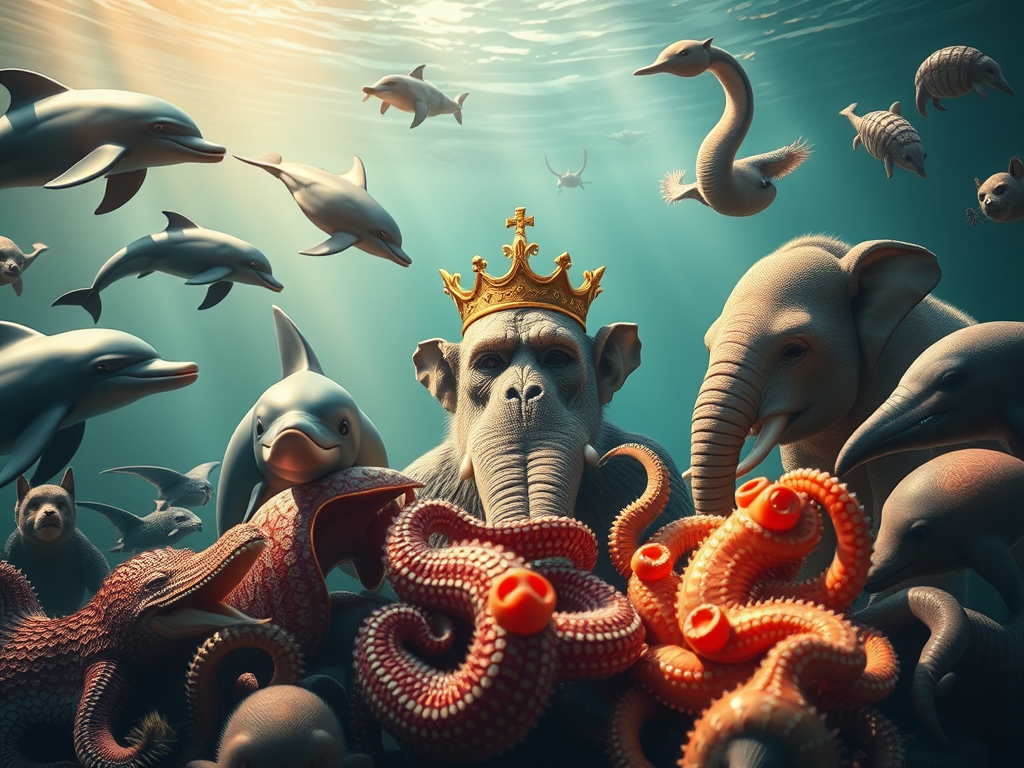
Humanity likes to imagine itself at the pinnacle of intelligence, the crowning achievement of evolution. But evidence from biology, cognition, and evolution suggests a more humbling reality. Modern Homo sapiens may excel at certain mental feats, yet we are not obviously the most intelligent animal – or even the most exceptional hominid – in Earth’s history. By taking an evidence-based look at other highly intelligent animals and extinct human relatives, we can see that intelligence comes in many forms. In some arenas dolphins, elephants, birds, and even cephalopods (octopus and cuttlefish) rival or surpass us. And our extinct cousins like Neanderthals may have been cognitively comparable, even if they left a subtler archaeological footprint. To truly measure “intelligence,” we must move beyond anthropocentric yardsticks (such as spoken language or gadgetry) and consider brain physiology, social and emotional savvy, memory, planning, and ecological adaptation. What emerges is a tapestry of different intelligences shaped by different environments and evolutionary pressures – with Homo sapiens as just one quirky thread, not necessarily the apex.
In fact, the one arena where modern humans are truly unique may not be raw brainpower at all, but our capacity to imagine things that don’t exist – to create shared symbolic worlds of beliefs, laws, money, and identities. In the second half of this exploration, we’ll argue provocatively that humans are less the pinnacle of evolution’s intellect and more the masters of “symbolic hallucination”: we conjure fictions and then live by them collectively until they become real in effect. This ability to externalize imagination – to treat myths as tangible truth – has given us extraordinary power (for good and ill), even as other species live richly in the real world without such fabrications. By the end, we might see Homo sapiens not as nature’s ultimate brain, but as a peculiar storytelling primate whose genius is making fiction real. Let’s dive in – with open mind and without our human crown – to compare ourselves with the other clever creatures past and present.
Rethinking “Intelligence” Beyond the Human Lens
What do we mean by “intelligence”? Too often, we define it in ways that conveniently place humans on top – using tools, speaking language, building cities – as if those were the only benchmarks. This is anthropocentrism at work. A fair comparison needs a broader lens. Cognitive scientists now talk about intelligence as a multifaceted set of abilities: problem-solving, adaptability, memory, social learning, self-awareness, foresight, emotional understanding, and more. Different species excel in different facets. For example, tool manufacture is one kind of smarts (humans are great at it), but navigating by Earth’s magnetic field (as migratory birds do) or remembering thousands of food cache locations (as some jays do) are other forms of intelligence tuned to those species’ lives.
To set the stage, consider some physical metrics of brains, which long served as rough proxies for smarts. Humans do not win on brain size alone. The sperm whale’s brain is about 8 kg – by far the largest on Earth, though its body is enormous so its brain-to-body mass ratio is low. A more instructive measure is the encephalization quotient (EQ), which factors in body size. Humans have one of the highest EQs (~7 or 8, meaning our brain is about 7–8 times larger than expected for our body size). Dolphins come in second; a bottlenose dolphin’s brain (~1.6 kg) is about 4–5 times larger than a typical mammal of similar body size. Many great apes, and even some small brained creatures like certain shrews or birds, have respectable EQs too. However, scientists caution that neither raw brain mass nor simple brain-to-body ratio tells the full story. For instance, a rat has a brain-to-body ratio similar to a human (around 1:40), yet a human-size rat would certainly not outscore us on an IQ test. Why? Because what matters is how the brain is organized – especially the cerebral cortex (the wrinkled outer layer responsible for complex thought) and the number of neurons packed into it.
On that front, humans do have an edge in primates: about 86 billion neurons in total, with roughly 16 billion in the cerebral cortex. That cortical neuron count is often linked to computational capacity. Still, even here we are not utterly unique. Elephants actually have more neurons overall (~257 billion) – their brains are larger than ours – but the majority of an elephant’s neurons reside in the cerebellum (which controls muscle coordination) rather than in the cortex. In the cortex proper, an elephant has around 5.6 billion neurons, only about one-third of the human cortical count. Some large whales have cortical neuron counts in the same ballpark: a recent estimate for the false killer whale (a dolphin species) is about 10.5 billion cortical neurons, and the pilot whale may have around 12–13 billion. These are high for non-primates, indicating that dolphin and whale brains devote an impressive neural workforce to cognition. Birds take a different path – their brains are small but densely packed with neurons. Parrots and crows, for example, have as many neurons in their forebrain as some monkeys, despite much smaller volumes. In short, biology has engineered many roads to high intelligence: packing more neurons in (like humans and corvids do), or enlarging certain brain areas (like elephants’ cerebellum or dolphins’ auditory cortex for echolocation). No single metric (brain size, EQ, neuron count) guarantees smarts, but they offer clues. And these clues tell us humans aren’t utterly alone in the cognitive stratosphere.
Perhaps more telling than anatomy are behavioral indicators of intelligence: Does the animal solve novel problems? Can it plan ahead? Does it exhibit self-awareness or empathy? Can it learn complex skills and flexibly adapt? Using such measures, scientists have documented remarkable intelligence across a spectrum of species. Let’s tour a few of our smartest non-human peers – and see how Homo sapiens truly stacks up.
Giants of Mind: Dolphins and Elephants Outsmarting Us?
When it comes to fellow mammals, dolphins and elephants are often touted as honorary members of the “high IQ club.” These creatures evolved along very different paths – one in the sea, one on land – yet both show convergently high intelligence in many domains.
Dolphin Minds: The Other Big-Brained Primates of the Sea
Dolphins (and their larger cousins, whales) have captivated researchers with their combination of playfulness and savvy. A dolphin’s brain is second only to humans in relative size, and it’s not just size – their brains are highly complex. Dolphin cerebral cortexes are as intricately folded as ours, indicating lots of surface area for neurons. They even possess specialized “spindle neurons” previously thought unique to great apes – cells associated with social emotions and empathy. These neurons have been found in species like humpback whales, orcas, and sperm whales, hinting at parallel evolution of sophisticated social brains.
Behaviorally, dolphins impress on multiple fronts. They pass the classic mirror self-recognition test: when marked with a temporary paint spot, bottlenose dolphins will inspect and try to rub off the mark upon seeing themselves in a mirror, proving they recognize the reflection as “me”. This self-awareness has been documented in only a few species (great apes, dolphins, elephants, magpies, and very recently one fish), and in dolphins it appears at a younger age than in human children. Dolphins are also consummate social learners and mimics – in the wild, juveniles learn hunting tricks from elders (like using marine sponges to protect their snouts while foraging on the seafloor), a form of tool use and cultural transmission. They communicate with high complexity: signature whistle “names” identify individuals, and some researchers have likened dolphin communication to a proto-language (though we’re still deciphering its grammar). Captive dolphins have even been trained to understand rudimentary artificial languages or hand-signals, grasping syntax (for example, the difference between “bring the surfboard to the ball” vs. “bring the ball to the surfboard”). This level of comprehension rivals a toddler’s.
Their problem-solving and memory are legendary. In one study, dolphins demonstrated excellent memory for social voices: a dolphin could remember the unique whistle of a tank-mate it had been separated from for 20 years, responding when it heard the familiar call played back. They also show creativity and play – famously, captive dolphins invented “ring games,” blowing circular bubble rings and then biting them to watch them pop, seemingly just for fun. Such spontaneous play with objects and water currents suggests imaginative capacity. Perhaps most striking is dolphins’ empathy and altruism: there are countless anecdotes (and some scientific observations) of dolphins helping injured individuals, even of other species – including reports of dolphins supporting exhausted swimmers or protecting humans from shark attacks. While anecdotal, these stories align with research showing dolphins (and whales) have strong social bonds and even grieve for lost companions (mother dolphins have been seen carrying deceased calves for days).
All told, many scientists consider dolphins to be on par with great apes in intellectual prowess. Neuroscientist Lori Marino notes that “it’s absolutely clear to me that these are extremely intelligent animals,” emphasizing that by many measures (brain complexity, social cognition) dolphins stand “closer to the human range” than even our nearest ape relatives. Indeed, the encephalization of dolphins suggests a high capacity for abstract thinking. To be fair, dolphins live in a very different medium and lack hands, so their intelligence is expressed differently – they haven’t built cities, but they have complex social alliances and possibly even something like names and cultural traditions. It’s anthropocentric to assume their inability to make fire or write means a lack of smarts; in their world, they are perfectly adapted, top-tier thinkers.
Elephant Intellect: Memories and Empathies that Rival Humans
Asian elephants cooperating in a coordinated task: they learned to pull two ends of a rope simultaneously with a partner to slide a food tray within reach. Such foresight and teamwork had been confirmed only in humans and apes until this experiment.
On land, the elephant has become emblematic of animal intelligence – and with good reason. Elephants’ brains are the largest of any land animal (~4.5–5 kg in adults), and packed with plenty of complex circuitry. While their cortical neuron count (about 5–6 billion) is lower than ours, elephants exceed us in other neural areas and have a uniquely expanded cerebellum. More impressive is how that brain manifests in behavior. Field ethologists widely consider elephants to be among the most intelligent and empathic of creatures.
“An elephant never forgets,” says the proverb – and research suggests there’s truth to it. Matriarch elephants (the oldest females who lead the herd) carry in their memories a mental map of their territory, including water holes and feeding grounds that may be separated by tens of miles and only seasonally available. During a drought, a matriarch’s memory of a distant water source can save the entire family – a feat of recall and spatial awareness confirmed by long-term studies of African elephant herds. One famous example documented how during an unusually severe drought, an experienced matriarch led her family on a beeline march to a waterhole she had not visited in perhaps 30 years, yet she somehow remembered its location. Such prodigious long-term memory is critical for survival in elephants’ environments and arguably surpasses the average human’s spatial memory (few of us could recall a location from decades past without a map!).
Elephants also excel at social intelligence and empathy. They live in complex multi-generational herds, recognize dozens of individual peers and even humans, and have been observed to mourn their dead. Field researchers report elephants gently touching and caressing the bones of deceased elephants and even revisiting sites where companions died, suggesting an awareness of death and possible mourning rituals. In lab tests, elephants show mirror self-recognition just like dolphins and apes: an Asian elephant named Happy famously used her trunk to explore a painted X on her forehead while facing a mirror, indicating she knew the reflection was herself. Empathy and helping behaviors are abundant. For instance, if an elephant calf is in distress or stuck, not only the mother but others will rush to help lift or console it. Elephants have been seen to assist injured fellows, using their trunks to support a weakened elephant walking. In one compelling experiment, elephants demonstrated both cooperation and understanding of a partner’s needs: when two elephants were required to simultaneously pull on ropes to drag a food platform toward them, the elephants quickly figured out they had to pull together – and if one elephant was late to the rope, the other would patiently wait up to 45 seconds, a remarkable show of impulse control and understanding of timing. They even learned not to bother pulling if their partner wasn’t in position, avoiding a futile effort. This level of coordinated cooperation had previously been confirmed only in primates, and it suggests elephants grasp the concept of a partner’s role.
Emotionally, elephants might even outdo us in some respects. Neuroscientists note that elephants have a highly developed limbic system (involved in emotion), and behaviors like allomothering (females taking care of others’ babies), coalition forming, and greeting ceremonies all point to rich social lives. As one researcher put it, elephants display “remarkable displays of helping, empathy and compassion” in the wild. For example, elephants will comfort a distressed fellow by chirping softly and stroking them with the trunk – a sign of consolation also documented in apes. Such emotional intelligence – recognizing and responding to others’ feelings – is a key facet of cognition where elephants, dolphins, and apes all shine.
Critically, elephants show problem-solving too: in captivity, elephants have been observed moving cubes or stools to use as a stepstool for reaching high treats, a sign of insightful reasoning (comparable to a chimp stacking boxes in Köhler’s classic experiments). Their trunk, essentially a versatile “hand,” can manipulate objects with great finesse, enabling tool use like swatting flies with branches or plugging watering holes with chewed bark to prevent evaporation. They likely don’t fabricate tools to the degree apes or crows do (perhaps because their strong trunk makes many potential tools unnecessary), but they understand how to use their environment cleverly.
In sum, across multiple dimensions – memory, social savvy, self-awareness, cooperation – elephants rank among the most intelligent animals on the planet. It’s little wonder that researchers often put them in the same elite class as dolphins, apes, and humans. Are they “smarter” than us? Not in every way – for example, they haven’t developed external technologies (again, lacking hands and fire, they wouldn’t) – but in their emotional and social world, they might actually surpass the average human. One could argue an elephant’s combination of long memory, empathy, and thoughtful deliberation (they are not hasty creatures) reflects a form of wisdom our impulsive species could learn from.
Feathered Einsteins: The Remarkable Intelligence of Birds
When we think of “intelligent animals,” we often picture mammals with big brains. But some of the sharpest minds in nature come wrapped in feathers. Birds, especially corvids (crows, ravens, jays) and parrots, have blown away scientists’ expectations in the last few decades. Their brains may be the size of walnuts, but they are packed densely with neurons and wired in efficient, if alien, ways. In fact, large-brained birds have neuron counts equivalent to or greater than primates of similar mass. With these brains, they achieve cognitive feats once thought uniquely human.
Toolmakers and Plotters: Crows and Ravens
Corvids – the family that includes crows, ravens, magpies, and jays – are often called “feathered apes” for their intelligence. Tool use is a prime example. New Caledonian crows famously fashion hooked tools from twigs and even modify materials into better tools. A captive crow named Betty astonished researchers by spontaneously bending a straight piece of wire into a hook to retrieve a bucket of food from a tube – without ever being taught to do so. Initially this was heralded as ingenious innovation (and it is), though later studies suggested wild crows might already have a propensity to bend sticks, meaning Betty’s feat could be a natural behavior applied in a new context. Either way, it showed crows have the mental flexibility to use and create tools on the fly. In the wild, these crows use tools as part of daily foraging, prying insects out of logs with stick probes. They even carry a “toolkit” of favorite sticks and keep them for reuse – the bird equivalent of a craftsman cherishing their best tool.
Beyond tool use, corvids excel at planning and foresight. A groundbreaking 2017 experiment demonstrated that ravens can plan for future events in ways that match or exceed great apes (and 4-year-old children). Ravens were taught how to use a specific tool (a stone) to open a puzzle box for a reward. The next day, with the box absent, they were offered a tray of objects including the correct tool and various useless distractors. Fifteen minutes later, the box would be brought back. Remarkably, the ravens picked the correct tool over 80% of the time, often ignoring immediate temptations (like a smaller immediate treat) in order to save the tool for the future task. They even aced a bartering task: selecting a token which, only much later, they could trade for a better reward – essentially showing delayed gratification and planning. In some trials, ravens waited 17 hours and still remembered to use the token when the experimenter returned. This level of flexible planning had only been seen in humans and apes; the ravens’ performance was on par with chimps and even young children. The fact that ravens do not routinely use stones or tokens in the wild (unlike caching food, which they do) means this wasn’t just an instinct – it was domain-general planning ability. As one scientist commented, “the ravens’ stellar performance, in some cases exceeding that of great apes and four-year-old children, has many scientists excited” because it shows intelligence may evolve convergently in very different brains. Indeed, the consensus was that planning and foresight evolved at least twice – once in primates, once in birds – separated by 320 million years of evolution.
Corvids also shine in social intelligence. Many species cache (hide) food for later, and those that also pilfer each other’s caches have evolved cunning counter-strategies. For example, the Western scrub jay will re-hide its food stash if it knows another jay was watching when it hid it the first time. This implies the jay can project the possibility of another stealing – essentially a rudimentary “Theory of Mind” (thinking about another’s perspective). They only do this if they themselves have a history of stealing others’ caches, interestingly – “a thief thinks everyone else is a thief” scenario – suggesting they use their own experience to infer others’ intentions. That’s sophisticated social cognition for a bird. Ravens in captivity have been observed to actively deceive each other: hiding a treat in one place while a competitor watches, then moving it once the competitor is out of sight, to mislead the other. Such tactical deception again hints at Theory of Mind.
Memory is another forte: Clark’s nutcrackers (a type of corvid) hide tens of thousands of pine seeds over dozens of square kilometers and can recall the locations months later to retrieve them through snow. Humans, without maps, would be hard pressed to match that spatial memory.
Some corvids pass the mirror test too – magpies have shown self-recognition by removing colored stickers from their bodies when seeing themselves in mirrors, a first for non-mammals. And their communication is complex; crows have different calls that appear to signal specific information (including “words” that can identify individual human faces as friendly or threatening, which other crows learn and remember). If you harass a crow, it may scold you and remember your face for years, recruiting other crows to mob you next time you show up – a sobering thought for would-be bird bullies.
In experiments, crows and ravens have solved multi-step puzzles that would stump most animals (and many humans!). For instance, New Caledonian crows can solve the “water displacement” problem (Aesop’s fable test) – dropping stones into a tube of water to raise the water level and get a floating treat – showing understanding of cause and effect with volume. They even preferentially choose stones over floating objects (knowing stones sink and displace water) and can discern tube width and water vs. sand-filled tubes, an impressive cognitive model of physical rules.
All told, a growing body of work on corvids has demolished the old insult “birdbrain.” In fact, corvid brains, while different from primates’, achieve primate-like cognition through a differently wired forebrain (the avian pallium corresponds functionally to our cortex). As one neuroscientist quipped, birds have “small brains with lots of neurons” and in corvids “those neurons are doing some of the same things primate neurons do” – planning, tool use, social reasoning. The parallel evolution of intelligence in corvids and apes is one of the most striking demonstrations that we are not alone at the top of cognitive capacities. It forces us to recognize that an animal very unlike us can reach similar cognitive heights.
Parrots: The Gabby Problem-Solvers
Close behind corvids are the parrots, our other feathered intellectuals. Parrots not only mimic human speech – they sometimes understand aspects of what they’re saying. The late African grey parrot Alex, trained by Irene Pepperberg, learned to label over 100 objects, actions, and colors in English and could answer simple questions (“How many red keys?” – he could count up to 6 and get it right). Alex even coined a phrase: seeing an apple for the first time, he came up with “banerry” (mix of banana and cherry) – suggesting creativity with language akin to a toddler. Beyond mimickry, this indicates conceptual understanding (color, shape, quantity). Alex would also express frustration (“Wanna go back” when he was done with tests) or apologize (“I’m sorry”) unprompted after annoying a trainer – behaviors hinting at emotional intelligence.
Even in the wild, parrots show cleverness. Some cockatoos have been documented crafting tools from sticks to probe for seeds. Others can pick locks or undo latches to escape cages (YouTube is full of videos of parrots unscrewing things meticulously). Parrots are also excellent social learners and can learn by watching others (including humans). Like corvids, many parrots can solve multi-step puzzles for treats, and some have passed self-control tests. A recent study found Goffin’s cockatoos can delay gratification, waiting over a minute to exchange a less preferred food for a better one, similar to the famous marshmallow test.
One fascinating 2020s finding is that some parrots seem to use chemistry knowledge in their environment: wild Amazon parrots have been observed licking clay on riverbanks, which scientists believe they do to neutralize toxins from seeds they eat – a form of self-medication that shows a kind of ecological savvy (not intelligence in the problem-solving sense, but in the evolutionary sense of adapting behavior to challenges). Parrots’ social intelligence is evident too – many species mate for life and coordinate raising young; they can even show consoling behavior to distressed mates.
Neuroscience again backs up their smarts: parrots have an enlarged brain region (the medial spiriform nucleus) linking cortex and cerebellum, much like primates have, potentially supporting advanced learning and motor planning. They also have a high neuron count in the forebrain for their size – a parrot brain of only 20 grams might have on the order of a billion neurons, rivaling a small monkey’s brain in number. In short, parrots and corvids underscore that intelligence has evolved multiple times. Birds may not write poetry or build rockets, but in tasks relevant to their world, they exhibit creativity, memory, and problem-solving that give mammals a run for their money.
Alien Minds: Octopuses and the Invertebrate Intellect
Thus far we’ve looked at vertebrates – animals with backbones – whose brains share a common architecture to ours. But what about truly alien intelligence? For a long time, scientists assumed invertebrates (animals without backbones) were mostly driven by instinct, not insight. Then along came the cephalopods: octopuses, squids, and cuttlefish, who have upended our notions of what a “smart” animal can look like. These evolutionary cousins of clams and snails boast large brains (for invertebrates) and astonishing cognitive abilities, despite having last shared a common ancestor with humans over 600 million years ago. Studying octopus intelligence is almost like a thought experiment: what happens when nature evolves a complex brain along an entirely independent route?
Octopuses are often called “eight-armed geniuses.” Each of an octopus’s arms has a mind of its own – literally, since the majority of its half-billion neurons are distributed in the arms and body, not all clustered in the head. Yet somehow, this decentralized brain still enables learning, problem-solving, and even play. Octopuses in labs routinely solve puzzles like unscrewing jar lids to get at food inside, or navigating mazes. They can learn to recognize shapes and patterns, and even people. Keepers at aquariums report that octopuses recognize individual staff members – often squirting water at those they dislike and greeting the ones they favor. One famous anecdote is of an octopus named Otto who was known to juggle hermit crabs for fun and even learned to squirt water at a light to short-circuit the annoying bright bulb (seemingly out of boredom). There’s documented evidence of play behavior: octopuses have been observed repeatedly shooting objects like bottles into a circular current in their tank and then catching them, analogous to how dolphins play with rings. Play is considered a hallmark of higher intelligence because it’s done for enjoyment and requires cognitive surplus.
Tool use? Yes, octopuses do that too. The veined octopus (also called the coconut octopus) was filmed collecting halved coconut shells, carrying them under its body while tiptoeing across the seafloor, and later assembling the shells as a shelter when needed. This is arguably the first documented tool use in an invertebrate: the octopus plans ahead, hauling a tool for future deployment as portable armor – a remarkable example of foresight in a creature with a lifespan of only a couple years. (Imagine a being that dies before age 3 yet can plan for tomorrow!). Other octopuses have been seen taking discarded bottles or shells to use as hiding spots or using jets of water to dislodge prey, which some consider tool-like behaviors.
And consider cuttlefish, cousins of octopus: a 2021 study demonstrated that cuttlefish can pass a form of the “marshmallow test” of self-control. Cuttlefish were trained that one chamber would deliver a less-preferred snack immediately, while another chamber would, after a delay, deliver their favorite food (live shrimp). The cuttlefish consistently resisted the immediate snack and waited up to 50–130 seconds for the better one. Some even turned away from the tempting snack, as if to distract themselves from temptation. This is the same strategy human children use to delay gratification! The cuttlefish’s ability to exert self-control is on par with large-brained animals (apes, crows, parrots) and was the first time such a result was found in an invertebrate. It’s a profound example of convergent evolution – very different organisms arriving at similar cognitive traits. What evolutionary pressure gave cuttlefish self-control? Researchers hypothesize it might be a byproduct of needing to remain camouflaged and motionless for long periods (to avoid predators) which incidentally also demands patience in feeding behavior. In essence, a cuttlefish that can resist moving (and resist impulsively grabbing a mediocre snack) might survive longer – so maybe that selected for a sort of cognitive self-discipline, which just so happens to look like intelligence as we test it.
Cephalopods also show rapid learning and good memory. Octopuses can learn by watching other octopuses (demonstrating social learning, though generally they’re solitary). They can navigate and remember mazes for weeks. Squids and cuttlefish have complex courtship signaling that requires recognizing and remembering mates and rivals. They have even been seen engaging in deception: male cuttlefish sometimes display female patterns on one side of their body (to fool rival males) while showing male patterns to the female they’re courting – simultaneously courting and disguising themselves in one clever act.
Physiologically, cephalopods are radically different – their brains are shaped like donuts (with the esophagus running through the middle!). And yet these “outsiders” of the cognitive world independently evolved many of the hallmarks of smarts. Their example teaches us that large brains, a long lifespan, or sociality (often considered prerequisites for intelligence) aren’t the only routes. Octopuses are short-lived (1–2 years typically), mostly solitary, yet very bright. This is a bit of a paradox: most highly intelligent animals (humans, elephants, dolphins, parrots) are long-lived and social, presumably because intelligence pays off when you have a long time to learn and a community to learn from. Octopuses break the mold, possibly because their flexible problem-solving helped them exploit many niches in the sea, offsetting their short life. Or it could be that their ancient lineage had a burst of brain evolution for reasons we don’t fully understand (some speculate it might relate to complex predator-prey arms races in the Cambrian oceans).
No wonder some people jest that octopuses are “alien minds” on Earth – in fact, scientists genuinely struggle to intuit what octopuses think or feel, because their embodiment and senses are so different (imagine having eight semi-independent arms, each tasting and touching the world). But clearly, they think in their own way. As one scientist put it: octopuses “are scarily smart”, with good memories and the ability to use past experiences to predict where to find food. They remind us that intelligence is a spectrum, not a ladder with humans at the top and insects at bottom. In that spectrum, octopuses occupy a high perch in their own right – one that evolved entirely separately from ours.
Forgotten Geniuses: Neanderthals and Other Human Relatives
So far, we’ve compared modern humans to living animals. But what about other hominid species – our extinct human cousins? Were Neanderthals, Denisovans, or other archaic humans less intelligent, or could it be that Homo sapiens simply had different skills or luck? It’s a fascinating question, because if any creatures were nearly as brainy as us, it would be those who shared our large brains and tool use. The conventional wisdom for years was that Neanderthals were a bit dimmer – stereotyped as brutish cavemen. Yet recent evidence has shattered that caricature. Neanderthals had brains as large as or larger than modern humans (the average Neanderthal brain volume was ~1500–1600 cc, compared to ~1400 cc for ancient Homo sapiens). They made complex stone tools, hunted big game in cooperative groups, controlled fire, and had some degree of symbolic or artistic expression. They buried their dead, at least occasionally, and likely cared for injured members of their groups (a nearly toothless Neanderthal fossil suggests that individual was kept alive by others despite being unable to chew, indicating feeding/care). They even interbred with modern humans – meaning whatever cognitive differences existed did not preclude social interaction and mating.
Still, there were differences. One intriguing study in 2013 by Pearce, Dunbar, and colleagues examined Neanderthal skulls and concluded that, although Neanderthals had large brains, a greater portion of that brain was devoted to vision and body control than in modern humans. Because Neanderthals evolved in higher latitudes (dimmer light in Ice Age Europe), they had larger eyeballs (a 20% larger eye socket area) to gather light, which correlates with a larger visual cortex. They also had more robust bodies to manage, requiring more neural resources for motor control. After “correcting” for these factors, the researchers estimated that Neanderthals had substantially less brain volume remaining for other cognitive functions – roughly 200 cc less dedicated to social and abstract thinking compared to early modern humans of equivalent brain size. In numbers: although both species’ raw brain sizes were ~1470 cc on average, Neanderthals effectively had maybe ~1130 cc for higher cognition vs. ~1330 cc for early Homo sapiens. This aligns with the theory that Homo sapiens had a cognitive edge in social complexity. With more neural capacity for handling large social networks, humans could maintain broader trade and communication groups, perhaps 150 or more individuals, whereas Neanderthal groups were smaller. Dunbar argued this might have limited Neanderthals’ ability to form extended alliances or innovate technologically at the same pace. It’s hypothesized that these differences contributed to Neanderthals’ eventual disappearance ~40,000 years ago, as modern humans (with their tighter social webs and innovation) outcompeted or absorbed them.
However, it’s crucial not to misinterpret this as “Neanderthals were dumb.” They were very intelligent by any absolute standard – likely our equals in mastering survival skills and adapting to harsh environments. Archaeological evidence over the last decade has revealed surprises: Neanderthals were making art and jewelry before Homo sapiens arrived in Europe. In Spanish caves, abstract painted symbols (dots, hand stencils, geometric patterns) have been dated to ~65,000 years ago – before modern humans were in Europe – strongly suggesting Neanderthals painted them. In France, a set of carefully arranged stalagmites deep in a cave (Bruniquel Cave) dated to ~176,000 years ago indicates Neanderthals were constructing complex structures underground, possibly for ritual or shelter – a sign of planning and group effort. Neanderthals also made personal ornaments: eagles’ claws with cut marks appear to have been fashioned into necklaces or pendants, and ochre (pigment) was used by Neanderthals, possibly for body painting. These are all symbolic behaviors, hinting that Neanderthal minds were not devoid of imagination or abstract thought.
They also mastered technologies requiring foresight. For example, Neanderthals produced a kind of glue (birch bark tar) to haft spear points to handles. The process to make this tar is complex – one method involves heating birch bark in the absence of air (dry distillation) at a controlled temperature for hours. That’s essentially chemistry and engineering; one must imagine the process and execute multi-step procedures. The fact that Neanderthal tar lumps have been found suggests they discovered and shared this knowledge.
Furthermore, Neanderthals likely had language or proto-language. They possessed the FOXP2 gene variant associated with speech in modern humans, and their hyoid bone (a throat bone used in speech) is shaped similarly to ours, implying they could produce at least some speech sounds. While we have no Neanderthal literature (alas!), there’s no reason to think they couldn’t communicate complex ideas verbally. Thus, the difference between Neanderthal and modern human intelligence might have been more about degree or social scale than fundamental ability.
Consider also Denisovans – an enigmatic sister group to Neanderthals, known mostly from DNA and a few bones in Siberia. We know little of their behavior, but given they interbred with modern humans in Asia and left genetic traces (some populations today have ~5% Denisovan DNA), they likely were comparable to Neanderthals in cognition. A fascinating artifact from Denisova Cave is a greenstone bracelet dated around 40,000 years ago, with drill holes likely made by some rotary tool – possibly crafted by Denisovans. If so, they too had fine motor skills and aesthetic sensibilities.
Even earlier human species had sparks of intelligence. Homo erectus (who lived ~2 million to 400k years ago) controlled fire, spread from Africa to Asia (first hominid to do so), and made the Acheulean handaxe – a stone tool requiring skill and teaching to produce. Homo heidelbergensis (likely ancestor of Neanderthals and us) hunted big game and may have built simple shelters. And there are the odd cases like Homo floresiensis (the “Hobbit” of Flores Island) – a tiny human with a brain the size of a grapefruit who nonetheless made stone tools and perhaps used fire. Intelligence does not strictly scale with brain size, as this 1-meter tall hominin shows.
It’s worth noting that modern humans coexisted with Neanderthals and Denisovans for millennia and even swapped genes – suggesting we were compatible at a social level. If Neanderthals truly had been cognitively like apes compared to us, it’s hard to imagine interbreeding and living in proximity for thousands of years. The reality is they were likely more similar to us in mind than any other creature ever has been. One paleoanthropologist mused that if a Neanderthal child were magically raised by humans today, they might do fine in school – perhaps excelling in some areas (visual-spatial skills) and struggling a bit in others (maybe language fluency), but overall indistinguishable from other kids. We can’t test that, of course, but it’s a caution that “more advanced technology” doesn’t necessarily mean “more intelligent.”
Ultimately, why did Homo sapiens prevail while those others went extinct? The answer might lie in collective intelligence and culture more than raw brainpower. Our species may have had a slight edge in being able to cooperate in larger groups (via shared myths or wider trade networks), or we simply had larger population sizes that innovated faster and recovered from setbacks better. Once Homo sapiens had a technological or social advantage (better hunting weapons, wider alliances), that could spiral into dominance. But that’s not the same as saying the individual Neanderthal was stupider than the individual Homo sapiens. In fact, one could argue Neanderthals survived the harsh Ice Age Eurasia for ~300,000 years – far longer than modern humans have been around so far – which is an impressive run for any intelligent species. Longevity counts as success in evolution.
If anything, examining these other humans reminds us how contingent intelligence and success are. We modern humans nearly went extinct ~70,000 years ago (genetic evidence suggests our numbers dropped to maybe a few thousand breeding individuals at one point). We didn’t survive because we solved that crisis with genius; it was likely luck or modest advantages that saw us through. Neanderthals didn’t die out just from any lack of smarts – factors like climate change, competition, maybe diseases brought by Homo sapiens, all played roles. So crowning ourselves the undisputed pinnacle might be premature. As one article starkly put it, “if we were to use intelligence to destroy ourselves – via nuclear war, ecological collapse, or other technological disasters – then the evolution of the big human brain would have been as bad an evolutionary result as any trait ever was”. In other words, if your big brain leads you off an evolutionary cliff, it wasn’t such a great adaptation after all.
Evolution Is Not a Ladder (and Humans Aren’t on Top)
It’s time to tackle a deeply ingrained idea: that evolution is a progress march towards greater intelligence, culminating in us. This notion – that humans are the “pinnacle of evolution” – is a misconception that biologists have long tried to dispel. Evolution has no pre-set goal, no ladder of improvement. It’s a blind process of adaptation to environments. Every species alive today, from bacteria to oak trees to dolphins to humans, is equally the product of 4+ billion years of evolutionary success. In that sense, every living species is at the pinnacle of its own lineage. We’re all winners because we’re not extinct (yet). As one evolutionary biologist quipped, “It’s a tie for first place among all living things. The only meaningful measure of evolutionary success is survival – and by that standard, a human is no better than a bacterium or a beetle; we’ve all made it this far”.
Humans are indeed extraordinary in many ways, especially in our cumulative culture and technology. But if we step back, plenty of organisms outperform us in specific arenas that matter to them. Who is to say a dolphin’s ability to live gracefully in complex social groups in the open ocean is “less advanced” than our ability to design smartphones? Or that an elephant’s combination of memory and empathy is somehow a lesser cognitive achievement than a human’s ability to do calculus (which, by the way, only a tiny fraction of humans can do well)? Intelligence is plural and diverse in nature.
Crucially, evolution doesn’t rank species by intelligence. Many species do just fine with minimal brains – some of the most abundant and enduring life forms (like insects, or even simpler, bacteria) operate largely on simple rules and instincts. They don’t build tools, yet they thrive in massive numbers and have survived millions of years longer than any hominid. On the flip side, having high intelligence can sometimes be a curse if it causes a species to overreach. We see hints of this in our own predicament: our cleverness has given us industry and weapons and global dominance, but it also gives us climate change, nuclear risks, and ecological crises. If these problems lead to a collapse of human civilization, then from an evolutionary perspective our vaunted intelligence might be a short-lived flare rather than a sustainable trait.
Let’s reflect on longevity: Dinosaurs ruled for ~160 million years. Our genus Homo has been around for maybe 2.5 million, and Homo sapiens as a distinct species for only ~300,000 years – a blink of an eye in geologic time. If we destroy ourselves or our environment in the next few centuries, our entire species’ existence will have been a brief flash compared to, say, Triceratops or T. rex. Intelligence is impressive, but it’s not invincibility. As one writer put it, some imagine Homo sapiens standing atop life’s ladder thanks to our “extraordinary three-pound blob of neurons,” but if those neurons cause our extinction, then our so-called pinnacle brain was actually a evolutionary dead-end.
In evolutionary terms, saying humans are “higher” or “more evolved” is nonsense – evolution isn’t hierarchical. We are different, certainly. Our difference (symbolic abstract thinking) gave us power to reshape the planet, which can look like being the pinnacle. But cockroaches, sharks, and ferns are all exquisitely evolved to their niches and haven’t needed a big brain at all. They might outlast us easily. The only slightly hierarchical statement one can make is: a species that survives is doing better than one that goes extinct. By that measure, at present humans are doing well, but not better than say ants, who are in no danger and are arguably the most successful animal by biomass and numbers. We have to drop the ego and see that we are one experiment among many that evolution has run.
The Hallucinated Greatness of Homo sapiens: Symbolic Imagination as Our Real Trump Card
So if we’re not the smartest across the board, what is special about humans? Why are we the ones with cities and rockets, composing symphonies and doing science, if not sheer intelligence? Many anthropologists and cognitive scientists argue that the secret is not that our individual brains are dramatically superior (a lone human isn’t that much brighter than a lone Neanderthal or perhaps even a lone chimp in some tasks), but that we have a unique ability to share knowledge and imagination across individuals and generations. In essence, our superpower is culture – and at the heart of culture is our capacity for symbolic thought. We don’t just learn facts about the real world; we invent fictional worlds – myths, religions, nations, money, laws – and crucially, we collectively believe in them and act as if they’re real, making them real in their consequences.
Yuval Noah Harari, in Sapiens, famously argued that what allowed Homo sapiens to conquer the globe was a “Cognitive Revolution” about 70,000 years ago when we evolved the ability to speak about things that do not physically exist – essentially, the ability to tell shared stories. He calls these shared fictions “imagined orders.” Humans create imagined orders – tribal myths, gods, hierarchical systems, moral codes – and because everyone believes them, they become the framework of society. This might sound abstract, but consider concrete examples:
- Money: Strips of paper or pieces of metal have no inherent value. Their power comes only from collective belief. A $100 bill is just linen and ink – worthless if people don’t agree it’s worth 100 units of something. In essence, money is a fiction, but because we all participate in the fiction, it works. As Harari notes, economic systems “consist of mostly shared stories that we tell each other – stories about how much a dollar is worth… None of these things are really out there in the world. They are in our brains”. Yet this shared hallucination called money guides the very real actions of billions of humans daily and coordinates massive cooperation (you won’t get people to build you a skyscraper by friendship or force, but pay them money – an imaginary incentive – and the skyscraper rises).
- Nations and Laws: There is no physical thing you can point to that is “France” or “Japan.” Those nations exist as agreed-upon concepts marked by borders everyone consents to. Laws, similarly, are just words – you can’t touch a law, it’s a notion that lives in minds and on paper. But humans will act, even sacrifice their lives, for these notions. A soldier fights to defend “his country,” essentially an idea represented by flags and anthems. The law influences our behavior only because we collectively uphold it.
- Religion and Gods: From an academic perspective, gods and spirits are classic shared fictions – powerful motivators for cooperation. Two strangers who both worship the same god have a basis for trust and alliance even if they’ve never met. Harari uses the example of two strangers who might otherwise fight, but if they both believe an all-powerful deity commands “thou shalt not kill” or will punish wrongdoing, they have a reason to cooperate ethically. Shared myth can thus alter the game-theory of human interactions, encouraging large-scale peace and unity under a common belief.
These “shared myths” are what truly set us apart. No other animal we know of can invent completely arbitrary rules or stories and have an entire group adhere to them. Chimpanzees have social hierarchies, but those are based on physical dominance and immediate relationships – they can’t all decide that one chimp is king because of divine right or agree on an abstract principle like “individual rights.” We can. We can agree that a piece of paper (a contract or constitution) is supreme and will guide our actions. We can conceptualize invisible entities (souls, demons, nations, corporations) and alter our behavior en masse because of them.
Harari famously wrote: “There are no gods, no nations, no money, and no human rights in the universe, outside the common imagination of humans”. It’s a provocative way to say all these structures we take so seriously are, in a sense, mass hallucinations. But – and here’s the kicker – by acting as if they’re real, we make them real in their effects. The U.S. dollar may be a shared fiction, but you can’t deny its real impact on the world. The concept of France is a mental construct, but it has real borders, real governments. Our fictions become like a scaffolding on which we build very real structures.
This ability might be dubbed “symbolic hallucination made real through collective belief.” We externalize our imagination into tools, art, institutions, and those in turn shape the world. We imagined flying, then built planes. We imagined gods, then built cathedrals and went on crusades. We imagined “nation-states,” and now the globe is partitioned accordingly. Other species, by contrast, live in what we might call objective reality – their social structures and behaviors are grounded in tangible things (strength, mating, immediate survival needs) and relatively little in pure imagination or arbitrary rules.
Is this capacity “intelligence”? It’s certainly a kind of intelligence – symbolic intelligence. It allowed for what one anthropologist called an “information bonanza.” Unlike Neanderthals who may have innovated slowly, Homo sapiens using symbols could rapidly change social arrangements, invent new tools, etc. – our cultures could transform within decades rather than millennia. For example, a person born in 1900 in Germany saw their society reinvented multiple times (empire, republic, fascist regime, communist East Germany, then democratic state) without any genetic change – our flexible fictions enabled that. No other animal could so drastically reconfigure its social reality so quickly, because none other had that software of shared imagination running on essentially the same hardware.
However, calling it “hallucination” reminds us that these things aren’t real in the way a tree or mountain is real – they exist in the collective psyche. We live immersed in layers of human-created “virtual reality”: values, stories, identities. This is both our strength and, potentially, our weakness. It’s a strength because it allows large-scale cooperation among strangers. Harari points out that large numbers of strangers can cooperate successfully if they believe in common myths. No 50,000 chimpanzees could ever cohere into an army or a corporation – but 50,000 humans can, if united by a shared story like nationalism or a corporate mission. That is why we dominate: as he succinctly states, “Large numbers of strangers can cooperate by believing in common myths”.
Yet it’s a weakness when the fictions we serve lead us to maladaptive behavior. For instance, the relentless pursuit of profit (a fiction of value growth) can drive environmental destruction that in reality undermines our survival. Or fanatical devotion to an ideology (religious or political fiction) can lead to wars and genocides that actually harm our species’ well-being. No other species is motivated to slaughter thousands of its own kind over an idea. Lions fight over territory or mates, which are tangible; humans might fight over whether a certain god’s word is true, something no other animal would even conceive.
So, while our symbolic imagination is immensely powerful, it is not the same as raw cognitive processing power. A solitary human on a desert island with no cultural knowledge is not significantly smarter at surviving than other primates – in fact, he’d probably fare worse than an orangutan in a jungle. Our advantage lies in the collective brain – pooling knowledge through language and teaching, and coordinating via shared fictions. We are the apex collaborators, the apex storytellers.
It’s telling that when we measure “intelligence” in a lab, some animals beat us at certain tasks (remember the chimp with photographic memory that outperformed humans, or the Clark’s nutcracker with spatial memory beyond our capability). But give humans collectively a challenge and we excel because we can share information so well. We don’t rely on one brain, we network many via language. Ants and bees also share information and coordinate in colonies, but their communication is relatively rigid (pheromones) and limited to concrete needs. Humans can discuss abstract futures, possibilities, and thereby plan civilization-scale projects. That’s the difference.
In sum, Homo sapiens may not be individually the smartest across every dimension, but we have an unmatched collective cognition fueled by symbolic thought. If a dolphin is a brilliant soloist in nature’s orchestra, humans are a well-coordinated choir – maybe not hitting the highest notes of any single voice, but achieving a richer, more complex performance together. Our dominance comes less from individual genius and more from being able to accumulate knowledge (through writing, records, teaching) and to coordinate flexibly in huge groups using shared imaginaries. As one commentary on Harari put it, humans “radically change our way of interacting by changing the stories we tell”. We are defined by this narrative-driven cooperation. We are ultimate believers – and it just so happens that believing in things like nation, money, or human rights, even if they are figments of collective imagination, has allowed us to build mega-societies that none of our ape cousins could.
Living in Harmony with Reality: Lessons from Earth’s Other Intelligences
There’s an irony in our situation. By many measures, other animals live more harmoniously with the natural world than we do. They take what they need, their populations ebb and flow with ecological limits, and they don’t delude themselves about being separate from nature. A wolf doesn’t pretend it’s above the food chain or invent a concept of owning all the deer. It just hunts when hungry and stops when sated, and the deer population and wolf population find a balance. Humans, armed with symbolic imagination, stepped outside these natural feedback loops in some ways. We act according to cultural “truths” that can override environmental common sense. For instance, the economic myth of infinite growth or divine mandate to dominate the Earth has driven us to extract and consume far beyond sustainable limits – something no animal population would do unless its natural controls were removed. In a sense, other species live in the real world; we increasingly live in a world of our own making. And that man-made world can blind us to the real one.
This isn’t to say animals are noble conservationists – if left unchecked by predators, any species might overconsume (e.g., deer overgrazing an island). But ultimately nature corrects them (they starve or predator numbers rise). Humans circumvent these checks with technology and global trade, fueled by our imagined orders (like the capitalistic drive for profit or national ambitions). We have the peculiar distinction of being an animal that needs abstract fictions like “environmental ethics” or “sustainable development goals” – more fictions! – to consciously do what most other species do instinctively: live in balance. We have to tell ourselves new stories (“save Mother Earth,” “think of future generations”) to counteract the negative side-effects of our other stories (like “economic progress at all costs” or “manifest destiny”).
One might argue other species, lacking our symbolic vision, simply cannot upset the balance as we do – they operate within the tight constraints of their ecosystems. In that sense, they exhibit a wisdom that we sometimes lack: they don’t defecate where they eat, figuratively speaking, whereas we might pollute our own water for short-term imaginary gains. You could cheekily say that no dolphin ever ruined its ocean for the concept of money, and no elephant ever drove another species to extinction over an ideology. Those types of folly are uniquely human, tied to our ability to operate in fictional frameworks detached from biological reality.
This is not to idealize animals as saints – nature can be cruel, and many animals would exploit an advantage if they had one. But it underscores that intelligence is not equal to wise stewardship. Our intelligence enabled mastery over environment, yet our symbolic urges (greed, glory, dogma – all abstract things) often push us to unsustainable behavior. We might ask: Is it truly “intelligent” to ravage the only planet we have? If an objective cosmic observer were rating species by long-term viability, humans might score poorly compared to less “brilliant” but more balanced species.
From dolphins and elephants, we might learn about living richly without destroying our environs – they have complex societies but have not caused mass extinctions of others (until we came along). From crows or octopuses, we might learn curiosity and adaptability that doesn’t overshoot – they solve problems but don’t insist on bending the entire ecosystem to their will. Of course, these animals also don’t have the means to do what we do – but that’s precisely it: having the means (via intelligence) places on us a responsibility that purely instinctual creatures don’t carry.
In a philosophical sense, other species are grounded in reality – their concerns are food, safety, reproduction, social bonds – tangible things. Humans meanwhile live in a self-constructed matrix of symbols: we worry about bank accounts, reputations, afterlives, ideologies. These can cause us great stress or drive great achievements, but they remove us from the present and the real. A bird wakes with the sun and lives its day; a human might ignore the sunset because they’re glued to a smartphone or fretting about stock markets. So who’s living “better,” the one fully present in the actual world or the one chasing phantoms of imagination? It’s a provocative question. Our imagination gifts us art, science, and philosophy, but it also curses us with anxieties and delusions no animal suffers.
The point of this comparison is not to say “humans bad, animals good.” It’s to highlight that judging intelligence in a vacuum is incomplete. Perhaps wisdom – the ability to live in a balanced, meaningful way – is not the same as IQ or technological prowess. Other animals, content in their niche, may in some sense be wiser at being than we are. We are the self-described “wise man” (Homo sapiens means “wise human”), yet our behavior toward our only home planet sometimes looks downright foolish.
Conclusion: A Humbling Recalibration of Human Greatness
Standing back, what have we learned by peering past our human hubris? Modern science and observation have revealed minds all around us that are brilliant in their own fashions. We’ve seen that dolphins have elaborate languages and social brains reminiscent of our own, elephants grieve and cooperate on a level that once we thought only we could, crows and parrots solve puzzles and plan ahead like crafty little geniuses, and even octopuses – those solitary, short-lived aliens of the deep – exhibit a curious intellect that defies our expectations of “simple” creatures. Our extinct human cousins, the Neanderthals, were not fumbling half-wits but likely shared much of our cognition, differing perhaps in social scale rather than raw smarts. In sum, Homo sapiens is one of the smartest species, but not an uncontested champion in every arena. Memory? Elephants and nutcrackers may outmatch us. Problem-solving? Crows and chimps give us a run for our money. Social intelligence? Dolphins and bonobos have intricate societies too. We happen to be pretty good across the board and especially good at communicating and collaborating, which amplifies everything.
That amplification – the ability to pool intellect and accumulate culture – turned out to be our ace card. It allowed us to rocket ahead in the evolutionary “arms race,” not because an individual human is a super-genius compared to other beasts, but because we found a way to connect many average intelligences into something greater than the sum of its parts. We externalized our thinking into language, writing, art, and now digital media, so knowledge snowballs through generations. No other animal does that so extensively. A chimp is mostly on its own to figure things out, aside from some mimicry; a human child taps into the entire vault of human knowledge as they grow (through schooling, books, etc.). This cultural ratchet is why we have spaceships and chimpanzees still crack nuts with rocks – not a difference in the potential of individual minds as much as a difference in how minds share information.
With that perspective, calling ourselves the “pinnacle” is misguided. We are unique, yes, but so is every species. Evolution isn’t a ladder with us on top; it’s a branching tree. We are a strange branch that developed an extreme social-symbological brain. That gave us power to reshape Earth – power that no other animal approaches. But power isn’t the same as inherent superiority. After all, if we judge by long-term survival or ecological balance (arguably more important in evolution’s eyes), we might rank quite poorly. Every species that lives in balance for millions of years could be considered successful. By that measure, Homo sapiens has much to prove. Will we last as long as the average dinosaur species (~million years) or will our cleverness burn us out quickly?
The real hallmark of humans is that we live in a dual reality: the real natural world and an invented world of symbols and stories. This dual reality is what allowed thousands or millions of us to cooperate – you can’t build a pyramid without a shared belief (whether in a god-king or in a wage-paying economy to organize labor). Our cities, our internet, our nations – these are triumphs of collective imagination. We turned imagination into a force that can literally move mountains (or flatten them). In the grand story of life, that is an astonishing twist. We turned abstract thoughts into global dominion.
As we recognize that, we should also be humbled by the intelligence present in other forms all around us. The modern human has a tendency to underestimate other animals – sometimes to tragic ends in how we treat them – because we used to think they were unthinking automatons. Science is shattering that arrogance. Whales may sing in dialects and share family traditions; ravens can remember people who wronged them and reciprocate favors; pigs can play video games with joysticks (true experiment!) and slove mazes; bees can communicate the location of flowers through the dance language of the hive. There is wonderment and deep mental life across the animal kingdom. We occupy one little corner of it with our linguistic-symbolic niche.
Perhaps the takeaway is a more egalitarian view of intelligence. Instead of a single ladder, imagine a broad plain with many hills – each species climbs a hill that makes sense for its way of life. We climbed the hill of abstract reasoning and symbolic thought particularly high. Dolphins climbed the hill of auditory communication and social intuition. Elephants climbed the hill of emotional intelligence and memory. Crows climbed a technological problem-solving hill using a very different brain structure. Octopuses climbed a short but steep hill of clever adaptability in a very alien way. No hill is inherently “the pinnacle” of the whole landscape – it depends on what you value and where you stand. We declared our hill the highest, but from another angle, maybe it isn’t.
And here’s one more humbling perspective: if an alien intelligence visited Earth, they might measure “intelligence” by entirely different standards – perhaps by harmony with environment, or telepathic awareness, or something we can’t imagine. They might be appalled that we risk our own life support system (the biosphere) for imaginary numbers (GDP, money) – they might conclude we are irrational or unintelligent for doing so. They might admire, say, the dolphins who manage their society in balance with the ocean for millions of years as truly wise. It’s all in the eye of the beholder.
In the end, acknowledging that the modern human individual isn’t unambiguously the “most intelligent” creature in all aspects doesn’t diminish us – it places us in context. It invites us to learn from other minds rather than just assuming we are the model to emulate. It also lets us appreciate intelligence in its many guises: the planning raven, the empathic elephant, the crafty octopus, the perseverant Neanderthal. We can be proud of our achievements (art, science, ethics) while staying modest about our instincts (which often lag behind our intellect, as our problems show).
Homo sapiens is brilliant, indeed – but perhaps our brilliance shines brightest in storytelling. We are, as one novelist said, the storytelling animal. Our myths built civilization. Now we might need new myths – like the myth of living in harmony with all life – to steer that civilization wisely. Recognizing that we’re not the singular pinnacle of intelligence is the first step to crafting a humbler, more sustainable narrative about our place in the world. After all, true wisdom might consist in realizing the value of all intelligence around us, not just our own, and acting accordingly.
In closing, let’s remember that the Latin name Homo sapiens means “wise human.” It remains to be seen if we can live up to that title. We have the smarts to understand the world and ourselves – but do we have the wisdom to use those smarts well? The jury is still out. What’s clear, however, is that we are not alone in the kingdom of mind. The animal world is full of alien intelligences, each with their own genius. If we let go of the notion of a linear hierarchy, we gain a sense of kinship and maybe even a bit of guidance: perhaps the dolphins, elephants, crows, and others have been quietly succeeding in ways that matter, living in the real world without needing golden crowns or evolutionary pedestals. There’s a lesson in that, if we’re wise enough to heed it.
Sources:
- Herculano-Houzel, S. (2009). “The human brain in numbers: a linearly scaled-up primate brain.” Frontiers in Human Neuroscience, 3:31. (Neuron counts and brain comparisons)
- Live Science (2022). “Which animal has the largest brain relative to its body size?” (Discussion on brain size vs intelligence, quotes from neuroscientist Sophie Scott)
- Wild Dolphin Project – Blog (2024). “Dolphin Smarts: How Intelligent Are Dolphins?” (Overview of dolphin cognition: self-awareness, empathy, brain features)
- Live Science (2011). “Elephants Cooperate, Proving How Smart They Really Are.” by Charles Q. Choi (Elephant cooperation experiment results)
- Scientific American (2017). “Nevermore, or Tomorrow? Ravens Can Plan Ahead.” by Jesse Dunietz (Study showing ravens’ future planning abilities on par with apes)
- Scientific American (2014). “How to catch a crow: Understanding future planning in animals.” (Ravens waiting 17 hours, self-control)
- Live Science (2021). “Cuttlefish show self-control, pass ‘marshmallow test’.” by Mindy Weisberger (Cuttlefish delaying gratification for better reward)
- SAPIENS Magazine (2019). “The Neanderthal Brain – Clues About Cognition.” by Anna Goldfield (Comparing Neanderthal vs human brain regions and implications for cognition)
- Smithsonian Magazine (2013). “Science Shows Why You’re Smarter Than a Neanderthal.” by Joseph Stromberg (Study on Neanderthal brain allocation to vision/body vs social cognition)
- Psychology Today (2019). “Six Misconceptions About Evolution That Deserve Extinction.” by Guy P. Harrison (Debunks evolution-as-progress myth; warns big brains aren’t automatically good if they lead to self-destruction)
- Harari, Y.N. (2014). Sapiens: A Brief History of Humankind. (Ideas on shared myths/imagined order enabling large-scale cooperation)
- Rising Entropy blog (2020). “Sapiens: How Shared Myths Change the World.” (Explainer of Harari’s concept with examples of God, money, etc., as shared myths that alter human behavior)
 Horizon Perspective News
Leave a comment