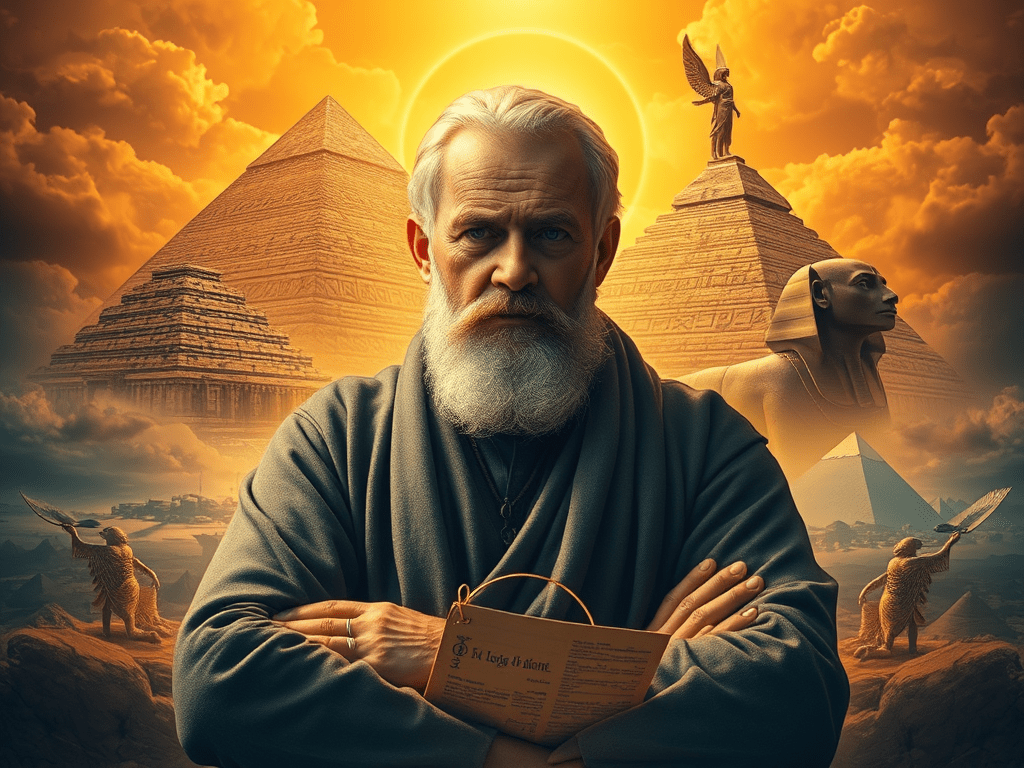
Wettenhovi-Aspa’s Vision: Finns as Founders of Ancient Egypt
In the early 20th century, a Finnish artist-turned-scholar named Sigurd Wettenhovi-Aspa put forth a bold and fantastical theory: that the Finnish people and language descended directly from an ancient high civilization which had founded Ancient Egypt and seeded all the great cultures of the world. According to Wettenhovi-Aspa’s Fenno-Egyptian theory, the primordial Finns did not always dwell in the far north; instead, he imagined they had journeyed from a distant cradle (by one account, even the island of Java in Asia) and settled in the Nile Valley long before the Pharaohs. In this telling, “Äijäkupittaa” – a tongue-in-cheek Finnish rendering of Aigyptos (Egypt) – was the ancient homeland of the Finns, literally translated as “Old Man’s barter-place,” implying a venerable marketplace of wisdom in antiquity.
Wettenhovi-Aspa believed these Fenno-Egyptians established Pharaonic Egypt and then spread out across the globe over millennia. He claimed that all other nations and cultures ultimately derived from this Finnish root, from the civilizations of the Mediterranean to those of Asia and the New World. He buttressed this sweeping narrative with inventive linguistic and mythological parallels. For example, he asserted that the ancient Egyptian language retained traces of Finnish: the word “mummy” (muumio in Finnish) he explained as coming from muu mies, “other man,” hinting at a transformed state of a preserved corpse. The word “pyramid”, Wettenhovi-Aspa claimed, actually came from Finnish pyhät raamit, “holy frames,” as if the pyramids’ sacred geometry had been named by Finnish builders. Even the name of Egypt’s famous necropolis Abu Simbel was alleged to derive from Simpele, a small Finnish town. In his view, Finnish was the primal tongue, the lexicon of an advanced people who left linguistic footprints worldwide.
Such intuitive etymologies were not strict academic linguistics but what he called “creative permutation” – a freeform reassembly of words across languages. With a nationalist twinkle in his eye, he “discovered” Finnish roots in words like culture (from kulta-ura, “golden track”) and Venice (from venesija, “place of boats”). Even Buckingham Palace in London, he joked, echoed Pukin hamina, “Goat’s harbor,” in Finnish. Though linguists dismissed these as playful fantasies or pseudohistory, Wettenhovi-Aspa insisted they signaled real historical connections. He famously proclaimed the Finnish national epic, the Kalevala, to be “the oldest book in existence,” an ancient chronicle preserving the story of this world-spanning Finnish high culture. The Kalevala, compiled in the 19th century from oral folklore, was in his mind not just myth but ancient history and even a source of medical and scientific wisdom.
In summary: Wettenhovi-Aspa’s theory turned conventional history upside-down. Instead of Finland being a remote fringe of civilization, he imagined it as the birthplace of civilization – with Finnish adventurers civilizing Egypt, then giving rise to the Greeks, Romans, and even cultures across oceans. While mainstream scholarship (then and now) finds no factual basis for Finns founding Egypt, Wettenhovi-Aspa’s ideas captured the imagination by weaving Finnish identity into the grand narrative of antiquity. To appreciate the poetic appeal of his vision, we can explore the symbolic parallels he drew between Finnish lore and Egyptian antiquity – parallels that, to him, were clues of an ancient connection.
Kalevala and the Pharaohs: Mythic Parallels and Symbolic Resonances
Wettenhovi-Aspa eagerly pointed out mythological echoes between Finnish folklore and Egyptian religion, believing these shared motifs were far too specific to be coincidence. A centerpiece of his comparisons was the striking similarity between a story in the Kalevala and the Osiris myth of Egypt. In the Kalevala, the hero Lemminkäinen dies and is dismembered during his quest in the underworld; his body is cast into the dark river of Tuonela (death’s realm). Lemminkäinen’s devoted mother searches tirelessly, dredging his torn limbs from the river and reassembling him. Finally, a tiny bee sent by the sky-god Ukko brings a magical honey ointment to revive Lemminkäinen, restoring him to life. This tale uncannily mirrors the ancient Egyptian myth of Osiris: the god Osiris was murdered and cut into pieces by his brother Set, who scattered the fragments in the Nile. Osiris’s wife (and sister) Isis retrieved the pieces of his body from the waters and resurrected Osiris with divine magic so that their son Horus could be conceived. Both myths share the motif of a dismembered hero reassembled and revived by a loving, persistent female figure, whether mother or wife. Scholars have noted the parallel, though likely explained by broad mythic patterns or medieval transmissions, but Wettenhovi-Aspa took it as evidence that the Finnish saga and Egyptian theology sprang from the same ancient source. In his 1935 book Kalevala ja Egypti (“Kalevala and Egypt”), he even asked pointedly: “Are Lemminkäinen and Osiris the same person?” – implying an identity or direct link between the Finnish hero and the Egyptian god of resurrection.
Other symbolic resonances delighted Wettenhovi-Aspa’s comparative eye. The creation story in Finnish folklore begins with a primordial water-mother (Ilmatar) floating in the sea, upon whose knee a duck lays a golden egg; when the egg shatters, its pieces form the earth, sky, sun and moon. This imagery of a cosmic egg and sea has parallels in many cultures – notably, some Egyptian creation myths speak of a primeval ocean (Nun) and a radiant cosmic egg from which the sun god was born, or a lotus that emerged to reveal the sun. To Wettenhovi-Aspa, such motifs in Finnish and Egyptian creation myths hinted that the two peoples remembered a common “Genesis” – perhaps recorded in the Kalevala as a “lost ancient Egyptian genesis,” as one chapter of his book muses. He argued that it would be “certainly strange if the Egyptian metaphors of nature did not also appear in the Finnish tales of the Kalevala,” given that he believed “all of Egypt’s great gods…have Finnish names or can be explained with the Finnish language.” In his view, the Kalevala – with its sky-father deity Ukko (literally “Old Man”, akin to the sky-god), its earth mother, its heroes and magic – was essentially the Finnish chapter of a universal mythos that included Egyptian lore.
Indeed, Wettenhovi-Aspa went so far as to “translate” the names of Egyptian gods into Finnish terms. He asserted, for instance, that many Egyptian deities’ names held meaning in Finnish, as if the gods were originally Finnish personages. (In one fanciful example, he claimed Ra and Amon could be traced to Finnish roots, though the exact correspondences are murky.) He certainly equated Osiris with a Finnish figure – one section of his book is tellingly titled “Osiris = Pet-like” (the exact meaning of “Pet” here is unclear, possibly a Finnish nickname). What is clear is that he saw Finnish counterparts for the Egyptian pantheon: perhaps Isis as a mother goddess akin to Ilmatar or Mielikki, Thoth as a wisdom figure like Väinämöinen, and so on. Wettenhovi-Aspa wasn’t aiming at rigorous linguistic derivation but at imaginative alignment – finding a Finnish mirror for every Egyptian god, symbol, and myth.
One fascinating parallel he drew was between the heroic characters of the Kalevala and the classical heroes of the Mediterranean. He pointed out that Kalevala’s wise old bard Väinämöinen – a magician whose music could charm all creatures – resembles the Greek sun-god Apollo (patron of music) and the legendary musician Orpheus, who enchanted even stones and animals with his lyre. In one chapter, Wettenhovi-Aspa compares “Apollo – Väinämöinen – Orpheus” side by side, noting how each is associated with music, poetry, and a form of solar wisdom (Apollo literally being a sun deity, Väinämöinen often sailing in a boat of fire or bringing light through knowledge). Likewise, he linked the tragic Kalevala hero Kullervo – a powerful, accursed figure who accidentally brings ruin on his family – with Heracles of Greek myth, who in madness killed his own children. Both are strong men with tragic fates, and Wettenhovi-Aspa imagined this was no accident but a shared mythic archetype passed down from the Fenno-Egyptian root culture. Even the Sampo, the mysterious magical artifact in the Kalevala that churns out wealth and sustenance, he revisited as a riddle possibly connected to other cultures’ sacred objects. (In Finnish myth, the Sampo is eventually broken and lost at sea – one might analogize it to a lost ark of power or a world-mill, perhaps akin to the shattered pieces of Osiris or other cosmological “mills” in Indo-European myth).
He didn’t stop at Egypt and Greece. According to Wettenhovi-Aspa, echoes of Finnish influence could be found as far as Mesopotamia and India. For example, he fancifully asserted that the name of Tunisia derives from Finnish Tuonensija, “place of Tuoni (death)” – as if the Phoenician colony of Tunis had been named by Finnish seafarers after the god of the underworld. He saw the word “Babylon” hiding in the Finnish phrase papi ja lonni (“priest and idler”), and “labyrinth” in läpiriinto (“run-through”). While these playful translations were not linguistically valid, they served to reinforce his overarching notion: Finns were everywhere in antiquity. Finnish shamanic symbols, such as the world-tree or pillar (the Finnic concept of the “sky nail” or pillar holding up the heavens), were compared to the Egyptian Djed pillar (the backbone of Osiris, symbol of stability) and the world-spanning Yggdrasil of Norse myth. In Wettenhovi-Aspa’s mind, these weren’t independent inventions, but shared legacies of an ancient unity.
By weaving together these mythic and linguistic parallels, Wettenhovi-Aspa painted a picture of deep connections: The Kalevala’s tales of vaulting heroes, cosmic eggs, and magical smithcraft resonated with the pyramid builders, sun-worshippers, and resurrection myths of Egypt. The symbolic resonances – a mother’s miraculous healing of her slain son, a sky-god hurling thunderbolts (Ukko like Zeus), a divine smith forging a wondrous artifact (Ilmarinen forging the Sampo, much as Ptah or Hephaestus forged divine objects) – all suggested to him that Finland and Egypt once shared a cultural wellspring. It was an invitation to imagine that the Finnish epic was not provincial folklore, but the echo of a grand prehistoric saga that also gave rise to Egyptian civilization.
A Lost Northern Civilization Seeds the Nile: A Speculative Saga
Let us step into Wettenhovi-Aspa’s imaginative framework and envision the saga he proposed – a mytho-historic journey in which a lost northern civilization carries the torch of wisdom southward. In this speculative narrative (tinged with poetic grandeur rather than academic certainty), the far north is not a frozen backwater but the very cradle of wisdom. Long ago, in the dim post-glacial millennia (perhaps circa 10,000 BCE, after the Ice Age), a hardy people blossomed in the boreal lands. They dwelt among evergreen forests and mirror-still lakes under the midnight sun, developing knowledge of nature’s secrets while the rest of the world was still in darkness. These proto-Finnic people – call them the Fenno-Egyptians – preserved lore of the stars, healing herbs, metallurgy, and magic. In legend, they would later be remembered as the Hyperboreans, the people “beyond the North Wind” whom the Greeks like Herodotus and Pindar spoke of in awed tones: a sun-blessed northern race visited by Apollo each year.
Around 7000–5000 BCE, as this northern folk prospered, climatic shifts and curiosity led them to wander. Wettenhovi-Aspa imagined a great migration: the ancestors of the Finns setting sail from their Baltic homelands, venturing first east and south through Asia (one version of his theory had them sojourn in India and Java, picking up wisdom along the way). Eventually, they made their way to North Africa, arriving in the fertile Nile Delta long before the Pyramids rose. We can picture these Northern sages arriving in a land of marsh and mud villages, bringing with them advanced skills and a cosmic worldview nurtured under polar skies. They found in Egypt a new home – dubbing it Äijäkupittaa, the “Old Father’s marketplace,” as Wettenhovi-Aspa quipped, perhaps after their sky-father deity (Äijä or Ukko). There, they taught the local peoples agriculture, navigation by the stars, and architecture aligned to the heavens. It is intriguing to note that the Finnish term for boat, puu(t) (literally “cut wood”), appears echoed in the English word “boat” – a tenuous hint, perhaps, that the Fenno-Egyptians carried seafaring terms across cultures. Wettenhovi-Aspa would say it’s no coincidence that the world’s oldest known boat relics are from Egypt and the Finnish word vene (boat) survives in place names like Venice (Venesija, “place of boats”). In our saga, these are the linguistic footprints of the Finnic navigators who spread the art of boat-building from the Baltic to the Nile and beyond.
By ~3000 BCE, as per this speculative history, the Nile Valley civilization began to flourish under the guidance of these northern immigrants. They established the early Dynasties of Egypt, essentially Finnic chieftains becoming Pharaohs. Could it be that the iconic Pharaoh’s headdress with the uraeus (rearing cobra) was inspired by northern shamans who wore serpents as symbols of wisdom – much like Finnish shamans honored the snake as a healing spirit? In any case, the Fenno-Egyptians imparted their symbolic language to Egypt. Wettenhovi-Aspa noted that many Egyptian symbols can be “explained exclusively with the help of the Finnish language”. For instance, the Egyptian sun-god Ra might resonate with the Finnish word rao (a ray or gap of light), and the sky-goddess Nut who arches over the world could be likened to nyyti, a Finnish word for a wrap or covering – poetic correspondences that speak to a shared symbolic vocabulary. The very name Kemet (Egypt’s native name, meaning “Black Land”) was, in Wettenhovi-Aspa’s view, derived from Kemi – which happens to be the name of a Finnish river and region, meaning “estuary” or perhaps stemming from kemiä, “dark soil”. Thus, the “Black Land” of the Nile bore the name of a far-northern river valley, as if the colonizers had transplanted a piece of Finland onto African soil.
Under this northern guidance, the Egyptians built pyramids – and here Wettenhovi-Aspa’s intuition of pyramidi = pyhä raami (“holy frame”) gains a mythic logic. The pyramid’s shape, reaching to the sky, could be seen as the frame of heaven, a sacred structure taught by temple-builders who remembered the world-mountain of their arctic homeland. (In Finnish myth, the idea of a world-mountain or pillar appears in the concept of Maailmanpylväs, the pillar holding up the sky, sometimes envisioned as the Pole Star and the axis around which the heavens rotate. The pyramids, perfectly oriented to north, might have been physical incarnations of that polar axis concept – a gift of northern cosmology to Egypt.) The Fenno-Egyptian priests might have introduced the practice of mummification as well, in accord with their ancient belief in preservation of the body. It’s poetic that muumio (“mummy”) in Finnish contains muu, meaning “other” – a mummy being the “other form” a person takes on the journey to eternity. We can imagine a Finnish sage explaining to awe-struck proto-Egyptians that death is but a transformation into another man, and wrapping the corpse in linen preserves it for rebirth – just as Lemminkäinen was reborn when carefully reassembled and anointed with honey.
This northern colony in Egypt, in Wettenhovi-Aspa’s vision, flourished as a mighty empire – a Fenno-Egyptian Empire – which then became the fountainhead for further cultural diffusion. Over the ensuing centuries (2500–1500 BCE), splinter groups of these traveler-scholars fanned out. One group sailed west through the Mediterranean, their language leaving traces in place-names: they saw a pair of large islands and called them Pari-saaret (“Twin Isles”), a name that survives in Paris. Another group ventured into the British isles, naming an important site Pukinhamina (“Goat’s Harbor”), remembered today as Buckingham (as in Buckingham Palace). Some went northward back into Europe, carrying with them the seeds of Greek and Roman civilization. Wettenhovi-Aspa audaciously suggested that even Shakespeare owes his name to Finland – “se Haaksenperä” in Finnish (meaning “that ship’s stern”) supposedly gave us “Shakespear”. While this claim is tongue-in-cheek, in our mythic tale it symbolizes how deep the northern influence ran: even the bard of England would be touched, at least in name, by this Fenno-Egyptian legacy.
Other emissaries journeyed east. We might speculate that some Fenno-Egyptian sages reached Mesopotamia, becoming the mysterious apkallu (sage beings) of Sumerian legend. The Sumerians spoke of Oannes, the fish-man who came from the sea to teach them laws and letters – could this have been a northern seer in another guise, arriving by sea wearing fish-scale armor or seal-skin, thus appearing as a half-fish being? The idea is fanciful, yet Wettenhovi-Aspa would nod approvingly: after all, if the Sumerian word for culture or civilization has any echo of kulttuuri (Finnish for culture, from kulta, gold), that might be another breadcrumb left by our migratory Finns.
By ~1000 BCE, according to this expanded hypothesis, the ripples of the Fenno-Egyptian influence had circled the globe. In the Far East, hints of a northern connection could be whispered – for instance, ancient Chinese legends of a paradise in the far northwest (sometimes equated with Kunlun mountain or the land of the immortals) might be distorted memories of Hyperborea, the Finnish homeland of the gods. The Chinese emperor’s dragon, symbol of imperial authority, finds a curious parallel in the Finnish Louhi’s dragon or the many-headed serpent in Kalevala that the hero must overcome – perhaps both stemming from a primeval dragon-slayer myth born in the north. Even the Chinese concept of the cosmic axis (the pole star revered as the residence of the Celestial Emperor) aligns with Finnish and Egyptian polar symbolism. While there is no direct evidence that ancient China was touched by Finnic travelers, our mythic narrative allows us to imagine that a single great vision of the cosmos – a heaven-piercing pillar or mountain, encircled by dragons or serpents, with the Imperishable North Star at its summit – was shared from Finland to China.
Across the ocean in the Americas, too, one can draw provocative parallels. The Maya and Aztec pyramids echo the form of the Egyptian pyramids – could ship-borne voyagers from Egypt (themselves originally Finnish in our tale) have crossed the Atlantic long before Columbus? Native legends in Mesoamerica speak of Quetzalcoatl, the feathered serpent god, often depicted as a bearded light-skinned teacher who came from across the sea to bring knowledge and then departed. In the 19th and early 20th centuries, many fancifully equated Quetzalcoatl with outsiders (from Vikings to Atlanteans); here we might whimsically imagine he was a Fenno-Egyptian sage, wearing a feathered cloak (feathers of the northland swan, perhaps) and bringing the calendar and astronomy that ultimately trace back to Finnish star-lore. Similarly, in South America, the deity Viracocha – a bearded god said to have emerged from Lake Titicaca to civilize the Andes – might be another cultural memory of these northern “culture bearers.” While mainstream historians firmly place the development of American civilizations in independent local hands, in Wettenhovi-Aspa’s mythic history the persistence of pyramidal structures and flood myths around the world is no coincidence. They are the calling cards of a global seeding by a master civilization – the one that had first built pyramids on the banks of the Nile under the guidance of Finnish priest-engineers.
To make our journey concrete, let’s outline a timeline of this speculative Fenno-Egyptian saga:
- c. 10,000–7000 BCE: Northern Cradle – Proto-Finnic “Hyperboreans” thrive in the far north (Finland/Baltic), developing advanced shamanic culture, art, and navigation under benign climate after the Ice Age. Legendary wisdom (songs of Väinämöinen, knowledge of Sampo) originates here.
- c. 5000–3000 BCE: Migration and Nile Foundation – Northern explorers migrate through Asia to Egypt. They settle in the Nile Delta (Äijäkupittaa) and intermix with local tribes. The early Egyptian Pre-Dynastic culture is guided by these outsiders who introduce farming, megalithic building, and writing systems (conceivably inspiring the hieroglyphic script, which in this poetic scenario might owe some concepts to Finnish runes or symbols). The 1st Dynasty of Pharaohs is established with semi-divine rulers who preserve memory of a northern homeland (this memory later survives as the Ta-Neter – “Land of the Gods” – from which Egyptian gods came, possibly a distant land to the north).
- c. 2500 BCE: Pyramid Age – With Fenno-Egyptian wisdom at its peak, the Great Pyramids and Sphinx are constructed. (Wettenhovi-Aspa might say that the word sfinksi (Sphinx) hides the Finnish sä finkas – “it was carved” – a stretch, but in our myth every name holds a Finnish meaning.) During this era, the Kalevala’s events take place in the far north: perhaps simultaneously, the Kalevala heroes are performing great deeds in their homeland, while their cousins on the Nile build empires. The Sampo is forged by Ilmarinen in Kalevala, while the Benben Stone (sacred capstone of Heliopolis in Egypt) is installed by his counterparts in Egypt – two expressions of one archetype, the cosmic source of prosperity.
- c. 2000–1000 BCE: Diffusion to Distant Lands – After firmly establishing Egypt as a beacon of civilization, Fenno-Egyptian explorers sail and ride to new horizons. They help spark the Minoan and Mycenaean cultures in the Aegean, laying groundwork for classical Greek civilization (the memory of a golden-age Hyperborea giving rise to Apollo’s worship). Others move west into Europe, their language leaving traces (Finnish-like toponyms in Celtic lands and beyond). In the east, they traverse to Mesopotamia: perhaps a Northern sage becomes the legendary “Melchizedek” teaching Abraham, or a Finno-Egyptian princess is behind the legend of Sargon’s birth (set adrift in a basket – a motif also in Kalevala, where infant Lemminkäinen is found in a basket in the reeds). In South Asia, one might whimsically say the Rigvedic hymns carry a note of northern memory (indeed, some Vedic myths speak of a far northern origin of the Aryans, which fringe theorists sometimes link to Arctic regions).
- c. 500 BCE – 1 CE: Echoes and Mythic Memory – As direct cultural contacts fade, the world’s civilizations codify their own myths and identities. Yet, echoes of the Fenno-Egyptian root persist in myth and scripture. Greek historians talk of Hyperborea as a real place where Apollo visits. The Kalevala oral poems continue to be sung in Finland, preserving encrypted history of world origins (in Wettenhovi-Aspa’s view). The Egyptian religion retains core concepts – resurrection, the judgment of the soul with a feather of Maat, etc. – which perhaps originated in that northern spirituality of justice and reincarnation (note: Finnish folklore has the idea of souls reincarnating or nature spirits, loosely parallel to Egyptian ka and ba). Even in the Mesoamerican Popol Vuh, the image of a heavenly heart of sky and a great flood could be distant reflections of the same primeval wisdom.
Of course, the above timeline is highly speculative – a kind of “lost chapter” of history that conventional archaeology does not support. But it serves to illustrate the grand narrative that Wettenhovi-Aspa intimated: that a unified, far-reaching civilization once connected Finland to Egypt and all points beyond. In this narrative, the north – often seen as peripheral – becomes the secret wellspring of human culture, the true cradle of wisdom hidden behind legends of Hyperborea and Atlantis. (It is perhaps no accident that Theosophists and mythographers of the era were enamored with ideas of polar origins and lost continents; Wettenhovi-Aspa himself, a Theosophist, likely drew inspiration from such sources.)
Echoes of a Northern Legacy in World Cultures
By embracing Wettenhovi-Aspa’s perspective, we start to see tantalizing echoes of a Fenno-Egyptian legacy everywhere. The world’s mythologies and sacred symbols become like a grand jigsaw puzzle in which Finnish pieces interlock with Egyptian, Mesopotamian, and others – all forming an older picture. Consider the motif of the World Tree: In Finnish lore, there is an idea of a great oak or pillar that once stood at the center of the world, later cut down to restore the sun’s light. In Egyptian mythology, a holy Ished tree stands at Heliopolis where Thoth and Seshat record the Pharaoh’s name – a sort of world tree of time. In Norse myth, Yggdrasil, the ash tree, links the heavens, earth, and underworld. Could all these be descendants of one primal concept taught by the sages of the north? Wettenhovi-Aspa would enthusiastically say yes. He speculated that even the Finnish word for heaven, taivas, might be found in far-flung languages; for instance, the name of the ancient Chinese supreme god Taiyi has a resemblance, as does the Egyptian sky goddess Tefnut (if one plays with the consonants). This kind of phonetic daydreaming aside, the structural parallels of cosmologies are intriguing: the finno-ugric shamans, the Egyptian priests, and the Druids of Europe all revered a cosmic axis (be it a tree, pillar, or mountain) and understood the cardinal directions, solstices, and equinoxes deeply – as if inheriting a shared sacred science.
Even in the realm of architecture and monument-building, our mythic lens finds common patterns. The megalithic stone circles in Britain (Stonehenge) align to solstices much like the entrance corridors of Egyptian pyramids align to circumpolar stars. Wettenhovi-Aspa might argue that who better to teach about the midnight sun and the cycling seasons than a people from high latitudes who had experienced eternal day and night? It’s an evocative thought that the stone circles of Europe and the circular timber temples of ancient Finland (of which traces have been found) could share a heritage, spread by Fenno-Egyptian druids on their journeys west. Similarly, the precise 365-day calendar of Egypt, so critical to its agriculture, might owe something to observations made in a land of stark seasonal contrasts (Finland’s year, with its dramatic differences, would demand careful time-keeping too). Indeed, Finnish folklore has songs tracking the months and natural cycles; marrying that with Egyptian needs could have refined the calendar.
One could continue in this vein to find resonant details: The Finnish epic’s mention of a hero with a rake or harrow dredging the sea – echoed by the Egyptian myth of the god Khnum dredging the Nile mud on his potter’s wheel to create humans. The mythic motif of the flood: in Kalevala, a great flood is hinted at during the birth of Väinämöinen, just as nearly every culture (Sumerian, Hebrew, Indian, Mesoamerican) has a flood myth – perhaps all hearkening back to a real deluge in post-Ice Age North Europe that the Fenno-Egyptians survived and memorialized as they traveled. The heroic last stand of Väinämöinen’s folk against Louhi (the North witch) to protect the Sampo might mirror the battle of the Egyptian gods against Apophis, the chaos serpent, to protect Ra’s solar barque – in both cases, a fight to preserve a source of life and order from forces of darkness.
Such comparisons walk a fine line between poetry and fantasy. Wettenhovi-Aspa was often criticized (rightly so) for excessive imagination over evidence, and many of his specific claims are far-fetched – for example, no linguist would derive “Buckingham” from pukin hammas (goat’s tooth) despite the amusing similarity. Yet, the spirit of his theory taps into something undeniably alluring: the idea that human civilizations are not isolated inventions but a connected family, and that perhaps at the dawn of history there were teacher-travellers who bridged continents. In his case, he placed his own ancestors at the center of this grand tale, turning Finland from student to teacher on the world stage.
Modern anthropology does not support a Finnish Egypt or a Fenno-global empire – yet as a mythic narrative, Wettenhovi-Aspa’s Fenno-Egyptian hypothesis has a kind of poetic truth. It reminds us that cultural pride and identity often seek reflections in the wider world. By linking Kalevala to the Nile, he was asserting that Finnish culture is as profound and ancient as any other, wrapping national identity in the mantle of deep time and far-reaching influence. The Kalevala versus Osiris parallel, for instance, genuinely speaks to universal themes of death and rebirth; it suggests that a Finnish mother’s love (Lemminkäinen’s mother) is on par with the famed love of Isis – in the realm of myth, they are the same archetype wearing different costumes. Likewise, saying the pyramids’ name comes from Finnish holy frames is a way of poetically stating that these monuments are part of a sacred architecture understood by the Finnish soul.
Conclusion: Mythic Truths in a Grand Vision
In the end, while Sigurd Wettenhovi-Aspa’s literal claims did not convince scientists, his work can be appreciated as a kind of mythopoetic enterprise – a grand narrative weaving. He took the threads of Finnish folklore, Egyptian hieroglyphs, and global myths, and wove a tapestry in which the North star shines at the center of human history. In this tapestry, the “peripheral” north becomes the pole around which the world’s cultures turn – much like the actual Pole Star around which the sky rotates. It’s a narrative that appeals to the imagination: What if wise sages in birch-bark canoes ventured forth from the Gulf of Bothnia and Baltics, long before Phoenician galleys or Viking longships, bringing song and knowledge to distant lands? What if the songs of Kalevala were the blueprint of civilization, and echoes of those songs can be heard in the hymns of the Pharaohs, the epics of India, and the chants of the Hopi?
Even if these ideas are taken as allegory, they underscore a symbolic truth: every culture has a stake in the shared heritage of humanity. By asserting a Finnish hand in crafting that heritage, Wettenhovi-Aspa poetically reclaimed a place for his people at the world’s oldest council fires. In doing so, he essentially said all cultures are siblings, and he simply cast the Finns as the eldest sibling who remembers the family’s first story. It is a story of unity and diffusion, not of isolation. And interestingly, it flips the usual script – instead of civilization flowing from south to north (e.g. the classical idea of learning coming to barbarian Europe from the Near East), here it flows from north to south. The periphery is the origin, the margins hide the source of the center.
In presenting Wettenhovi-Aspa’s ideas in their most compelling and poetic form, we allow ourselves to wonder and wander. Might there have been a grain of truth hidden in the fantasy? For instance, genetic and folklore studies do show ancient contacts across surprising distances – could a band of adventurous Finnic traders have reached Egypt in Pharaonic times? (We know Egyptian beads made it to Bronze Age Finland through trade, so contacts existed, albeit much later and indirectly.) The Fenno-Egyptian theory, if nothing else, prompts us to look for connections rather than divisions. In a faint allusion to even more fanciful possibilities, one could humorously imagine that behind Wettenhovi-Aspa’s “Finnish Atlanteans” lurked some even older influence – perhaps he would nod to the idea of a primeval intelligent species (dare we say Silurian?) that guided humanity, but then smile and say that of course, those Silurians probably spoke Finnish too!
Ultimately, the value of Wettenhovi-Aspa’s Fenno-Egyptian saga lies not in factual accuracy but in mythic richness. It invites Finns to see their Kalevala heroes as global heroes, and invites all of us to see global myths as variations of one human story. In that story, the cold white nights of Finland and the golden sun of Egypt are chapters of the same book – a book that may well be the “oldest in existence,” written in the language of symbol and star, and kept in the collective memory of our species. Wettenhovi-Aspa turned history into a canvas for epic imagination, and on that canvas the far North shines with the light of a primeval sun, casting its rays to illuminate Egypt’s pyramids, Babylon’s ziggurats, India’s temples, and beyond. It is a reminder that sometimes, in order to find meaning, we look not to what is factual, but to what feels true in the heart: the idea that wisdom knows no borders and that even a small nation’s soul can echo in the chambers of the oldest pyramids.
Sources: Despite the imaginative nature of this exploration, many of Wettenhovi-Aspa’s specific claims and parallels are documented in his writings and analyses of them. His peculiar etymologies (e.g. pyramidi = pyhät raamit, Venetsia = Venesija) are recorded and critiqued in modern sources. The comparison of Lemminkäinen’s resurrection to Osiris has been noted by scholars, and Wettenhovi-Aspa himself highlighted this in Kalevala ja Egypti. He outlined numerous Finnish–Egyptian mythic commonalities (e.g. the world-egg, sky god, sacred bull) and even drew parallels to Greek myth, equating Kalevala figures to Apollo, Orpheus, Hercules and others. Contemporary commentators (with some humor) have summarized his Fenno-centric etymologies and migration scenario. While modern linguistics and history do not support these theories (and indeed classify them as pseudohistory), the story we have spun here stays true to Wettenhovi-Aspa’s spirit: using “intuitive permutation” and imaginative coherence to find symbolic connections across cultures. In that spirit, this mythic investigation serves to celebrate the narrative grandeur of Wettenhovi-Aspa’s Fenno-Egyptian theory – a grand symphony in which Finland and Egypt play harmoniously in the overture of civilization.
Wettenhovi-Aspa’s theory – The Finnish pseudohistorian Sigurd Wettenhovi-Aspa claimed that the Finns were a primordial nation that migrated from a distant origin (Java) through India to Egypt, which he called “Äijäkupittaa,” leaving Finnish words in the local lexicon. From this Fenno-Egyptian empire, civilization spread to the rest of the world – Greek, Latin, Celtic, and other cultures allegedly owed their accomplishments to the Finns.
“Äijäkupittaa” and linguistic traces – Wettenhovi-Aspa offered inventive Finnish etymologies for foreign names: Egypt = Äijäkupittaa (“Old man’s barterplace”), tying the name Aiguptos to Finnish. He similarly claimed Khemet (Egypt’s native name) came from Keminmaa (“Riverland,” a region in Finland). A Swedish radio piece notes that in the early 1900s it was indeed asserted that “Egypti was originally Äijäkupittaa, Venice venesija (place of boat), and zebra seurahepo (companion horse)” as examples of Finnish being the source of other languages.
Examples of Wettenhovi-Aspa’s etymologies – He relied on “intuitive permutation” to derive words from Finnish. Some notable (if fanciful) examples include: pyramid from pyhä raamit (“holy frames”), mummy from muu mies (“other man”), culture from kultaura (“golden track”), zebra from seurahepo (“companion horse”), Buckingham from Pukin hamina (“Goat’s harbor/tooth”), Venice from Venesija (“boat place”), and Paris from Parisaaret (“pair of islands”). These illustrate his imaginative approach to finding Finnish roots in world languages.
Lemminkäinen and Osiris – Scholars have observed that the Kalevala tale of Lemminkäinen’s death and partial resurrection closely parallels the myth of Osiris. Wettenhovi-Aspa emphasized this, explicitly asking if Lemminkäinen and Osiris could be “the same person”. In both myths a dismembered hero is reassembled by a loving relative (mother or wife) and restored to life, a motif predating Christian resurrection narratives.
Finnish heroes as Hercules, Apollo, etc. – In Kalevala ja Egypti, Wettenhovi-Aspa drew direct comparisons between Finnish epic figures and those of classical myth. He linked Kullervo (the strong, ill-fated Kalevala antihero) with Heracles (Hercules), and he compared the venerable bard Väinämöinen with Apollo and Orpheus as culture-heroes and musicians. These comparisons illustrate his view of the Kalevala as world mythology in parallel with Greco-Roman and Egyptian legends.
Kalevala as the oldest book – Wettenhovi-Aspa regarded the Kalevala (compiled in 1835–49 from Finnish oral tradition) as literal history from antiquity. He asserted it was the oldest book in existence, preserving accurate historical knowledge and even medical wisdom from prehistoric times. This exemplifies how highly he elevated Finnish oral tradition, suggesting it carried memories of the Fenno-Egyptian civilization.
 Horizon Perspective News
Leave a comment