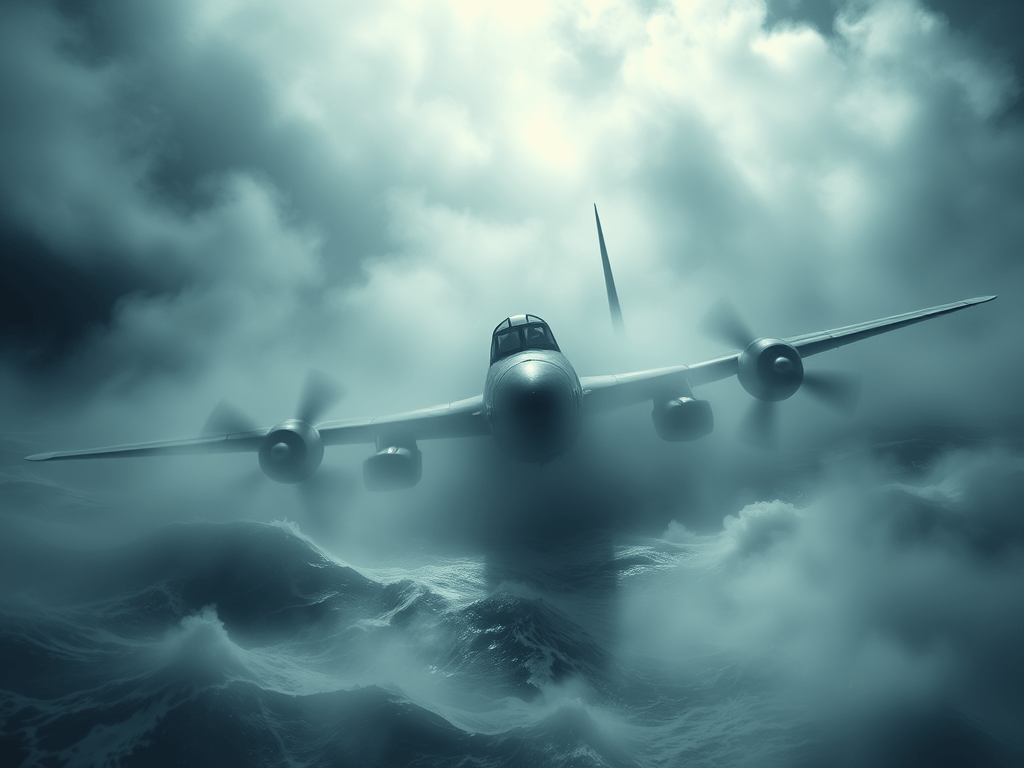
How a mash-up of quantum vacuum “sound” and space-time memory offers a fringe lens on the Bermuda Triangle’s most famous disappearances.
Fog, radio silence—and nothing
On 5 December 1945 five U.S. Navy Avenger bombers, call-sign Flight 19, lifted off from Fort Lauderdale on a routine navigation drill. Radio transcripts record rising confusion: compasses “spinning,” a “strange white haze,” crewmen unable to tell east from west. Hours later the squadron was gone—no wreckage, no distress beacon. The case joined a catalogue that begins with the collier USS Cyclops (309 souls lost in 1918) and stretches to the container ship El Faro in 2015. All vanished inside the loose polygon bounded by Miami, Puerto Rico, and Bermuda.
Skeptics cite storms, human error, and the sheer volume of traffic. A fringe alliance of acousticians and gravitational-wave physicists counters with an audacious two-step mechanism:
- Quantum-Vacuum Acoustic Pulses created in methane caverns below the Sargasso Sea scramble inner-ear balance and radio gear.
- Gravitational-Wave Time-Crystal Drift imprinted in quartz on board ships and aircraft nudges navigators off course for hours afterward.
Together, they sketch a failure cascade eerie enough for legend yet precise enough for instruments.
The ocean floor as a giant Casimir soundbox
The seabed beneath the Triangle is pocked with methane-hydrate domes. When warm eddies or seismic jolts fracture a dome, gas rushes into overlying cavities whose walls sit just tens of micrometres apart—dimensions ripe for the dynamic Casimir effect. Each rapid cavity expansion changes the boundary conditions of the quantum vacuum, spawning pulses of real, low-frequency phonons: think of them as “pressure pops” in empty space.
Unlike ordinary sound, these vacuum phonons ignore water and hull alike; they couple straight to matter’s zero-point energy. The calculated resonance (≈ 18 Hz) overlaps the natural frequency of the human vestibular organ and of flux-gate compasses. A crew inside such a pulse cloud would feel a sudden tilt, see instruments drift, and—crucially—be unable to trust either sensation.
A space-time bruise that refuses to heal
Hours or days earlier, a black-hole merger a billion light-years away may have sent a gravitational-wave (GW) train through Earth. Most of the wave passes unnoticed, but general relativity predicts a tiny, permanent “memory” distortion once it’s gone—imagine space-time stretched thinner on one side of a soap bubble.
High-Q quartz resonators—the heart of aircraft turn-and-bank indicators and ship chronometers—can trap this distortion as a time crystal: phonons locked in a perpetual whisper that slightly biases the resonator’s frequency. Instruments calibrated before the GW agree; after the wave, each quartz device begins to drift in a direction set by its lattice orientation.
In the Triangle, where navigation already leans on subtle magnetic and stellar cues, that micro-hertz skew is just enough to amplify the disorientation seeded by the vacuum pulse.
Failure chain in six beats
| Sequence | Effect |
|---|---|
| Methane dome fractures | Quantum-vacuum acoustic pulses radiate through water and hulls. |
| Crew inner ears entrain | Pilots perceive a bank; helmsmen sense a heading change. |
| Instruments wobble | Casimir pulses dither magnetic and gyro sensors. |
| GW memory passes | Quartz units shift frequency, locking wrong headings in place. |
| Radio mis-triangulation | Time-crystal bias skews direction-finding, so distress calls misreport position. |
| Storm or fuel exhaustion finishes the job | Search grids, plotted on faulty fixes, scour empty ocean. |
Flight 19’s “white haze,” some researchers argue, was the optical analogue: suspended sea-salt aerosols vibrating in the vacuum pulse field, scattering sunlight into a featureless glow.
Dragging the myth into the lab
- Seabed watch. Moor Casimir-sensitive MEMS cantilevers near known methane mounds; correlate 18 Hz phonon bursts with sonar bubble plumes.
- Quartz autopsies. Retrieve chronometers from documented sinkings (El Faro’s voyage data recorder survives). Cool the quartz to millikelvin and probe for locked-in GHz phonon populations—a time-crystal fingerprint.
- Air-sea drill. Fly instrumented drones through controlled methane bubble releases. Real-time vestibular IMUs and flux-gate compasses should show the predicted 18 Hz jitter.
- GW coincidence. Compare accident timestamps with LIGO/Virgo/KAGRA event logs; look for sinkings within the ∼24-hour window after strong mergers aimed at the Atlantic.
Any null result pares the chain; a single match tightens the net around an idea once relegated to tabloid ink.
Why the chase is worth the fuel
- Ocean hazards. Mapping quantum-vacuum “acoustic” hotspots could refine shipping lanes as neatly as charting sandbars once did.
- Navigation tech. If quartz really holds GW scars, future gyros must self-heal or reference redundant physics.
- Fundamental physics. A confirmed time-crystal memory would hand cosmologists a natural recorder of distant cataclysms—no need for kilometre-scale interferometers.
Skeptical speed bumps
- Energy from vacuum phonons is vanishingly small—can it truly churn human semicircular canals?
- Gravitational-wave memory strains Earth; quartz drift at that scale may drown in thermal noise.
- Recorded Triangle disappearances cluster around shipping density and hurricane tracks; coincidences with GW or methane vents may dissolve under rigorous statistics.
Only data, not lore, can decide.
From legend to ledger
Somewhere off Bermuda, methane still fizzes through shattered hydrates; somewhere beyond Virgo a fresh pair of black holes spirals inward. Whether their ripples ever conspire to erase a ship’s path is an open question—but a testable one. The Triangle, it turns out, may be less a graveyard of reason than a proving ground where quantum vacuum, gravitational memory, and maritime history intersect.
Until the sensors are lowered and the quartz is cooled, the compass needle between skepticism and wonder will keep its own uneasy spin.
 Horizon Perspective News
Leave a comment