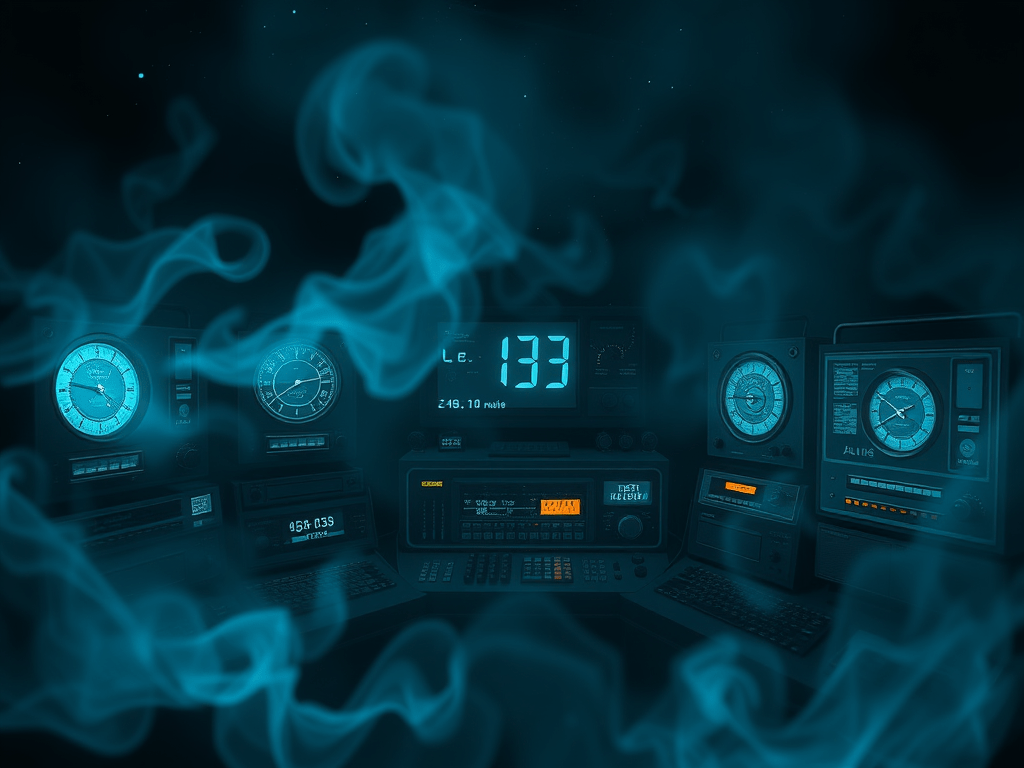
How Cold-War short-wave oddities—from “the Lincolnshire Poacher” to the Russian Woodpecker—seeded today’s wildest mind-control hypothesis.
The night-voices of short-wave
Spin a dial after midnight and you may still meet them: thin female voices counting in perfect monotone, Morse bursts that start and stop on the minute, or a bored buzzer droning “bzz-bzz-bzz” twenty-four hours a day. Radio hobbyists filed these transmissions under “numbers stations,” convinced for decades that they were spy maildrops—one-time-pad groups read aloud to field agents. The best-known, the Lincolnshire Poacher, opened with jaunty bars of an English folk song before rattling off five-digit groups from a transmitter on Britain’s outpost at RAF Akrotiri, Cyprus. (medium.com)
Across the dial, the Soviet-era UVB-76, today nicknamed “the Buzzer,” sits on 4625 kHz sending a relentless 25-tone-per-minute pulse, sometimes breaking to mumble a Russian call-sign or cryptic phrase. Western tabloids now frame it as a “dead-man’s switch” for nuclear retaliation, but its true function remains unconfirmed. (en.wikipedia.org, thesun.co.uk)
And then there was the Russian Woodpecker. In the late 1970s short-wave sets worldwide erupted with a harsh, 10 Hz knocking that hopped randomly across bands, ruining maritime and ham traffic alike. Listeners soon linked the sound to the giant Duga over-the-horizon radar near Chernobyl, yet conspiracy journals insisted the taps were Soviet mind-control experiments. (en.wikipedia.org)
Numbers stations never explained their purpose; the Woodpecker never apologised. Into that vacuum rushed rumor: coded orders, weather weapons, even broadcasts designed to make you feel something you didn’t choose.
A 21st-century twist: photons, microbes, and retro-empathy
A new fringe model tries to turn those rumors into a chain of laboratory-testable steps. It fuses two bleeding-edge ideas:
- Photonic anti-biosignature. Atmospheric chemists have reported narrow absorption dips in left-hand circularly polarised (LCP) sunlight that ordinary Earth biochemistry cannot explain. One interpretation points to hypothetical mirror-life microbes in the lower stratosphere—organisms whose chiral molecules are the mirror image of ours and therefore gulp LCP light where normal microbes reflect it.
- Quantum retro-empathy. In tabletop optics, researchers have coaxed particles into “pre-post-selected” states that appear to influence their own past micro-seconds before measurement. Scale that to biology: jostle an oxytocin molecule’s hyperfine levels just right, and its binding to receptors could nudge mood slightly before the jostle occurs.
Those two threads braid into a speculative transmitter-to-emotion pipeline:
- Hidden payload in the numbers. Beneath the spoken digits, a numbers-station carrier includes millisecond LCP notches timed to oxytocin’s 42 MHz hyperfine splitting.
- Mirror-microbe relay. The LCP packets pump the stratospheric mirror microbes, which then fluoresce downward in coherent near-IR—an optical drizzle covering anyone in the station’s skip footprint.
- Molecular trigger. The IR phase pattern plus the residual short-wave field inside a listener’s body pushes circulating oxytocin into a retro-causal entangled pair.
- Subjective drift. The brain, laced with time-skewed oxytocin, drifts toward heightened trust, dread, or docility—whichever “phase recipe” the broadcaster encoded.
In this telling, the Woodpecker’s jack-hammer pulses were an early, brute-force prototype—lacking finesse, but capable of stirring unease across oceans. Later stations like UVB-76 refined the craft, embedding mood codes beneath harmless buzzes.
Can the story be cracked?
Skeptical physicists insist that tissue scatters IR too chaotically for long-range coherence and that warm blood is lethal to fragile quantum states. Yet the hypothesis, unlike folklore, sets crisp targets for measurement:
| Test | Prediction if model is right |
|---|---|
| Polarimetric sweep of a live numbers station | Each block of five digits sits atop an LCP notch not found in random broadcasts. |
| Night-sky imaging during a transmission | A faint, spiral-fringe glow appears in the cloud base along the transmitter’s great-circle line. |
| Blood NMR in shielded listeners | Spin-echo “blips” precede the radio pulses by micro-seconds, signalling retro-causal oxytocin pairs. |
| Behavioural trust game | Participants exposed to authentic broadcasts shift cooperation rates more than those hearing frequency-scrambled placebo signals. |
Pass one of these hurdles and the debate becomes urgent; fail them all, and the mind-control legend retreats beside the Woodpecker in the museum of busted myths.
Why the chase still matters
Numbers stations, the Buzzer, the Woodpecker—they are real curiosities with real transmitters, not camp-fire ghosts. Following even an outlandish breadcrumb can refine polarised-sky cameras, push NMR sensitivity, or simply put folklore on firmer ground. Radio has always carried more than voices: propaganda, panic, hope. Whether it also carries a quantum key to our chemistry is a long shot—but short-wave has never been short on surprises.
So the next time a speaker whispers “4… 7… 2… 9,” remember: waveforms cross continents, photons seed clouds, molecules twitch in blood, and somewhere between physics and psychology lies a twilight band still waiting for a proper signal report.
Sources: overview of numbers-station practice (en.wikipedia.org); historical details on the Lincolnshire Poacher (medium.com); technical profile of UVB-76 “the Buzzer” (en.wikipedia.org, thesun.co.uk); background on the Russian Woodpecker (Duga radar) (en.wikipedia.org).
 Horizon Perspective News
Leave a comment