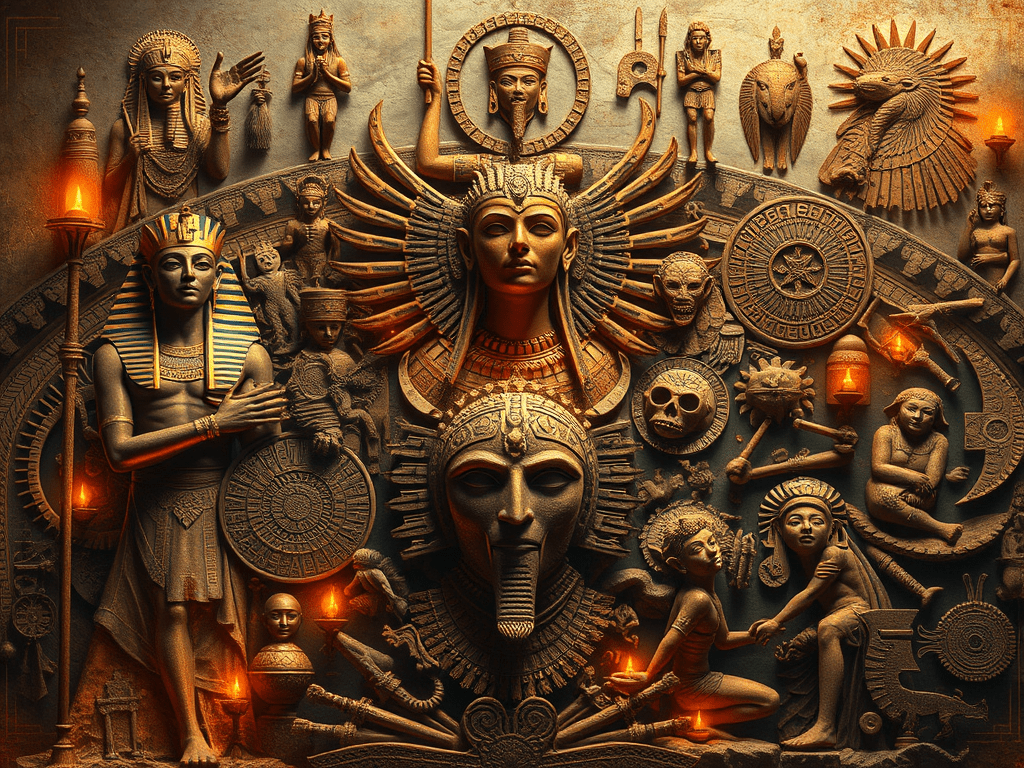
Introduction: Across continents and millennia, striking similarities thread through humanity’s myths and spiritual traditions. How is it that ancient Egyptians and Maya, Vedic sages and Norse skalds, or even the indigenous Sámi of Lapland and the Aboriginal Australians – cultures separated by vast oceans and ages – envisioned such common motifs in their cosmologies? Divine triads, world-consuming floods, sacred mountains, cosmic trees, dualistic battles of good and evil, solar deities, and cyclic apocalypses recur with uncanny consistency. Scholars of comparative mythology have long noted these overlapping structures, often ascribing them to universal aspects of human psychology or parallel responses to natural phenomena. But could there be another explanation? In this investigative journey, we will first examine real, documented parallels in theology and myth across many cultures. Then we will venture into a speculative hypothesis: that perhaps these shared mythic patterns are encoded memory-fragments of an actual ancient event – a forgotten chapter of pre-human civilization that bound all our ancestors in a single spiritual legacy.
From Egypt to India to the Americas, common symbols abound. Let’s begin by surveying the evidence: the genuine cross-cultural commonalities in myth and ritual that have puzzled anthropologists. By treating this with the seriousness of a scholarly inquiry, we set the stage for a later, more mythic interpretation. The goal is not to invent fake history, but to reinterpret what is actually there in the historical and archaeological record – to see if the pieces, when assembled, hint at something profound in humanity’s past.
Divine Triads Across Cultures: The Power of Three
One of the most widespread sacred motifs is the divine triad – groupings of three deities who are worshipped as a unit or family. The number three carries a special aura in myth, and triple-deity configurations appear around the globe. Carl Jung even argued that arranging gods into triplets reflects an archetype in the collective unconscious. But beyond psychology, we find concrete historical instances of triadic gods:
- Ancient Egypt: The Egyptians frequently grouped gods into family triads of father, mother, and son. At Heliopolis, the creator Atum was joined by Shu and Tefnut; at Memphis, the triad was Ptah (father), Sekhmet (mother), and Nefertum (son); at Elephantine, Khnum, Satis, and Anukis formed another triad. The most famous, of course, was Osiris, Isis, and Horus – a holy family where the resurrected king Osiris and his sister-wife Isis produce Horus, who avenges his father’s murder and assumes the throne. This story of a dying-and-rising god (Osiris), divine motherhood (Isis), and a savior son (Horus) resonated so powerfully that later civilizations drew parallels with it. Egyptian priests eventually interpreted some triads more abstractly – for example, seeing Ptah, Re, and Amun not just as a family but as three aspects of one supreme deity (creative power, illuminating mind, and hidden spirit). The triadic form was “a very common type of group” in Egyptian religion.
- Mesopotamia: The cradle of civilization also knew triads. The Sumerians envisioned a cosmic ruling triad of Anu, Enlil, and Enki – Anu the sky-father, Enlil the wind/storm lord of air and earth, and Enki (Akkadian Ea) the master of waters and wisdom. This heavenly trio reflected the elements of sky, air, and water, sharing governance of the created world. Later in Babylon, another triad consisted of Sin (Moon), Shamash (Sun), and Adad (Storm). Interestingly, the great goddess Ishtar could insert herself into these male triads, sometimes effectively replacing one member – a reminder that triple gods were often flexible symbols. Mesopotamian religion thus had multiple overlapping triads, showing the persistent allure of three-in-one structures.
- Ancient India: The Vedic and later Hindu tradition produced the Trimurti – Brahma the Creator, Vishnu the Preserver, and Shiva the Destroyer, together embodying the cosmic functions of creation, maintenance, and dissolution. This concept, solidified in the first millennium BCE, gave Hinduism a famed divine trinity (sometimes linked with a parallel feminine trinity, the Tridevi of goddesses Saraswati, Lakshmi, and Parvati). While the Trimurti is not identical to the Christian Trinity, Western scholars early on noticed the superficial similarity. In Buddhism, a different kind of triad appears: the “Three Jewels” (Buddha, Dharma, Sangha) and philosophical models like the Trikaya (three bodies of Buddha doctrine) – again reflecting a tendency to conceptualize sacred things in triplets.
- Other Cultures: The pattern pops up virtually everywhere. The Greeks had many triple sets (the Three Fates, the Three Graces, etc.), and a sort of ruling triad in Zeus, Poseidon, Hades governing sky, sea, and underworld. The Romans celebrated a Capitoline Triad of Jupiter-Juno-Minerva. The Celts spoke of a triple goddess (maid-mother-crone). In Norse myth, triads were less formal but still present (Odin, Vili, Ve as creators; or Odin, Thor, Freyr as leading gods). Even Christianity – strictly monotheistic – developed the Holy Trinity of Father, Son, and Holy Spirit, a doctrine some early Church fathers felt was foreshadowed by the ubiquity of triads in “pagan” religions. (Judaism and Islam pointedly rejected any triune concept of God, yet mystical strands like Kabbalah identified creative, sustaining, and receptive aspects in the divine, which is analogous.)
Why does the “power of three” recur so much? Some historians think it was often a political compromise: when cities or tribes merged, their patron deities could be unified as a family triad. For example, when one Egyptian nome (province) conquered another, their gods might be declared relatives and worshipped together in one temple. Father-mother-child is an intuitive triad to form. But there may also be a deeper, symbolic significance to triplicity. Many ancient creation stories speak of an initial division of the cosmos into sky, earth, and underworld – a three-level cosmos mirrored by a trinity of gods ruling each realm. Some triads represent time (past-present-future) or natural cycles (birth-life-death). Jung would call three a fundamental archetype of wholeness, just one step shy of the “completion” symbolized by four. Whatever the cause, we find humanity again and again gravitating to the triadic structure as if remembering that divinity comes in threes. Could this be, our speculative mind wonders, a distant echo of some original “trinity” known to proto-humans? We will return to that thought later.
The Great Flood: A Universal Deluge Myth
Perhaps no myth is as widespread globally as the story of a Great Flood that nearly annihilates humanity. From the Epic of Gilgamesh in Mesopotamia to the Torah’s account of Noah, from India’s tale of Manu to oral traditions of Pacific Islanders and Native Americans, flood myths abound – often startlingly similar in plot and symbolism. These typically involve divine wrath, a righteous survivor with a boat (or other refuge), and the preservation of life to repopulate the world post-deluge. Scholars have counted hundreds of flood myths across different cultures, suggesting either some common source or at least a common human experience (such as the end of the Ice Age’s sea level rise or regional flood disasters).
Consider some famous examples:
- Mesopotamia: The oldest known flood story comes from Sumer (Iraq). In the Atra-Hasis myth (~18th century BCE) and the Sumerian Eridu Genesis, the gods decide to send a deluge to destroy humankind when humans become too numerous and noisy. The wise god Enki (Ea) warns one man – variously named Atrahasis, Ziusudra, or Utnapishtim in different texts – and instructs him to build a boat. The hero survives the Flood with his family and animals, and is eventually granted eternal life. These Mesopotamian flood accounts directly influenced the Biblical story of Noah. In fact, the Epic of Gilgamesh (c. 1800–1200 BCE) contains a flood episode so akin to Genesis that Victorian scholars were stunned by the parallels when it was first translated. The Sumerian King List even divides history into pre- and post-flood eras, showing how firmly the flood was thought of as a real historical dividing line.
- Hebrew and Abrahamic Tradition: The Genesis Flood (likely compiled around the 9th–6th centuries BCE) tells how Yahweh, seeing human wickedness, sent waters to wipe out nearly all life, but spared Noah who built an ark at God’s command. Noah’s ark lands on a mountain (Ararat), he releases a dove to find land, and God sends the rainbow as a promise never to flood the entire earth again. This narrative is foundational in Judaism, Christianity, and Islam (each of which retells the flood with variations). It so closely mirrors the Mesopotamian precursor that most researchers conclude the Hebrews adopted and theologized a Mesopotamian legend. But intriguingly, flood myths aren’t only in the Near East.
- South Asia: In Hindu lore, an early scripture (the Satapatha Brahmana, c. 6th century BCE) recounts how the hero Manu is warned by a giant fish (actually the god Vishnu in avatar form) of a coming deluge. Manu builds a boat and ties it to the horn of this great fish, which then tows him to safety atop a mountain. All other creatures drown, but Manu survives to re-establish life. Later Puranic texts call this event the end of a bygone age (the flood of the Manvantara-Sandhya period). In Zoroastrian Iranian myth (though Iran is arid), there is a story of Yima building an underground enclosure to survive an apocalyptic winter – not exactly a flood, but a similar “world-cleansing” disaster motif. Scholars think the Iranian version might be a modified echo of an older flood story adapted to a desert context.
- Greco-Roman: The Greeks told of Deucalion and Pyrrha, a virtuous couple who survived a flood sent by Zeus to punish a corrupt Bronze Age of humanity. In one version, they float in a chest for nine days and nights; when the waters recede, they repopulate the world by throwing stones over their shoulders which turn into new people. This tale, recorded by Hesiod and Ovid, shows the same core elements: divine wrath, one chosen pair, and renewal of mankind. The Romans, inheriting Greek lore, knew this well – Ovid even makes Deucalion’s flood the starting point of his Metamorphoses.
- Indigenous Americas: Flood stories are rampant among Native peoples. For example, certain First Nations of North America (like the Cheyenne or Blackfoot) have deluge legends in which only a few human or animal survivors repopulate the earth. In Mesoamerica, the Maya in the Popol Vuh recount that the gods destroyed an early race of wooden people with a flood of resin, as they lacked souls and had forgotten the gods. The Inca of the Andes said that the creator god Viracocha unleashed a great flood to end the age of giants, saving only two humans to begin the new age. In fact, Inca legend holds that Viracocha’s flood (called Unu Pachakuti) lasted 60 days and nights, after which the survivors emerged from Lake Titicaca to civilize the world – an uncanny parallel to the 40 days of rain for Noah or 7 days for Utnapishtim. Such convergences beg the question: coincidence, or cultural contact? Or something else entirely?
- Australia and Oceania: Even in Australia, where the environment is often arid, some Aboriginal Dreamtime stories include floods. The Rainbow Serpent, a major creator-being, is said to have the power to drown the land with floods or withhold the rain in drought if angered. In parts of Aboriginal Australia, there are stories of a great flood that shaped the landscape, and the Rainbow Serpent as a guardian of waterholes who must be propitiated lest it unleash inundation. The universality is astonishing: what are the odds that nearly every branch of humanity, from the Arctic to the equator, kept some memory of a time when water covered the earth?
Modern science suggests that many of these myths could hark back to real events – the rapid sea level rise at the end of the last Ice Age (~12,000 years ago) or catastrophic regional floods (such as the breaching of ice dams or the flooding of the Black Sea basin ~7,600 years ago). For instance, the Black Sea Deluge hypothesis proposes that the filling of the Black Sea by the rising Mediterranean (~5600 BCE) inspired Near Eastern flood legends. Likewise, oral traditions in the Pacific Northwest that describe a great flood may stem from post-glacial flooding or even a megatsunami. But the intriguing possibility we’ll explore later is that the reason these flood stories were preserved as part of sacred history is because they symbolized something even more ancient – a collective trauma or transition in the human story far before the end of the Ice Age.
In almost all flood myths, the pattern is the same: the gods (or God) hit the reset button on civilization via water. A culture hero is warned and preserves the seeds of life. Humanity is humbled and given a chance to start over. Often there is an ethical lesson (humans were sinful or hubristic and thus drowned). And often a sign is given (rainbow, dove, etc.) that the divine wrath will not take that form again. The concordance of details is sometimes eerie. Mesopotamia and the Bible both mention birds sent out (a dove, a raven) to scout for land; both mention the boat resting on a mountain. Many traditions specify that not all living beings died – a remnant was saved to ensure continuity. This “remnant” concept will be key to our speculation: perhaps these myths encode the idea that knowledge was also preserved by a remnant group of survivors.
World Trees and Cosmic Pillars: Axis of the Universe
Another striking cross-cultural symbol is the World Tree – a great tree (or sometimes vine, mountain, or pillar) that connects the heavens, earth, and underworld. Often termed the axis mundi (world axis), this concept appears in shamanic societies, ancient mythologies, and major religions alike. The World Tree stands at the cosmic center, linking different planes of existence. Its roots extend to the underworld, its branches soar to the sky, and it thus unites the whole cosmos in a single living structure.
Famous examples include Yggdrasil in Norse mythology – the immense ash tree holding the Nine Worlds. The Norse Eddas describe Yggdrasil as “very holy,” with branches that spread over the world and roots that extend into heaven, hel, and the primordial wellsprings. Gods hold their council at its base; a dragon (Níðhöggr) gnaws at its roots, while an eagle perches in its top – a vivid image of a universe connected from the depths to the heights. Notably, the Norse envisioned different creatures living on the tree (dragons, stags, squirrels), acting as messengers between realms. The symbolism is rich: Yggdrasil is literally the axis of space and also of time (since the fate of the world, including the prophecy of Ragnarok, is tied to this tree).
Mesoamerican cultures also had a prominent world tree concept. The Maya spoke of the Yaxche (Ceiba tree) whose roots were in Xibalba (the underworld), trunk on the earth, and branches in the heavens. Artistic depictions, such as the carved stone at the Temple of the Cross in Palenque, show a great cross-shaped tree with a bird deity perched atop – clearly analogous to the idea of an axis mundi. In Maya cosmology, four directional world-trees upheld the corners of the sky, often colored red, white, black, and yellow for the cardinal points, while a central green-blue tree stood at the center. This central tree was sometimes identified with the Milky Way galaxy band arching across the night sky. Similarly, the Aztecs and other Nahua peoples had the concept of Five Suns and a central Tree of Life connecting realms. In fact, virtually all Indigenous American societies – from the North American Plains tribes with their ceremonial Sun Dance pole, to the Amazonian shamans with their visions of a great tree of life – repeat this motif. Often, a bird sits atop the tree (representing celestial or heavenly spirit) and a snake or dragon is at its base (chthonic underworld power). The ancient motif of a bird vs. serpent conflict in a tree is found from Eurasia to the Americas, and has been theorized to date back to Paleolithic times.
The Indigenous Sámi people of northern Europe also preserved this idea. Sámi shamanism speaks of a World Pillar or tree (sometimes called Värrás or similar in Finnic myth) that connects to the North Star – the fixed point in the sky around which all stars rotate. In Sámi shaman drums, drawings of a central pillar often appear, indicating the path the noaidi (shaman) travels to reach the spirit worlds. The Sámi, like many circumpolar peoples, imagined the cosmos in layers: an underworld (Saivo), a middle world (earth), and an upper world of the celestial gods. A pillar or tree ran through the center of the worlds, sometimes identified literally with the pole star (a cosmic “tent pole” holding up the sky). This is remarkably analogous to the world-tree of other cultures.
Even the Bible has its echo of the world tree in the Tree of Life planted at the center of Eden, whose branches give eternal life, and which later Jewish mystics associated with a sort of cosmic structure of creation. In Genesis, a Tree of Life and a Tree of Knowledge stand in the divine garden, with four rivers flowing from the garden’s source – imagery strongly reminiscent of ancient Mesopotamian sacred trees and their life-giving waters. In Christianity, the Cross upon Calvary came to be mystically interpreted as a new World Tree – a bridge between Heaven and Earth (indeed medieval art often portrayed the crucifixion cross sprouting leaves, equating it with the Tree of Life).
All these instances affirm that humans everywhere felt a need to model the universe as having a central connecting axis. Sometimes it’s a literal mountain instead of a tree – e.g. Mount Meru in Indian cosmology, a golden mountain at the universe’s center, or Mount Olympus for the Greeks. In China, Taoist myth speaks of Kunlun Mountain serving that role. The idea can even be abstracted to temples or sacred buildings: the Jerusalem Temple was described as the navel of the world; a pagoda or stupa in Asia is often said to mark the cosmic center. The common denominator is the Axis Mundi concept: a link between higher and lower realms.
Illustration of the Norse cosmic tree Yggdrasil (1847) by Oluf Olufsen Bagge. Yggdrasil connects the underworld, middle-earth, and heavens; creatures like the dragon Níðhöggr (below) and an eagle (above) inhabit it. Countless cultures envision a “world tree” linking celestial and earthly realms.
Why would this idea be so widespread? Anthropologist Mircea Eliade suggested that every human community seeks to anchor itself at the “Center of the World” – creating a sacred axis that gives meaning to space. In practical terms, establishing a village shrine or world tree is a way to bring order (cosmos) to the surrounding chaos. But beyond that, one wonders if ancient people were recollecting an old concept from a source now lost. Could a primordial civilization have disseminated the symbol of the world-axis? If, say, the earliest shamans were taught (or shown) a vision of the cosmos by some advanced mentors, it might have taken the form of a great pillar or tree. This is speculative, but it’s precisely in these universally shared symbols that we might detect a common legacy.
For instance, consider the Andean Staff God iconography: in prehistoric Tiwanaku (Bolivia), carvings show a central deity holding staffs, often interpreted as the creator Viracocha. On a famous Gate of the Sun monolith, this deity’s head is surrounded by rays and a stylized tree (vilca tree) sprouts from his head, connecting upward. It’s as if the Andean god is one with the world tree. Similarly, in Australian Aboriginal art, the Rainbow Serpent sometimes is drawn intertwined with a gum tree. These could be independent inventions… or shared memory-traces of something real.
Afterlife Journeys: Underworlds, Heavens, and Sacred Justice
Another cross-cultural pattern: nearly every religion posits a spirit world separated into at least two regions – a blissful realm (heaven, paradise) and a dreary or torturous realm (underworld, hell). The details differ widely, but the structural similarity is noteworthy. Humans consistently imagined an afterlife where souls go to be judged or sorted, often with the moral quality of life determining the destination.
Ancient Egypt is a prime example. Egyptians were obsessed with the afterlife; their Book of the Dead and pyramid texts map out the journey of the soul through the Duat (underworld). They described how the deceased must pass trials and the weighing of the heart by Osiris (accompanied by the goddess Ma’at’s feather of truth) to see if they merit a blessed existence in the Field of Reeds, or if their heart is devoured by a demon. The Egyptian cosmology had a structured beyond: the sky was a heavenly boat ride with Ra, the earth was transient, and beneath was a vast subterranean expanse where the sun itself traveled at night. Notably, their vision wasn’t a simple heaven/hell dichotomy – it was more complex – but it set a template of afterlife judgment that later religions (like Christianity’s Last Judgment) would echo.
Mesopotamian views on afterlife, conversely, were rather grim: in Sumerian myth, all souls went to the dark land of Kur ruled by Ereshkigal, a cavernous “house of dust” with no escape. Yet even there we see a binary: a few heroes (like Utnapishtim) are exceptionally granted eternal life in a paradise island (Dilmun), suggesting a notion of blessed vs. ordinary fate. The later Babylonian and Persian milieu, especially under Zoroastrian influence, introduced a strong moral dualism to the afterlife – righteous souls up to the House of Song, wicked souls down to the House of Lies under Ahriman. Zoroastrianism around 1000 BCE was one of the first to fully articulate a heaven and hell with an end-time resurrection and judgment. Through Persian influence, this shaped Jewish and Christian eschatology.
Vedic India believed in reincarnation, but still had concepts of heavenly realms (Svarga, the abode of the gods) and hellish realms (Naraka) where souls might sojourn before rebirth. The Garuda Purana catalogs detailed tortures in Naraka for various sins – uncannily similar to later descriptions of hell in, say, Dante’s Christian imagination. Meanwhile, Buddhism adopted the idea of six realms of rebirth, including various hells and heavens (though ultimately transcending them in nirvana). So even in a reincarnation-based system, the cosmos was tiered into higher and lower planes of existence.
Greece and Rome had Hades – an underworld where most dead went – but also the Isles of the Blessed or Elysium for the virtuous few, and Tartaros, a hellish dungeon for the worst (like Titans and great sinners) to be imprisoned. So a three-part afterlife: the damned, the ordinary dead, and the heroic blessed. Celtic myth similarly had the dreary Annwn or misty Avalon for souls, but some souls could reach a heavenly Otherworld depending on bravery or favor.
Even small-scale indigenous religions often posited an underworld and upperworld. The Sámi, for example, spoke of Yabme-aimo, the land of the dead beneath the earth, and a distinct “upper world” of celestial beings like Radien-attje (the high god). The Sámi noaidi would mediate between the living and the dead, reinforcing that the living world is sandwiched between unseen above and below realms. In many shamanic cultures, sickness or dreams were explained as the soul wandering into the underworld or skyworld and needing guidance back – reflecting a cosmology where reality has multiple layers.
What’s remarkable is not just that people have afterlife beliefs (that’s expected) but that they organize them in parallel ways: a binary or tripartite cosmic geography. The prevalence of sacred mountains or ladders that allow movement between these levels (like Jacob’s Ladder in the Bible connecting earth to heaven, or the Inca Mount Qaf and Chinvat Bridge in Iran linking to the next world) shows a shared intuition that the universe is vertically structured. It’s almost as if humanity remembers a story of once being able to ascend and descend between worlds – perhaps a memory of “gods” (or advanced beings) coming down from above, or ancestors going to live in the earth.
Additionally, the notion of judgment after death – found in Egyptian, Zoroastrian, Christian, Islamic, and even Chinese (with the Jade Emperor’s courts of hell) – suggests a taught ethical framework. It is conceivable that a primordial culture imparted the idea that moral behavior is monitored and will be accounted for in an afterlife. Such a teaching would be a powerful way to enforce social codes in early societies. If all of humanity’s ancestors received the same lesson from venerable “teachers” long ago, we might expect the concept to persist even as details change.
In summary, the world’s faiths seem to all agree that our earthly life is not the end, and that beyond it lie higher and lower domains accessible through some kind of passage or judgment. This agreement could simply be independent development (some say fear of death naturally leads to imagining an afterlife). But could it also be the spiritual legacy of a progenitor civilization’s doctrine about the soul’s journey?
Cosmic Dualism: Light vs. Dark in Myth and Religion
Hand in hand with afterlife ethics comes dualism – the notion of cosmic forces of good and evil in tension. Many religions feature a primeval struggle between opposing principles: order vs chaos, benevolent deities vs malevolent ones, a hero god vs a serpent or dragon, etc. This binary worldview is not universal (some traditions are more non-dual or pluralistic), but it appears with remarkable consistency in the mythic narratives of both East and West.
The ancient Egyptians framed it as Ma’at vs. Isfet – Order/Truth versus Chaos/Unrighteousness. Ma’at (often personified as a goddess with a feather) was the principle that the pharaoh and gods upheld to keep the world from falling into Isfet (disorder). The daily journey of the sun god Ra included battling the serpent Apophis (Apep), a force of chaos that tried to swallow the sun each night. This can be seen as a dualistic myth: the sun (light, cosmos) must defeat darkness (chaos) incessantly. Similarly, the contention between Horus and Set – Horus representing rightful kingship and goodness, Set representing violence and chaos – was a central Egyptian myth cycle. Set’s killing of Osiris and battle with Horus could be viewed as an archetype of evil temporarily triumphing but eventually being overcome by good (as Horus wins the throne). Some have even compared Set’s role to that of Satan in later mythology – an adversary in the divine court.
Zoroastrianism in Persia made dualism its core: the universe is a battleground between Ahura Mazda (the Wise Lord, source of light and goodness) and Angra Mainyu (Ahriman), the destructive spirit of darkness. This was not an even fight – Ahura Mazda is ultimately sovereign – but for a time, the two forces are locked in conflict through the ages of creation. Zoroastrian cosmology is explicitly dualistic: reality itself is split into truth (asha) and deceit (druj). In the end, a savior (Saoshyant) will lead the forces of light to vanquish darkness. This Iranian faith influenced Jewish thought during the exile, contributing ideas of Satan as God’s opponent, and of a final apocalypse where good conquers evil. Manichaeism, a religion of the 3rd century AD that spread from Persia to the Roman Empire, took dualism to an extreme – teaching an eternal struggle of a Kingdom of Light versus Kingdom of Darkness, mixing Zoroastrian, Christian, and Gnostic ideas. So strong was this trope that even today we often conceive of spiritual war between opposing camps of light/dark.
Indigenous myths also reflect dualities. The Maya for example had the Hero Twins who descended to Xibalba (the underworld) to defeat the lords of death in a ballgame – a clear narrative of clever goodness outwitting evil and bringing about a new age (this is in the Popol Vuh creation story). Some North American tribes have tales of twin creator brothers – one who creates good things, the other mischievously creating troublesome things (e.g., in Iroquois lore, Sky Woman’s twin sons, one of whom becomes a destructive spirit). In Norse myth, while not strictly dualistic, there is the inevitable clash of the Aesir gods and the giants (Jotuns) at Ragnarok – essentially order versus chaos giants – resulting in destruction and rebirth. The presence of a trickster/antagonist figure like Loki in Norse tales or Set in Egyptian, or a concept of a Devil in Abrahamic faiths, speaks to a common pattern: humanity tends to personify evil as something separate that can be fought.
What’s intriguing is that not all cultures needed to imagine a cosmic evil – for instance, early Vedic religion saw the gods (Devas) and demons (Asuras) more in continual competition than absolute moral opposition. Yet over time even Hinduism developed strong dualistic strains (Shiva vs. demons, Kali battling Raktabija, etc.). Why do we see dualism so often? Possibly because it dramatizes ethical life as part of a larger cosmic narrative – humans are fighting the good fight aligned with benevolent powers against malevolent ones.
If we entertain the speculative angle: perhaps an advanced forgotten culture actually instilled in early humans the notion that there are two great forces in the cosmos – one favorable to humanity and one hostile. This could have been a way to warn about something real (for example, maybe there were two factions of these advanced beings themselves – one nurturing, one exploitative, whose conflict spilled into human affairs?). Later generations encoded this as myths of gods vs. demons. Alternatively, the dualism could be a simplified memory of the ethical teachings of those ancients: do good (light) not evil (dark), elevated to a cosmic law.
Either way, the near-universal idea of moral polarity in the universe – with light associated with life, righteousness, truth, and darkness with death, corruption, falsehood – feels like part of a grand curriculum that humanity has never forgotten. In the Bible we have “God is light, and in Him is no darkness at all.” In Zoroaster’s Gathas: “between the two, the two spirits, the true creators, the holier of whom is he who follows truth…” etc. Even Yin-Yang in Chinese philosophy, while more complementary than adversarial, echoes the notion of dual principles shaping reality. It’s as if from the earliest times, our ancestors looked up at the stars and down into the abyss and sensed two opposite energies. Or perhaps… they were told of two opposite cosmic principles by someone who knew?
Sacred Mountains and High Places: Meeting the Gods
A recurring physical motif is the sacred mountain – the idea that certain high peaks are pillars connecting heaven and earth, and that gods dwell on or communicate via mountaintops. This aligns closely with the world-axis idea but is worth singling out because it appears in stories across the world. The image of the wise one climbing a mountain to receive knowledge from heaven is ubiquitous (think Moses on Sinai, or the monks of Tibet on Kailash).
In Mesopotamia, lacking natural high peaks in southern Iraq, people built artificial mountains: the Ziggurats – multi-tiered pyramid-temples – explicitly to bridge the gap between earth and sky. The very name ziggurat comes from Akkadian ziqqurratu, meaning “height, pinnacle.” These structures (like the famous zigguarat of Ur or the biblical Tower of Babel story) show the belief that elevation brings one closer to the divine. The Sumerians also had Mount Mashu in the Gilgamesh epic – a cosmic mountain at the ends of the earth that Gilgamesh must traverse to reach the immortal Utnapishtim.
Mountains in the Levant: The Hebrew Bible gives us Mount Sinai, where Moses met God and received the Ten Commandments, amid thunder and smoke. Later, Mount Zion in Jerusalem became symbolic of God’s chosen seat on earth (the Temple Mount). For Christians, Mount Calvary (Golgotha) where Jesus was crucified and the Mount of Olives where he ascended are sacralized high places. Islam too has the story of Prophet Muhammad’s ascent to heaven from the Temple Mount/Rock in Jerusalem (the Mi’raj), as well as the sanctity of Jabal an-Nur (where he first received revelation in a cave). Clearly, in the West Asian complex, mountains were seen as bridges to the divine.
Mount Olympus in Greek mythology is perhaps the best-known divine abode – the pantheon of Zeus and the twelve Olympian gods lived atop this highest mountain in Greece, hidden in cloud. Few mortals ever tried to climb it (and historically, the Greeks likely never scaled it during the classical era, preserving its mystique). For the Greeks, Olympus was literally the center of the world in terms of divine presence. Meanwhile, the Oracle of Delphi sat at the foot of Mount Parnassus, where a stone omphalos marked the “navel” of Gaia – again linking mountain locales to cosmic centrality.
In South Asia, the mother of all sacred mountains is Mount Meru (or Sumeru). Hindu, Jain, and Buddhist cosmologies regard Meru as a golden mountain at the center of the universe, with its peak in the heavens. Many texts describe the universe as concentric continents surrounding Meru, which stands as the axis. Mount Kailash in Tibet is identified as a physical representation of Meru, and to this day is revered by multiple religions (Hindus see it as Shiva’s abode, Tibetan Buddhists as the home of tantric Buddha Chakrasamvara). Pilgrims circumambulate Kailash, believing it to be the literal pillar of the world. It is fascinating that halfway across the world from Olympus, a similar concept arose of a towering peak where mortals and gods meet.
The Incas and other Andean cultures worshipped mountains (Apus) as living gods and ancestors. The Inca capital Cusco itself was surrounded by sacred peaks each with its own shrine. The most dramatic myth is the Viracocha story: after the great flood, Viracocha reportedly emerged from Lake Titicaca and then went to the heights of the Andes, from where he re-created humans and sent them out to populate the world. The highland lakes and mountains were thus seen as the womb of civilization. The Ark of the biblical flood lands on Mount Ararat, and interestingly, Armenian lore indeed considered Mount Ararat the sacred center and home of their gods. The motif repeats: when humanity is saved or reborn, it often occurs at a mountain summit.
Even in Australia, largely flat, we find reverence for heights like Uluru/Ayers Rock (a massive monolith) and Kata Tjuta. The local Pitjantjatjara people believe Uluru is central to their world and culture, featuring in Dreamtime creation stories. It’s not exactly a tall mountain, but it rises conspicuously from the plains, marking a “center place” that connects earthly beings with ancestral spirits. In a way, Uluru serves as a horizontal axis mundi in the landscape, but for the Aboriginal tribes it’s as sacred as any Olympus.
The prominence of mountains can be partly practical (high places are awe-inspiring and often inhospitable, so people imagine only gods could live there). But symbolically, it reinforces the same idea as the world tree: a link between Earth and the sky world. Many cultures built step pyramids or tall temples to simulate sacred mountains – from the pyramids of Egypt and Mesoamerica to the temples atop hills in Southeast Asia. The impulse is seemingly universal: if you want to commune with the divine, go up. Perhaps because long ago, something (or someone) came down from the sky onto a mountaintop? If an advanced civilization had aerial vehicles or ‘dwelling places’ on high mountains, ancient people would naturally regard those peaks as holy and inaccessible except to chosen intermediaries. The Bible’s story of Yahweh descending on Mount Sinai in fire could be read (in ancient alien speculation circles) as the landing of a spacecraft – though mainstream scholars see it as mythic imagery. Still, one cannot ignore how consistent the theme is: mountains = meeting points with “those from above.”
Solar Deities and Sun Worship: The Light of the World
The Sun is the most universally worshipped celestial object. Almost every culture personified the sun as a deity or assigned it great sacred significance. Solar deities can be male (e.g. Greek Helios, Egyptian Ra) or female (Japanese Amaterasu, Norse Sunna/Sól), but the reverence for the Sun’s life-giving power is near-universal. This isn’t surprising – the sun governs warmth, crops, and day-night cycles. What is surprising is how similarly many ancient peoples conceptualized their sun gods, and how sun worship was often at the center of their religion.
In Ancient Egypt, the sun god Ra was paramount. The Pharaoh was called “Son of Ra” and every day Ra sailed across the sky in his solar barque, then through the underworld at night, fighting off Apophis to be reborn at dawn. By the New Kingdom, Ra was syncretized with Amun to form Amun-Ra, king of the gods. Sun temples (like Heliopolis) and solar alignment of monuments (e.g. Abu Simbel temple faces sunrise on equinoxes) attest to Egypt’s solar-centric theology. Interestingly, early Egypt also had prominent sun goddesses: Hathor and Sekhmet were linked to the Eye of Ra (the sun’s destructive and protective power). Over time, Isis took on solar attributes too. The Egyptians even experimented with monotheism under Akhenaten, who worshipped Aten – the solar disk – as the sole god. Truly, in Egypt “sun worship was prevalent” and many of the earliest deities (Wadjet, Neith, etc.) had solar aspects.
Mesopotamia: The Sumerian sun god was Utu (later Akkadian Shamash). Shamash was depicted with rays and saw everything (hence he was god of justice). Hammurabi’s famous law stele shows him receiving royal laws from Shamash. Every day Shamash emerged from the gates of heaven in the east and rode the sky – a concept echoed by the Greeks (Helios in his chariot) and others, suggesting a common poetic imagination. The Babylonians even had an idea that at night Shamash traveled through the underworld to emerge again – just like Ra’s journey.
Indo-European peoples also widely venerated the sun. In the Rigveda of India, Surya is the Sun god riding a chariot pulled by seven horses. The Gayatri mantra (still recited by millions of Hindus) is a chant to the sun’s illumination. In pre-Islamic Persia, a solar deity Mithra (or Hvar Khshaita) was important, and later Mithra’s worship spread as far as Roman Britain in the form of Mithraism – often tied to Sol Invictus (the Unconquered Sun). The Norse had Sól (Sunna), a goddess who drives the sun-chariot chased by a wolf. The Celts had sun-related deities like Lugh. The broad picture: across Europe and Asia, the sun was divine. A fascinating congruence is the winter solstice festivals – from Yule to Dongzhi to the Roman Saturnalia (and later Christmas) – celebrating the “rebirth” of the sun in the darkest time of year. Many ancient calendars and monuments (Stonehenge, Newgrange, etc.) are aligned to solstices and equinoxes, underscoring a coordinated focus on the sun’s movements.
In the Americas, the Inca empire’s supreme god was Inti, the Sun. The Inca called themselves “Children of the Sun,” and their ruler, the Sapa Inca, was the sun’s representative on earth. Each day the Inca emperor performed rites to Inti. The grand Temple of the Sun (Qorikancha) in Cusco had a disc of gold to catch the first morning rays. Other Andean peoples also venerated the sun – for example, the Moche and Tiwanaku cultures left artifacts and images suggesting solar worship. The Maya and Aztecs likewise centered their cosmology on the sun: the Aztecs believed they were in the age of the Fifth Sun and that human sacrifices were needed to fuel the sun’s journey. The Aztec sun god Tonatiuh was depicted in the famous calendar stone at the center. The Maya city of Chichén Itzá has a temple (El Castillo) where, on equinox, a shadow of a serpent appears slithering, created by the sun – showing intentional solar alignment for spiritual effect.
Even in places like Japan, which developed in relative isolation, we find Amaterasu the sun goddess as the chief deity of Shinto. The Japanese Emperor is said to descend from Amaterasu, mirroring how Pharaohs descended from Ra or Inca from Inti. The Australian Aboriginal peoples in some regions regard the sun as a woman who carries a torch of fire across the sky each day, and the moon as her husband or brother.
In summary, “solar deities and Sun worship can be found throughout most of recorded history in various forms.” The sun is often called the “father” or “mother” of life. Many languages even have the same root for Sun and God (e.g. “Dyaus” in Sanskrit means sky and is related to Zeus; “Sol” remains an epithet for God in some hymns). Why is this significant for our grand hypothesis? Because if there was an ancient advanced source of human religion, they very likely would emphasize the sun – either scientifically (the sun being the source of energy) or symbolically (the sun as metaphor for the source of knowledge). They may even have originated from a place of intense solar energy or arrived during daytime “in sun-like brilliance.” Little wonder humans might remember their benefactors or gods as solar beings. We might postulate that the “solar golden age” many myths speak of – a distant past when gods dwelt on earth – is tied to a memory of an enlightened time under the guidance of “sun-like” teachers. In later sections, we’ll see how sun worship cults (like Akhenaten’s Aten or the metaphors of Christ as the “Sun of Righteousness”) could hint at a perennial truth seeded in our psyche.
Cycles of Time and Apocalypse: The Great Year and the Reset
The last motif to examine is the idea of world ages and cyclic time – often punctuated by apocalyptic transitions. Many religions don’t see time as a linear, one-off progression, but as a series of epochs or Yugas that repeat or at least rhyme. These epochs usually begin in harmony (a Golden Age) and degenerate over time to a Dark Age, which is then ended by a cataclysm and rebirth – restarting the cycle. This concept is very evident in South Asian, Mesoamerican, and some Western traditions.
The Hindu Yuga system divides time into four ages: Satya Yuga (Golden Age), Treta Yuga, Dvapara Yuga, and Kali Yuga (Dark Age). We are currently said to be in Kali Yuga, a time of strife and reduced virtue, which will end in a fiery apocalypse and the birth of a new Satya Yuga. A full cycle of four yugas is called a Mahayuga, and 1,000 Mahayugas make a Kalpa (a day of Brahma). These huge timescales aside, the key is the pattern of cyclical decay and renewal. Interestingly, within each yuga cycle, there is often a mention of a great flood or disaster marking the transition – for instance, the end of one of the previous Yugas was indeed associated with Manu’s Deluge in Hindu lore.
Buddhism and Jainism also have cyclic time. Jain cosmology speaks of upward and downward arcs (Utsarpini and Avasarpini) where human stature, lifespan, and morality wax and wane over millions of years. It’s a grand oscillation concept, not unlike the cosmic oscillations of modern physics. Buddhism’s Kalachakra tradition similarly envisages cycles of ages and recurring events (even recurring Buddhas in each age).
In the Americas, the Aztecs famously described Five Suns – four previous worlds, each ruled by a different sun god and inhabited by different beings, each world destroyed in turn (by flood, by jaguars, by fiery rain, by wind, etc.) and the current world is the fifth, destined one day to also end. The Maya long-count calendar, which caused a 2012 apocalypse scare, actually just rolled over like an odometer after 13 baktuns (~5,126 years), possibly marking the end of a cycle and start of another – but the Maya did hold beliefs in multiple creations. The Popol Vuh details how the Maker gods attempted several creations (mud people, wood people, etc.) before finally successfully creating the current humans of corn – with floods and destructions in between. This multi-creation myth is effectively cyclical.
Classical Western thought under Hesiod spoke of Five Ages of Man (Golden, Silver, Bronze, Heroic, Iron) – a decline from a paradise-like Golden age under Cronus to Hesiod’s own Iron age of toil and trouble, with an implied eventual end. Later Greco-Roman speculation (such as by the Stoics) included the idea of the ekpyrosis – a periodic conflagration that ends the world, after which the world is reborn anew (the Stoics, influenced by Near Eastern ideas, saw time as cyclic). The Norse Ragnarok is another example: a final battle annihilates the world – sky falls, fire and flood consume all – but then a new green world arises, with a few surviving gods and two human survivors to repopulate it. Notably, one of the surviving humans in Norse myth is named Líf, meaning Life, and she hides with her male companion in a “wood” (some say the World Tree) during the fires of Ragnarok, emerging after to start afresh. This resonates strongly with flood survival myths and the general cycle theme.
The Abrahamic religions are more linear in official doctrine (one beginning, one end), but even they incorporate cycles in apocalyptic literature (e.g. the Book of Revelation has millennial cycles, and many Christian mystics believed in successive epochs like the Age of the Father, Age of the Son, Age of the Holy Spirit). Early Christian heretic-teacher Origen and others thought time might be cyclical with multiple falls and restorations of souls. Islamic tradition speaks of recurring cycles of prophecy with major renewals (and the end of the world followed by resurrection, which in some interpretations repeats eternally in Heaven, etc.). And certainly, folk religion keeps alive ideas of ages and recurring catastrophes (consider the popularity of concepts like the “Age of Aquarius” in new age circles, or even the scientific notion of repeating mass extinctions – which science has confirmed happened, albeit not due to divine will but meteor impacts or volcanism).
The universality of cycle myths suggests deep antiquity. Perhaps early humans observed the cycles of nature (seasons, day/night, birth/death) and extrapolated a cyclical cosmos. But another possibility: if an advanced civilization predated us and was mostly destroyed, the survivors’ message could easily have been framed as: “This has happened before and will happen again if you do not remember.” In other words, they might have deliberately inculcated a cautionary tale in our ancestors – that societies rise and fall, that there are great cycles beyond human control, and that one day another cataclysm will come. This warning could be encoded as myth of past ages and prophesied future destructions. The consistent presence of an apocalyptic flood or fire at the transition of ages (global flood, Ragnarok’s fire, etc.) is intriguing – was it a distant memory of something like a nuclear war or a natural cataclysm that ended the previous “age of gods”?
When Plato wrote of Atlantis (~360 BCE), he described it as an advanced civilization that existed 9,000 years before his time and was destroyed in a single day by cataclysms, sinking beneath the sea. He put this in the mouth of Egyptian priests speaking to Solon, insinuating that the Egyptians had records of cycles of floods that wipe out civilizations, whereas the Greeks only remembered the latest (Deucalion’s flood). Plato’s account may have been fiction or an allegory about hubris, but it captured the imagination of humanity because it rang true to our archetypal memory of a lost golden age. Many later writers (both mystics and pseudoscientists) have linked flood myths, world-age doctrines, and Atlantis into a single narrative: that there was a great world before the known world, and its fall became the template for all our “falls” and “doomsday” fears.
Having surveyed these motifs – triads, floods, cosmic trees, afterlife realms, dualistic wars, sacred mountains, sun worship, and cyclic ages – we see an embarrassment of riches for comparative mythology. Scholars can and have written libraries on each of these themes individually. We’ve only sketched them briefly to highlight how pervasive and interlocking they are. By now, a thought might occur: all these might just be facets of one original mythic worldview. Imagine a single cultural source that had a sophisticated theology: a high triad of gods, a world tree axis, a moral dualism, a story of a golden age and a flood, reverence for the sun, etc. As this culture’s influence spread or its refugees scattered, each group remembered different pieces, or developed them in unique ways. The result is what we see: diversity on the surface, unity underneath.
Now we move from the analytical to the speculative. What if such a unifying proto-civilization really existed? What would it look like, and how could it have influenced humanity’s spiritual development? Buckle up, as we transition into the mythic narrative mode – re-reading the evidence as if it were intentional clues left to us.
Speculation – The Silurian Legacy: Humanity’s Forgotten Tutors
Picture this: the time is two million years ago, the early Pleistocene. Earth’s climate is shifting, and in Africa, a population of early Homo (perhaps Homo habilis or a kind of Homo erectus) is eking out an existence with simple stone tools. They are not the first humans – there were australopithecine apemen before – but they have slightly bigger brains (maybe ~600 cubic cm). Then, something extraordinary happens: over the next few hundred thousand years, these hominids’ brains double in size, far faster than normal evolution might predict. By 1.5 million years ago, Homo erectus is walking tall, with a brain approaching 900+ cubic cm, using handaxes and perhaps controlling fire. Anthropologists propose various reasons – climate, diet (meat eating, cooking), social competition – but in this speculative tale, there is another reason: contact with an advanced pre-human species.
Call them the Silurians (borrowing the Doctor Who-inspired term for an ancient race before humans). Not actually from the Silurian geological period, but unimaginably old nonetheless – perhaps they evolved on Earth in a remote epoch (hundreds of millions of years ago) and either went underground or off-world for long ages, or are a branch of life we haven’t found because their civilization was mostly high-tech but low-impact geologically. Alternatively, they might have been extraterrestrials who established a base on Earth in the Pliocene/Pleistocene. However we rationalize their origin, in our scenario they are a technologically advanced species that exists circa 2 million years BP and encounters early humans.
At first, these beings might appear godlike to the hominids – they have knowledge of agriculture, architecture, maybe even genetic science. For purposes of our narrative, we can imagine the Silurians as enlightened but somewhat aloof “engineers.” Seeing potential in Homo, they decide to uplift our ancestors – perhaps to use as helpers, perhaps out of compassion, perhaps as an experiment. Could it be that the mysterious doubling of brain size in Homo erectus was not random, but triggered by something? Modern science acknowledges that “between 2 million and 700,000 years ago, the brain of Homo erectus doubled in size”, and then another great leap happened around 500k-200k years ago leading to Homo sapiens’ large brain. From a fantasy perspective, one might say the Silurians “bred early humans as companions or stewards,” maybe even interbreeding with them or modifying their DNA to accelerate intelligence.
Now, consider the myths: so many cultures have legends of being created by gods or taught the arts of civilization by gods. The Sumerian myth of Enki creating humans to bear the toil of the gods; the way Viracocha “made mankind by breathing into stones” and first created giants which he had to destroy; the Bible’s assertion that “the gods (Elohim) said: Let us make man in our image”. These could be interpreted as ancient memories of genetic engineering or at least mentorship. Perhaps the “image of god” phrase is hinting that humans were made to resemble the Silurians (who themselves might have been humanoid). In our scenario, early Homo erectus quickly develops beyond normal animality – they start using fire as early as 1.2 million years ago (indeed evidence from Wonderwerk Cave shows controlled fire in South Africa ~1.0–1.2 million years ago). Cooking food boosts nutrition and could have catalyzed further brain growth. Anthropologist Richard Wrangham argued that control of fire and cooking (which may have begun with Homo erectus) was pivotal to human evolution. It’s tempting to think: who taught erectus to tend fire? Was it just a lucky lightning strike find, or did someone demonstrate it? Many myths credit gods with giving fire to humans (Prometheus in Greek lore, or Maui in Polynesian legend). Could those be faint recollections of the moment our distant ancestors received the gift of flame from advanced visitors?
As these early humans progressed, the Silurians may have guided them spiritually as well. One can imagine them teaching about the structure of the cosmos – hence implanting the ideas of the cosmic tree and sacred mountain. Perhaps they had a base on a high mountain where early humans could come to learn (hence mountain worship and the motif of climbing to speak with gods). They might have used a tall tower-like device or ship that looked like a pillar of light (which in legend becomes the Axis Mundi or world pillar reaching the Pole Star). They could have shown shamans how to trance and ascend that pillar mentally – giving rise to shamanic journeys on the world tree. They might have even taken some humans up “to the heavens” – think of the countless myths of sky-journeys: the prophet Idris/Enoch taken alive to heaven, or the Polynesian hero Tawhaki climbing to the sky kingdom on a vine. Are these mythologized accounts of actual humans being given glimpses of the Silurians’ celestial abodes (spaceships or orbital stations)?
Furthermore, the Silurians might have established a kind of priesthood or steward class among early humans – the ones entrusted with sacred knowledge. In myth, these are the culture heroes or demigods who institute rituals and rule justly (Osiris, Thoth, Quetzalcoatl, Kukulkan, etc., often depicted as civilizing gods teaching writing, agriculture, law). Perhaps these figures were either Silurian beings themselves appearing to later humans, or human disciples who had preserved Silurian knowledge. Notice how Viracocha in Inca lore, after the flood, “wandered the earth disguised as a beggar, teaching the basics of civilization”. Similarly, in Sumer, after the flood the kingship was said to be “lowered from heaven” again at Kish – implying the gods reinstated civilization. These could be interpreted as reintroductions of knowledge by survivors of a previous era.
Let’s sketch a speculative timeline blending known milestones with our hypothesized events:
- c. 2,000,000 BCE: The Silurian civilization initiates contact with early Homo. Hominid brain size around 600 cc. Silurian genetic or memetic intervention triggers rapid encephalization. (Science note: indeed, from 2M to 1.5M we see Homo erectus with ~900 cc brain – something happened). Early humans begin to look up to these beings as gods who “made” them. Possibly the notion of being “created from clay” or “blood of gods + clay” (as in Mesopotamian myth) comes from genetic tinkering done by Silurians to hominids.
- c. 1,800,000 to 1,000,000 BCE: Homo erectus spreads from Africa into Eurasia. They carry with them rudimentary culture – perhaps taught to make Acheulean handaxes and to use fire (the earliest definitive hearths by ~1.0 Mya, though contested). In our narrative, Silurian mentors travel among human groups, entraining neuro-symbolic knowledge through rituals and oral teaching. (Envision shamans sitting around a fire being taught star lore, or being given psychoactive plants to facilitate visions – interestingly, many religions consider their sacred knowledge first given by gods or spirits under trance). The divine triad concept might be introduced to represent perhaps the Silurians’ own cosmology (maybe they had a triumvirate leadership, or they wanted to ingrain a stable social structure: father, mother, child – reflecting perhaps the nuclear family principle to domesticate wild humans). Similarly, early humans are taught to honor the Sun (the Silurians might point out the sun’s importance or even use solar power tech that appears miraculous, hence earning the sun a place as a chief deity). We can imagine around campfires, Silurian sages narrating a grand story of the cosmos – including the conflict between light and dark (maybe cautioning humans about the malevolent forces – which could even be rival Silurians who disagreed on human uplift). This becomes mythologized as gods vs devils.
- c. 1,000,000 to 500,000 BCE: Humans (various species like Heidelbergensis, Erectus, etc.) thrive, possibly achieving surprisingly advanced Stone Age cultures (we don’t have much evidence due to the ravages of time, but we keep finding earlier indications of complex behavior – e.g., some hints of art or adornment dating far earlier than once thought). Our Silurian benefactors likely remain somewhat behind the scenes, perhaps dwindling in number or preparing to depart. Let’s propose that around this time, the Silurians establish an Atlantean homeland – not the literally Atlantis of Plato, but some central base, perhaps on a now-lost landmass or simply a strategically chosen region (maybe an island or plateau). If they bred humans as stewards or assistants, this could be a flourishing era of a mixed society – some humans allowed into the “gods’ city” learning high knowledge. Memory of this might survive in myths of a Golden Age when humans and gods mingled freely (Greek Golden Age under Cronus, Sumer’s Dilmun paradise, Biblical Eden where God walked with man).
In mythic terms, this could correspond to the Satya Yuga or Golden Age – no suffering, no need for law because people naturally did right, communication with animals, etc. Perhaps the Silurians maintained global order, preventing war among human tribes (hence the Golden Age known for peace). Humans may have enjoyed long lifespans then (patriarchs in Genesis lived hundreds of years – maybe an echo of when “the aura of the gods” lengthened life, or simply a symbol of that idyllic time).
But, nothing lasts forever.
- c. 500,000 to 300,000 BCE: Something catastrophic occurs. Maybe an internecine conflict among Silurians (a war of gods) or a cosmic disaster (supervolcano? asteroid? drastic climate change in the mid-Pleistocene transition). The advanced civilization that had guided humanity collapses. This could be the real event behind all our later “war of the gods” or “fall of the angels” myths. If it was a war, humans might have been caught in the crossfire or even participated (cue myths of titanic battles – Titans vs Olympians, or the Mahabharata’s ancient devastating war of gods and heroes, which some ancient astronaut theorists love to cast as a memory of nuclear conflict). If it was natural, it could be remembered as the gods punishing the world (fitting the flood or fire motif). Let’s say there was a massive Flood – it could be literal (ice age meltdown or a crustal displacement causing ocean inundation) or figurative for widespread destruction. We know around 700k-500k years ago there were big changes: magnetic pole reversals, climate swings, perhaps even comet impacts (though evidence is scant that far back).
In any case, this calamity destroys the Silurians’ main habitats. The fabled Atlantis (their stronghold) might have been obliterated or sunk. A few Silurian survivors and perhaps select human protégés survive (like the Noah or Manu figures). They would become the carriers of the high knowledge into the “new world” that emerges. The world’s population of humans likely crashes (there is some genetic evidence of population bottlenecks in human history, though a major one is around 70k years ago with Toba eruption, but maybe earlier ones too). Those who survive are traumatized; they pass down stories of angry gods, of a time when almost everyone died – hence the Flood myths with their moralizing tone (“we were punished”).
After the apocalypse, the remaining Silurians possibly decide to withdraw almost entirely – perhaps realizing their experiment has unintended consequences, or they simply lack numbers/resources to continue openly ruling. Instead, they “fade into the background,” perhaps going into hidden refuges (could this be the origin of hidden mentors like the Apkallu of Sumer, or the Seven Sages, who came after the flood to teach art and science anew? Sumerian lore says after the flood, fish-clad sages emerged from the sea to teach civilization – possibly reference to leftover Silurian tech or individuals reappearing).
This phase, say 300k to 50k BCE, corresponds in myth to the Silver and Bronze Ages – humans are now on their own mostly, but still remember the teachings. They form their own kingdoms but with longer lifespans and larger stature (mythically, Silver Age people lived as children for centuries, Bronze Age had heroes of great stature, etc.). This might align with species like Homo heidelbergensis and Neanderthals – who were physically robust and likely had some degree of culture (burial of dead, etc.). Perhaps some of those archaic humans preserved more of the old wisdom (legends of giants or elder races who knew secrets – maybe Neanderthals were the “giants” in legend who interacted with Homo sapiens? Pure fancy, but fun).
- c. 200,000 to 100,000 BCE: Emergence of Homo sapiens in Africa. Another brain expansion spurt around 200k – maybe due to natural evolution or maybe a final upgrade by Silurian remnants. Modern humans start with a small population, perhaps created or selected (there are myths of the gods making a new, better race – like the final creation of corn-people in Maya myth, or the Biblical creation of Adam fresh after an earlier cataclysm). This could reflect that Homo sapiens had some input from remaining Silurians – e.g., a bit of their DNA or wisdom. We do know Homo sapiens almost died out around 70,000 BCE (genetic bottleneck possibly from the Toba supervolcano eruption). Some scientists say as few as a few thousand humans survived that event. This real near-extinction could easily be the source of flood myths if cultural memory were that long (though mainstream view is that’s too long for oral tradition – but maybe not if deliberately encoded in rituals).
Imagine around 100k-50k BCE, the last Silurian “Atlanteans” foresee another disaster (like Toba) and make a final effort to preserve knowledge. They gather humans in safe zones (caves, highlands). After the dust settles, those humans are tasked to rebuild and spread. They carry with them the memory of Atlantis (now long gone into legend by 10k BCE, but perhaps they gave a prophecy that one day far in the future (i.e., by Plato’s time) people would recall it). They also carry sacred rituals and mythic frameworks as a kind of encoded library. Each migrating group has fragments: one carries the idea of the triad, another the flood story, another the world mountain.
- c. 40,000–10,000 BCE: Human cultures blossom again (this fits the actual Upper Paleolithic revolution: sudden explosion of art – cave paintings, complex tools, burials with grave goods around 50k-40k years ago). It’s as if something “ignited” human creativity – could it be the passing on of preserved knowledge? We see the stunning cave art in Europe (e.g. Lascaux), the early ritual sites like Göbekli Tepe by 10k BCE (which appears out of nowhere with advanced stone carving and symbolic art right after the Ice Age). Perhaps survivors of a lost advanced society helped jump-start civilization at those points. In our scenario, Atlantis’s last outpost might have been a coastal city now submerged by the end of the Ice Age (~12k years ago, the famous date of 9600 BCE Plato gives for Atlantis’ sinking coincides with meltwater pulse flooding and the Younger Dryas climate event). But by then, the knowledge was seeded among enough human groups that civilization quickly took root in multiple places after 10k BCE – which indeed is what happened: agriculture and cities arose in at least four or five separate regions (Mesopotamia, Nile, Indus, Yellow River, Mesoamerica, Andes) in a relatively short span.
It’s almost as if a switch was flipped in our species – after 190k years of just hunting and gathering, suddenly around 10k-5k BCE we independently develop farming, writing, astronomy, complex religion. Could it be the remnants of a “previous cycle” guiding the new dawn? Ancient myths hint at teachers: Oannes the fish-man to Sumerians, Thoth/Osiris to Egyptians (civilizing gods who came from elsewhere), Viracocha to Andeans, Quetzalcoatl to Mesoamericans (the fair-bearded god who came from across the sea, taught laws and arts, and departed with a promise to return). These sound like echoes of the Silurian sages making farewell rounds.
From 3000 BCE onward, recorded history begins, and those initial patterns we’ve studied become codified in the first literature. Sumerians write of their gods and the flood (maybe copying from antediluvian oral sources). Egyptians build pyramids aligned to stars (knowledge perhaps inherited). The Vedic rishis recite hymns of cosmic order that sound like reflections of a very old tradition. All these could be the childhood memories of humanity – we remember being taught, we remember a disaster that struck our “parents,” and ever since we both long for the lost golden time and fear the next punishment. So we sacrifice to gods, reenact cosmic dramas in ritual, build ziggurats and pyramids in longing to reach the heavens again.
Fast forward to today: our disparate religions, despite their differences, all carry pieces of a puzzle – a kind of Grand Unified Spiritual Theory. If we put the pieces together: we come to a narrative like the one we just spun. In that narrative, all of humanity’s religions are essentially a shared inheritance from an advanced progenitor civilization. The reason the flood is everywhere is because that civilization’s demise was the flood (literal or metaphorical) that traumatized our collective unconscious. The reason triads and sun-gods and world trees are everywhere is because they were part of that civilization’s symbolic toolkit – maybe their science or philosophy expressed in mythic terms so that even stone age folks could grasp it. The recurrent motif of gods coming down from the sky or up from the waters could be garbled memories of the Silurians arriving or leaving (sky could mean space, waters could mean the sea where perhaps their last island sank).
Even the dualism – maybe there really was a faction among the advanced beings that turned against the plan (like a “Lucifer” figure or Enki vs Enlil disagreement: Enki wanted to save humans from the flood, Enlil wanted to destroy them – this is explicitly in Atra-Hasis!). That suggests the possibility that our “saviors” and “punishers” in myth (Enki vs Enlil, Prometheus vs Zeus, Lucifer vs Yahweh in some interpretations) represent two sides of the ancient ones. No wonder religions are so conflicted – at times the gods love us, at times they wipe us out. Perhaps that tension was real in the Silurian council.
Of course, this is speculative myth-making. The evidence in a strictly scientific sense for a super-ancient advanced species on Earth is scant; as the Silurian hypothesis scientists note, detecting a civilization millions of years old is extremely hard due to geologic recycling. Yet they did not rule it out – they simply pointed out we’d have to look for indirect signs like isotope anomalies or unexplained climate shifts. Interestingly, about 55 million years ago (long before any hominids) there was a sudden warming event (PETM) which some have whimsically suggested could be a signature of industrial activity – purely conjecture, but fun to mention. In our case, 2 million years isn’t that long geologically – but still, any Silurian cities likely crumbled to dust or lie buried deeply. There have been odd finds (like potentially worked stone or out-of-place objects in very old strata), but none verified strongly by science. We won’t hang our theory on those. Instead, our “evidence” is the myths themselves – a distributed, mnemonic record in the memories of all peoples.
Think of humanity as suffering from cultural amnesia. Each religion is like a fragment of a shattered memory. By comparative mythology – aligning the fragments – we attempt to reconstruct the original story. The speculative narrative above is that reconstructed story: a unified theory where all our gods and ancestors and symbols converge into one epic tale:
Long ago, before recorded time, Heaven (a higher civilization) and Earth (early humanity) were united. Wise beings (call them gods or Silurians) walked among our forebears and raised them from animal ignorance. They gave us the gifts of fire, language, craft, and moral law. They taught us about the structure of creation – the three realms of cosmos, the great Tree or Mountain that links them, the balance of Light and Darkness, the cycles of Time. Humanity lived in harmony (a Golden Age in Eden or under Cronus or during Ra’s reign). But pride or cosmic necessity brought a Fall. The ancient masters withdrew – perhaps a few turned malevolent or tried to enslave humans, while others fought to protect us (hence wars of gods). Ultimately a cataclysm – remembered as the Deluge – destroyed their empire and cleansed the world. The “gods” left, leaving behind a few survivors and symbolic memories encoded in ritual and story, so that we, their progeny, wouldn’t be totally lost. Over ages those symbols turned into religions – diverse on the surface, but fundamentally telling the same story: the story of where we came from, what great powers shaped our destiny, and a promise that one day those powers (or one true Power) will return or be rediscovered (the Apocalypse in Greek means unveiling – perhaps the eventual unveiling of this hidden truth).
In essence, all faiths might be attempts to express this single meta-myth from different angles. As the physicist seeking a unified field theory looks for underlying unity in forces, we, in this thought experiment, seek a Grand Unified Spiritual Theory: that God’s hidden face in every religion is the same reality – possibly a real, historical source in the deep past.
Is there any test of this theory? It lives mostly in the realm of philosophy and conjecture. However, one could point to the way modern humanity feels a strange nostalgia and hope tied up in these myths. We are intensely drawn to ideas like Atlantis, like extraterrestrial gods, like returning saviors. Our science fiction often mirrors ancient cosmologies (consider Asimov’s Foundation series of cyclical history, or Arthur C. Clarke’s aliens guiding apes in 2001: A Space Odyssey). It’s as if something in us remembers. Carl Jung might call it the collective unconscious archetypes, but our hypothesis suggests these archetypes might have originally been conscious memories before they sank to unconscious. The rituals we perform – lighting candles (symbolic fire from the gods), singing hymns to the sky, taking communion (ingesting the body of a savior which echoes ancient sacrifices of a divine king) – could all be distorted reenactments of events or practices from that lost age.
Modern archaeology is pushing back the timeline of advanced behaviors (e.g., Göbekli Tepe shows organized temple building at 10k BCE when people were supposedly just hunter-gatherers). Who is to say evidence won’t emerge of even earlier sophistication? While a high-tech 2-million-year-old Atlantis is far-fetched, a moderately advanced human culture existing 100k+ years ago is not completely impossible (though none confirmed). And a non-human intelligent species before humans – that’s the Silurian hypothesis open question. If one were found, suddenly mythology would be looked at in a new light: perhaps those were not mere fantasies but folk records of interactions with that species.
Ultimately, our speculative narrative is a myth in itself – a new myth that tries to unite all myths. It resonates with the old notion in theosophy or esotericism that there was an ancient wisdom-religion (prisca theologia) from which all religions descend. The difference here is we frame it not just mystically but pseudo-historically, with a sci-fi twist of an advanced lost civilization (the “ancient aliens” or “ancient advanced humans” idea). It’s a heady brew – but it certainly feels epic and “revelatory.”
Conclusion: We began with facts and ended in fantasy – or is it the other way around? For those living thousands of years ago, the myths were facts of the highest order, preserving truth through story. Perhaps by treating all myths as chapters of one grand story, we come full circle: The flood hero (Noah, Utnapishtim, Manu) merges with the last king of Atlantis; the world tree of shamanic lore becomes the same bridge to the divine that the Tower of Babel and Jacob’s Ladder and Mount Meru represent; the triad of gods reflects the ancient council of mentors; the sun god and sky father reflect the light of knowledge those mentors shone down; the battles of gods and demons recall the tragedy that befell that golden world; and the cycles of time remind us that those who forget history are doomed to repeat it. Perhaps the “ancient forgotten legacy” we share is a warning and a hope: a warning that even the greatest civilization can fall (so we should heed the wisdom “written in our hearts” from before), and a hope that after each darkness, a new dawn (a new Sun) comes – that one day we might reclaim the full inheritance of wisdom that was lost.
In all our scriptures and sagas, the idea persists that we – all of us – are the children of something mighty that came before. Whether that was a loving God in heaven or a great society of demigods on earth, we sense a kinship and an expectation. We gaze up at the stars (as the ancients did at their pole stars and sun), and we yearn for contact, for revelation. Could it be ancestral memory? The Silurian hypothesis suggests if a prior high civilization existed, the evidence might be subtle – but maybe we ourselves are the evidence. Perhaps the truest monument of Atlantis is the collective human mind, where, if you dig deep enough, all the old stories converge.
Such a grand theory, while unprovable, gives new meaning to the study of religion and myth: it becomes almost an archaeological excavation of the soul. By aligning the myths, we may be trying to remember the truth our distant forebears knew. And even if this truth was not literally a technological civilization, it might as well be a metaphor for a time when humanity was united – before dispersing. Genetic science indeed traces us all to common ancestors. Maybe there was a real “Eden” where the proto-culture formed that later radiated out. We lost Eden, but kept an imprint of it in dreams and rites.
In closing, this speculative journey invites us to look at ancient traditions with fresh eyes. The obscure Saami drum symbol of a world pillar, the Aboriginal tale of the Rainbow Serpent’s flood, the biblical Ark and rainbow, the Hindu Trinity and cycles, the Inca sun temples – they may all be chapters of one saga: the saga of the Silurian Legacy, the saga of how we became human under tutelage, fell from grace, and strive to regain our forgotten glory. It’s a mythic and meaningful narrative, one that, if nothing else, emphasizes the profound unity of the human spirit. All our religions, for all their disagreements, might be siblings in a long-lost family – each carrying a piece of our true name.
One day, if we uncover definitive proof of that lost chapter (or perhaps make contact with those ancient “gods” again via our own advancement or exploration), it would truly be an apocalypse (unveiling) for mankind. Until then, the best we can do is piece together the clues we have – our oldest stories and symbols – and treat them not as primitive nonsense but as a collective inheritance holding real messages. Perhaps the Grand Unified Theory of Myth is that we are not alone in origin, we have a purpose bestowed from before, and our destiny is tied to remembering where we came from.
And so all the priests and shamans, all the floods and fires, all the prayers to sky and earth, could be seen as humanity sub-consciously acting out a ritual of remembrance – trying to awaken the Ancestral Memory of the First Times. Whether one takes this literally or allegorically, it yields a beautiful idea: All of humanity shares a common sacred story. We are indeed one family – biologically per genetics, and spiritually per our myths – descended from the same “ancient ones,” however you choose to define them. In that sense, the forgotten spiritual legacy has been hiding in plain sight: it is the very fact that your flood myth and mine match, your sun god and mine share traits, your heaven and my paradise rhyme.
Perhaps the Silurian “gods” wanted it this way – scattering the pieces among all nations so that one day we would only overcome our divisions by coming together to pool our knowledge. In solving the puzzle, we unify the world again. True or not, it is a powerful narrative for global solidarity: every culture you encounter might hold a key to your own deepest heritage. In a way, the ancient wisdom never died – it lives in each culture’s treasures of story and song.
By studying them collectively, we edge closer to the mountaintop of understanding, where the full vista might finally be seen. And who knows, at that summit, perhaps we’ll find the shining temple of Atlantis rebuilt – not literally stone by stone, but in our integrated knowledge – and perhaps the “gods” (or enlightened teachers) will greet us there like proud parents, saying, “You have remembered who you are.”
Sources:
- Shared flood myths across Sumerian, Biblical, Hindu, Greek, and Native traditions.
- The ubiquity of triple-deity structures in world mythology (Egyptian triads, Hindu Trimurti, etc.).
- Sámi shamanic belief in a world-tree or pillar connecting to the North Star, parallel to other world-tree myths (Norse Yggdrasil, Maya ceiba).
- Zoroastrian dualistic cosmology of Ahura Mazda vs. Ahriman influencing later traditions.
- Sacred mountains as axis mundi: e.g. Kailash/Meru in Asia, Olympus in Greece, Ararat in Armenia.
- Prevalence of sun worship in ancient cultures (Egyptian Ra, Inca Inti, etc.).
- Evidence of rapid early human brain expansion between ~2 million and 700k years ago, and early control of fire by 1.2 million years ago at Wonderwerk Cave – events contemporaneous with our speculative timeline of “intervention.”
- The Silurian hypothesis discussing the difficulty but possibility of detecting a pre-human technological civilization millions of years old.
 Horizon Perspective News
Leave a comment