1. Archetypes and the Collective Unconscious
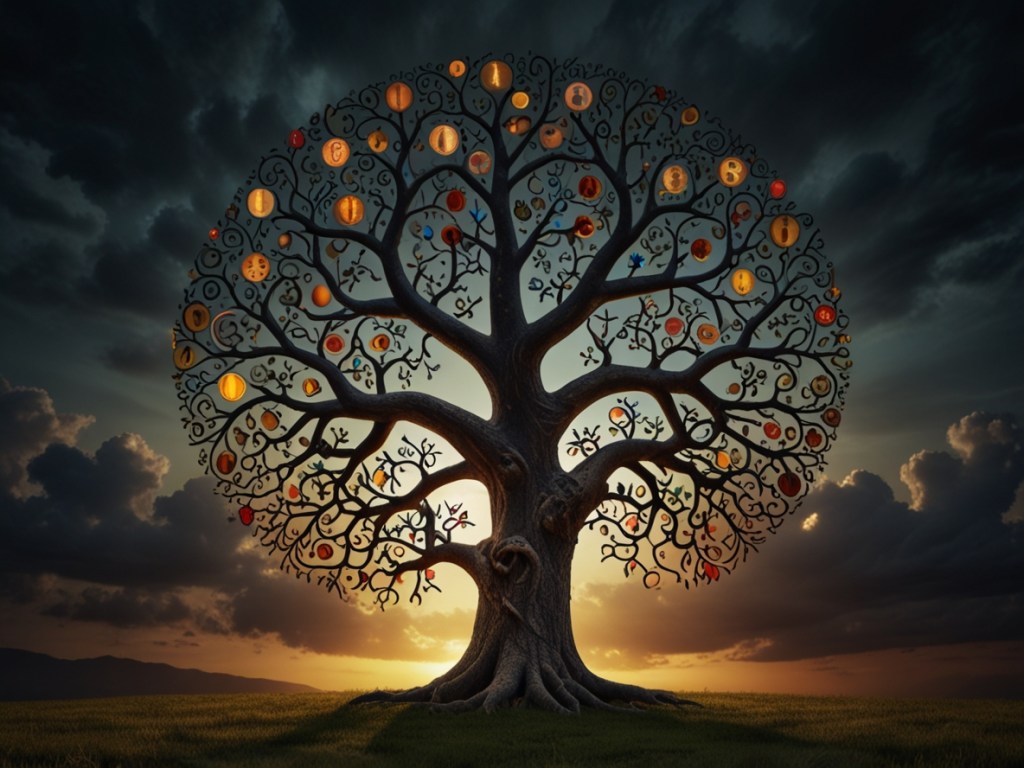
Jung proposed that all human beings share a collective unconscious, a part of the unconscious mind common to all humans, consisting of archetypes, universal symbols, and motifs. The tree of the knowledge of good and evil can be seen as an archetype representing duality and the interconnectedness of opposites.
Duality and Integration of Opposites
- Duality: The tree symbolizes the inherent duality in life: good and evil, light and dark, consciousness and unconsciousness. Eating from the tree introduces the capacity to discern and differentiate between these opposites.
- Integration: Jung believed in the necessity of integrating these opposites to achieve individuation, the process of becoming a whole, self-actualized individual. The act of eating the fruit can be seen as the beginning of this journey towards self-awareness and integration of the conscious and unconscious parts of the psyche.
2. Individuation and the Development of Consciousness
Individuation is the process through which a person integrates the various aspects of their psyche, leading to self-realization. The tree of the knowledge of good and evil symbolizes the start of this journey.
- Awakening of Consciousness: By eating the fruit, Adam and Eve gain awareness of good and evil, symbolizing the awakening of consciousness. This newfound knowledge is crucial for individuation, as it forces them to confront and integrate the complexities of human existence.
- Loss of Innocence: This act also represents the loss of innocence and the beginning of the individual’s journey toward maturity and self-knowledge. It marks a shift from a state of unconscious unity with nature (Eden) to a state of conscious separation and self-awareness.
3. Shadow and Moral Responsibility
In Jungian psychology, the “shadow” represents the unconscious part of the psyche that contains repressed weaknesses, desires, and instincts.
- Confronting the Shadow: The tree can symbolize the encounter with the shadow. By gaining knowledge of good and evil, individuals are forced to confront their own shadow and moral ambiguities. This confrontation is essential for psychological growth and moral responsibility.
- Ethical Consciousness: The tree introduces the concept of moral choice and ethical consciousness. Understanding good and evil entails the capacity for making ethical decisions, an essential component of individuation.
4. The Tree as a Symbol of Transformation
Jung often associated trees with growth, life, and the process of transformation.
- Symbol of Growth: The tree of knowledge represents not just the acquisition of knowledge but also the growth and transformation that comes with it. It stands as a symbol of the human potential for growth through the integration of knowledge and experience.
- Connection to the Self: Trees in Jungian symbolism also connect the earthly and the divine, the conscious and unconscious. The tree of the knowledge of good and evil, thus, represents a connection to the Self, the totality of the psyche that includes both the conscious and unconscious mind.
Conclusion
From a Jungian perspective, the tree of the knowledge of good and evil is a profound symbol of duality, the integration of opposites, the awakening of consciousness, and the beginning of individuation. It represents the journey towards self-awareness, moral responsibility, and the integration of the shadow. Through this lens, the tree is not merely a source of temptation but a catalyst for profound psychological and spiritual growth.
 Horizon Perspective News
Leave a comment