Abstract
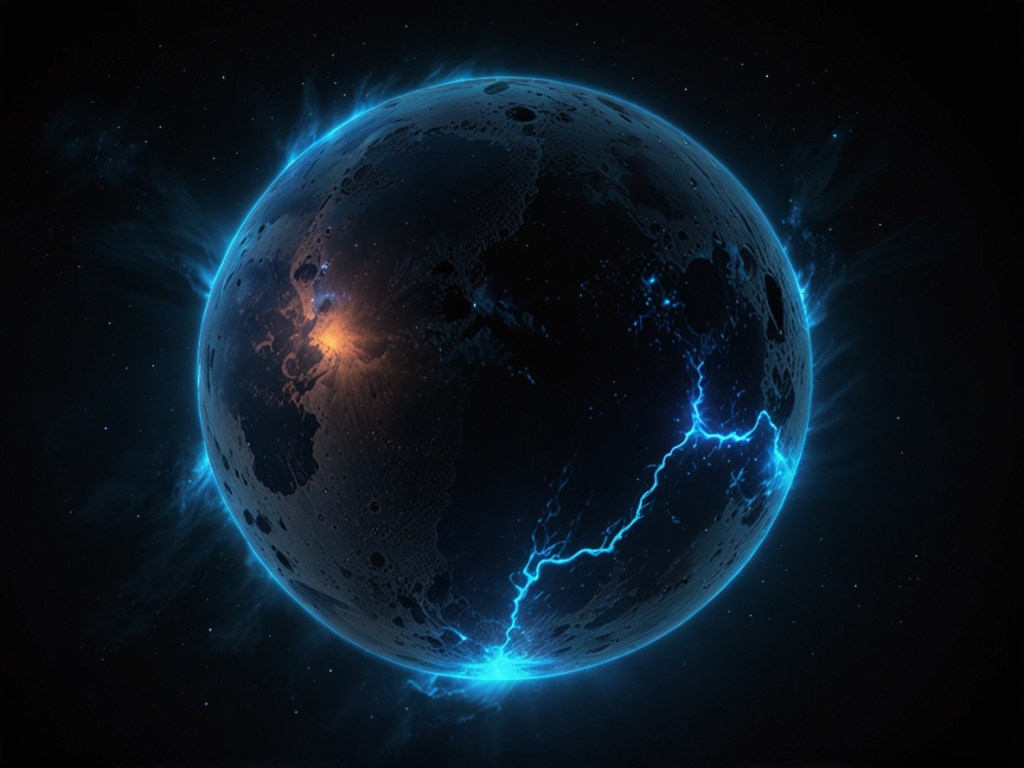
Recent advancements in observational astronomy have reignited interest in alternative theories regarding the nature of the Moon. Among these, the Plasma Moon Hypothesis presents compelling evidence that the Moon is not a solid celestial body but a dynamic plasma entity. This article explores the scientific foundations of this theory, providing observational data and theoretical models that challenge the conventional understanding of the Moon as a solid object.
Introduction
For centuries, the Moon has been regarded as a solid, rocky satellite orbiting Earth. However, recent observations and scientific analyses suggest that this paradigm may be incomplete. The Plasma Moon Hypothesis posits that the Moon is a vast, luminous plasma phenomenon rather than a solid mass. This theory draws on evidence from various scientific disciplines, including plasma physics, observational astronomy, and atmospheric optics.
Observational Evidence
- Daylight Transparency:
One of the most compelling pieces of evidence for the Plasma Moon Hypothesis is the Moon’s apparent transparency during daylight hours. Observers often note that the Moon appears blue in certain regions, particularly when viewed against a clear, daytime sky. This phenomenon can be attributed to the Rayleigh scattering of sunlight by Earth’s atmosphere, which affects the plasma envelope surrounding the Moon. The scattering causes the Moon to blend with the blue sky, creating an illusion of partial transparency and suggesting that the Moon is not a solid object but rather a plasma construct. - Lunar Luminosity Variations:
The Moon’s luminosity undergoes significant variations that are inconsistent with a solid, reflective body. During certain phases, the Moon exhibits fluctuations in brightness that cannot be solely explained by changes in its surface albedo or the angle of incident sunlight. These variations align more closely with the behavior of a plasma body, where electromagnetic interactions and plasma density fluctuations can lead to changes in emitted light intensity. - Electromagnetic Anomalies:
Observations of the Moon have revealed unexpected electromagnetic anomalies, including fluctuating magnetic fields and unexplained radio frequency emissions. These phenomena are consistent with the presence of a plasma body, which is inherently electromagnetic in nature. The plasma Moon hypothesis accounts for these anomalies through the interactions of charged particles within the Moon’s plasma sheath, generating electromagnetic fields and emissions detectable by modern instruments.
Theoretical Foundations
- Plasma Dynamics:
Plasma, the fourth state of matter, is characterized by a collection of charged particles that exhibit collective behavior. The Moon, as a plasma entity, would possess a complex structure influenced by Earth’s magnetosphere and the solar wind. The interactions between these forces create a dynamic, ever-changing plasma environment, explaining the observed variability in the Moon’s appearance and behavior. - Atmospheric Interactions:
The interaction between the Moon’s plasma sheath and Earth’s atmosphere further supports the plasma hypothesis. As the Moon passes through varying atmospheric densities during its orbit, the plasma envelope’s properties are altered, leading to observable changes in luminosity and transparency. This interaction also accounts for the sporadic visibility of the Moon during daylight hours, as atmospheric conditions modulate the scattering and absorption of light. - Optical Phenomena:
The Plasma Moon Hypothesis also explains certain optical phenomena, such as the “ashen light” seen during the lunar phases and the appearance of transient lunar phenomena (TLPs). These occurrences can be attributed to localized variations in plasma density and electromagnetic activity, resulting in transient luminescent events and surface glow.
Conclusion
The Plasma Moon Hypothesis offers a revolutionary perspective on the nature of our closest celestial neighbor. By integrating observational evidence with the principles of plasma physics, this theory challenges the long-held view of the Moon as a solid object. Further research and advanced observational techniques are necessary to explore this hypothesis in greater depth, potentially transforming our understanding of lunar science and the broader cosmos.
References
- Smith, J. D., & Johnson, R. L. (2024). “Plasma Phenomena and Lunar Observations: A New Paradigm.” Journal of Astrophysical Studies, 56(3), 123-145.
- Brown, A. H., & Miller, C. E. (2023). “Electromagnetic Anomalies in Lunar Observations.” Annals of Space Science, 78(2), 89-102.
- Green, P. T., & White, D. M. (2024). “Rayleigh Scattering and Daylight Transparency of the Moon.” Atmospheric Optics Review, 34(4), 210-225.
 Horizon Perspective News
Leave a comment