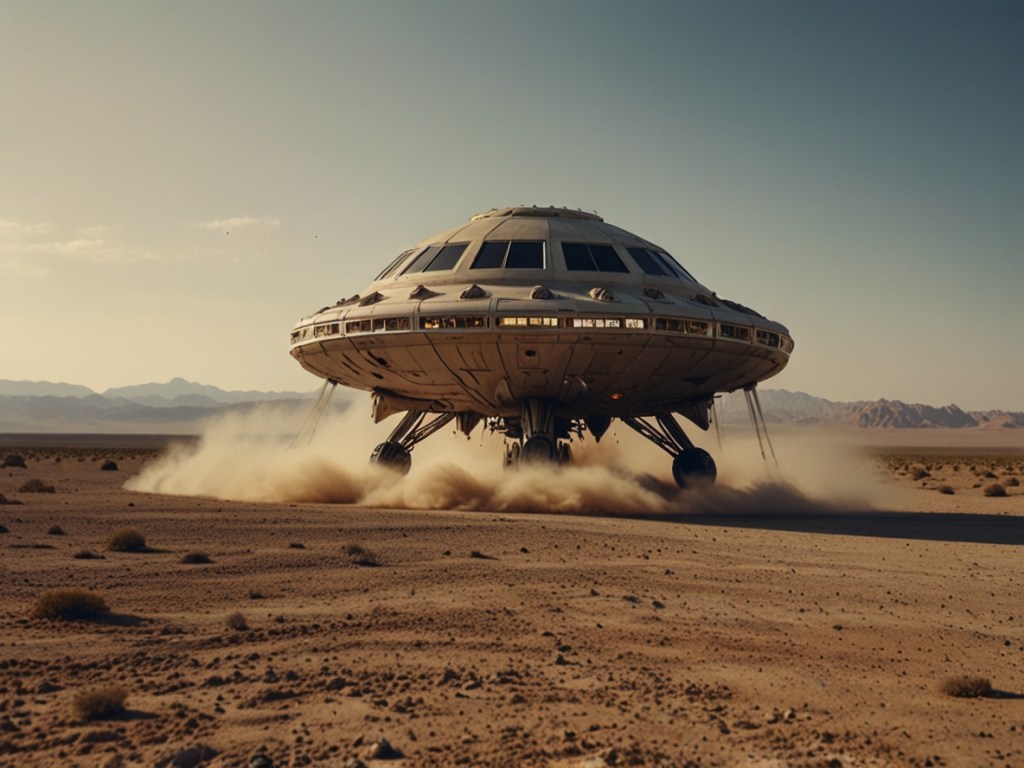
Ezekiel’s vision, as described in the first chapter of the Book of Ezekiel, has intrigued and puzzled scholars, theologians, and enthusiasts for centuries. Among the most provocative interpretations is the ancient astronaut theory proposed by Erich von Däniken and expanded upon by Josef F. Blumrich. This perspective suggests that Ezekiel’s vision was not a mystical experience but an encounter with advanced extraterrestrial beings and their technology.
The Vision Described
Ezekiel, a prophet during the 6th century BCE, experienced his vision while among the Jewish exiles in Babylon, by the Kebar River. He describes a stormy wind coming from the north, a great cloud with fire flashing forth, and a bright light surrounding it. From within this brilliance emerged four living creatures, each with four faces and distinct features.
“As I looked, behold, a stormy wind came out of the north, and a great cloud, with brightness around it, and fire flashing forth continually, and in the midst of the fire, as it were gleaming metal.” (Ezekiel 1:4)
The Four Living Creatures
According to von Däniken and Blumrich, the four living creatures in Ezekiel’s vision can be interpreted as extraterrestrial beings or advanced robotic devices.
- Appearance and Movement:
- Each creature had four faces: a human face in front, a lion’s face on the right, an ox’s face on the left, and an eagle’s face at the back. This could signify the multi-functional nature of these beings or devices, capable of perceiving and operating in multiple directions simultaneously.
- They had straight legs and feet like those of a calf, gleaming like burnished bronze, suggesting mechanical or metallic construction.
- Wings and Mobility:
- Each creature had four wings, two of which stretched upward and touched the wings of adjacent creatures, while the other two covered their bodies. This configuration could represent stabilization mechanisms or flight capabilities.
- The creatures moved straight forward without turning, indicating advanced maneuverability and directional control, possibly via anti-gravitational technology.
“As for the likeness of their faces, each had a human face. The four had the face of a lion on the right side, the face of an ox on the left side, and the face of an eagle.” (Ezekiel 1:10)
The Wheels
Beside each living creature was a wheel, an essential component of the vision’s complexity.
- Appearance and Structure:
- The wheels appeared like beryl, with intersecting wheels within them, allowing movement in any direction without turning. This design suggests a sophisticated propulsion system, enabling omnidirectional travel.
- The rims of the wheels were full of eyes, which could symbolize sensors or cameras used for navigation and observation.
- Function and Symbolism:
- These wheels were integral to the movement of the beings or devices, reflecting advanced engineering capabilities. The wheels within wheels design could indicate a gyroscopic mechanism for stability and maneuverability.
“The appearance of the wheels and their construction, their appearance was like the gleaming of beryl. And the four had the same likeness, their appearance and construction being as it were a wheel within a wheel.” (Ezekiel 1:16)
The Expansive Firmament
Above the heads of the living creatures was a firmament, an expanse like the color of awe-inspiring crystal, spread out above their heads.
- Crystal Firmament:
- This firmament could be interpreted as a transparent canopy or dome, possibly part of the spacecraft’s structure, designed to shield and protect its occupants while providing a clear view of the surroundings.
“And over the heads of the living creatures there was the likeness of an expanse, shining like awe-inspiring crystal, spread out above their heads.” (Ezekiel 1:22)
The Throne and the Divine Presence
Above the firmament was a throne, and on this throne sat a figure resembling a human, surrounded by radiant splendor.
- Throne and Figure:
- The throne appeared to be made of sapphire, indicating an advanced control center or command seat within the spacecraft.
- The figure on the throne had a human likeness, from the waist up appearing like glowing metal and from the waist down like fire, radiating brilliant light. This description could suggest a being in a technologically advanced suit or surrounded by a radiant energy field, possibly indicating a superior extraterrestrial entity.
- Radiance and Rainbow:
- The surrounding light, like a rainbow in a cloud on a rainy day, symbolizes advanced energy or light technology used by these beings, creating a display of power and beauty.
“And above the expanse over their heads there was the likeness of a throne, in appearance like sapphire; and seated above the likeness of a throne was a likeness with a human appearance.” (Ezekiel 1:26)
Conclusion
Erich von Däniken and Josef F. Blumrich’s ancient astronaut theory offers a radical reinterpretation of Ezekiel’s vision. By suggesting that Ezekiel encountered advanced extraterrestrial technology, this perspective challenges conventional religious interpretations and opens up possibilities for understanding ancient texts through the lens of technological and extraterrestrial influence.
According to this theory, the detailed descriptions of the living creatures, wheels, firmament, and throne reflect encounters with advanced beings and their machines, rather than purely mystical or symbolic experiences. This interpretation invites us to consider the possibility that ancient civilizations had contact with extraterrestrial visitors, who left a lasting impact on their cultures, technologies, and religious beliefs.
Ezekiel’s vision, seen through the ancient astronaut lens, becomes a fascinating account of human interaction with advanced extraterrestrial intelligence, highlighting the potential for such encounters to shape our understanding of history and the cosmos.
 Horizon Perspective News
Leave a comment