Introduction
The origin of the universe has captivated human curiosity for centuries. From ancient creation myths to modern scientific theories, we grapple with questions about how it all began. Among the most influential ideas is the Big Bang theory, which proposes that our cosmos emerged from an incredibly dense and hot state approximately 13.8 billion years ago. But does this theory truly reveal the ultimate origin of the universe, or does it merely scratch the surface of a deeper cosmic enigma?
The Big Bang Theory: A Prelude
The Discovery of Cosmic Expansion
The journey begins with the discovery of cosmic expansion. In the early 20th century, astronomers observed that galaxies were moving away from each other. The Belgian priest and astronomer Georges Lemaître was one of the pioneers in understanding this phenomenon. He realized that if the universe were expanding, then it must have been denser and hotter in the past. Lemaître’s work laid the groundwork for what we now call the Big Bang theory.
The Name “Big Bang”
The term “Big Bang” was coined by British astrophysicist Fred Hoyle during a BBC radio broadcast in 1949. Ironically, Hoyle was a critic of the theory, preferring his own steady-state model. Nevertheless, the name stuck, and the Big Bang theory became synonymous with the birth of the cosmos.
The Redshift of Galaxies
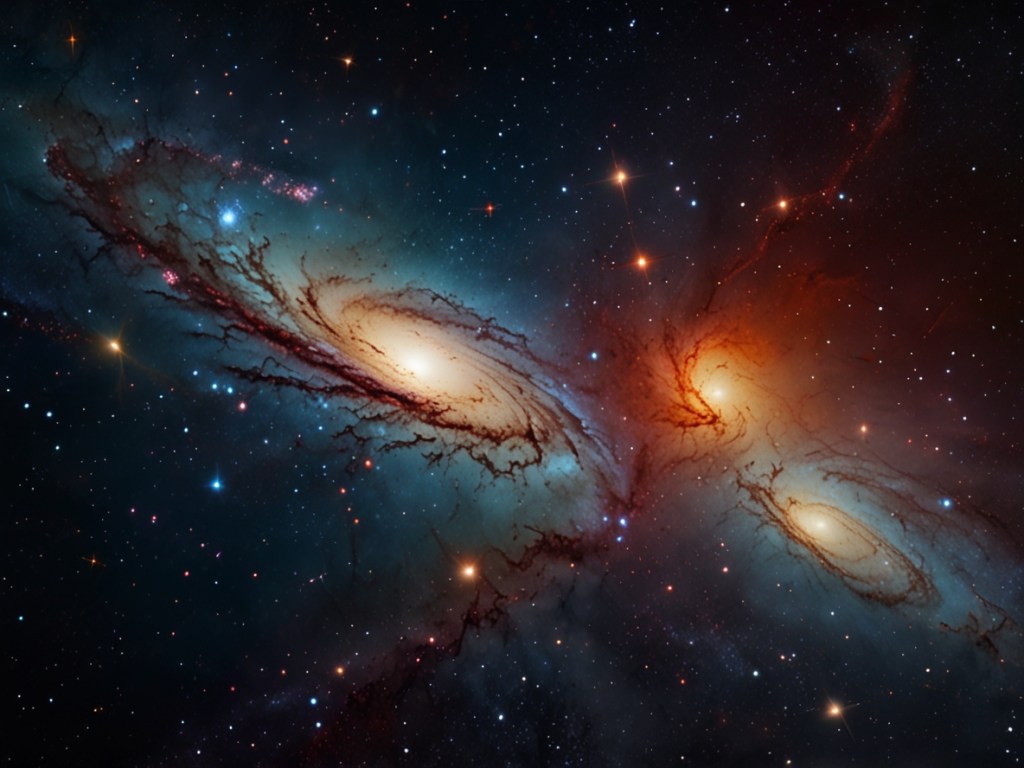
The redshift of light emitted by distant galaxies is a fundamental phenomenon in cosmology and astronomy. As light travels across the vast cosmic expanse, its wavelength stretches, shifting toward the less energetic (higher wavelength) end of the spectrum. This redshift provides critical clues about our universe, but it also sparks controversy and raises intriguing questions. Let’s delve deeper into the history, interpretations, and challenges surrounding cosmic redshift.
The Origins of Redshift
The First Clue: Slipher’s Discovery
In 1913, American astronomer Vesto Melvin Slipher observed the redshift of light from distant galaxies. He noticed that their spectral lines were shifted toward longer wavelengths, suggesting that these galaxies were receding away from Earth. This initial clue hinted at an expanding universe.
The Big Bang Emerges
Friedmann and Lemaître, building on Einstein’s general relativity, formulated the theory of cosmic expansion. Edwin Hubble’s observations in 1929 confirmed this expansion, leading to the establishment of the Big Bang model. According to this model, the universe began as an ultra-hot, ultra-dense singularity and has been expanding ever since.
The Controversies and Challenges
1. Selective Galaxy Formation
The redshift-distance relationship implies that galaxies are receding from us at speeds proportional to their distance. However, this raises a puzzling question: Why do galaxies form selectively with precisely this spacing between them? Is there an underlying cosmic blueprint guiding their arrangement?
2. Intrinsic Redshifts
An alternative possibility is that something strange occurs within galaxies themselves, altering their redshifts. Perhaps interactions between matter, dark energy, or other unknown forces play a role. These “intrinsic redshifts” challenge our understanding of how light behaves over cosmic distances.
3. Tired Light Theory
The Tired Light theory proposes that photons lose energy as they travel through space due to interactions with other particles. This gradual energy loss results in redshift. However, this theory faces significant hurdles, including the lack of direct evidence and its inability to explain other cosmological phenomena.
4. Gravitational Redshift
Einstein’s general relativity predicts that massive objects, such as galaxies, can cause gravitational redshift. As light climbs out of a gravitational well, its energy decreases, leading to a redshift. While this effect is real, it cannot account for the entire cosmic redshift.
Beyond the Big Bang: Alternative Models for Red Shift
1. Compton Effect
The Compton effect suggests that photons scatter off electrons, losing energy in the process. This scattering could contribute to redshift. However, it remains a minor effect compared to cosmic expansion.
2. The Relativistic Doppler Effect
The relativistic Doppler effect accounts for the motion of galaxies relative to the observer. As galaxies move away, their emitted light experiences a redshift. This effect aligns with the expanding universe but doesn’t explain all aspects of redshift.
3. Gravitational Lensing
In gravitational lens systems, light from distant sources bends around massive objects (like galaxy clusters), causing multiple images of the same source. The redshift difference between these images provides a novel probe of cosmology. Upcoming surveys, such as Euclid, aim to detect such systems and refine our understanding of cosmic parameters.
The Misconceptions

Not a Bang, Not the Beginning
Contrary to popular imagery, the Big Bang was not an explosive event like a cosmic firework. It was not a “bang” in the conventional sense. Rather, it marks the moment when the universe transitioned from an ultra-hot, ultra-dense state to its current form. It was not the beginning; it was a transformation.
The Smoothness Conundrum
As we trace the universe’s evolution backward, we encounter a perplexing issue: smoothness. The cosmic microwave background radiation—the afterglow of the Big Bang—appears remarkably uniform. But how did it achieve such uniformity? Known physical laws alone cannot explain this. Enter the concept of inflation.
The Inflationary Epoch
Imaginary Inflation
Inflation posits that the universe underwent a rapid expansion phase shortly after the Big Bang. During this inflationary epoch, space expanded exponentially, smoothing out irregularities. However, inflation remains theoretical, lacking direct evidence. It’s like adding an extra chapter to the cosmic storybook—one we can’t read yet.
The Inflationary Model: A Brief Overview
In the standard model of cosmology, the inflationary epoch is a period of rapid exponential expansion that occurred a fraction of a second after the Big Bang. Proposed by Alan Guth in 1979, inflation was introduced to solve several problems in the Big Bang theory, such as the horizon problem and the flatness problem. The theory suggests that during inflation, the universe expanded faster than the speed of light, smoothing out any irregularities and leading to the uniform universe we observe today.
The Smoothness Problem
The Uniformity of the CMB
The cosmic microwave background (CMB) radiation is remarkably uniform across the sky, which is puzzling considering the vast distances between regions that should not have been in causal contact with each other in the early universe. Inflation posits that the universe underwent a rapid expansion phase shortly after the Big Bang, which stretched space and evened out any initial irregularities.
The Horizon Problem
The horizon problem arises from the observation that regions of the universe that are separated by vast distances have nearly identical temperatures. This uniformity suggests that these regions must have been in contact at some point to equilibrate temperatures, which seems impossible without a period of inflationary expansion.
Challenges to Inflation
Theoretical Issues
Despite its success in explaining the smoothness of the CMB, inflation is not without its critics. Some argue that inflation requires fine-tuning of initial conditions and that it leads to a multiverse, which may be impossible to test empirically. Others point out that inflationary models predict a range of possible outcomes, making it difficult to falsify the theory.
Empirical Evidence
While inflation predicts certain features in the CMB, such as a flat universe and specific patterns of temperature fluctuations, the evidence is not conclusive. Some data from the Planck satellite and other observations have been interpreted as disfavoring the simplest inflation models, suggesting that alternative theories may need to be considered.
Alternative Interpretations
Quantum Fluctuations
Some physicists propose that quantum fluctuations in the early universe could have led to the smoothness observed in the CMB without requiring an inflationary period. These fluctuations might have created regions of space with uniform density and temperature, which later grew into the large-scale structure of the universe.
String Gas Cosmology
String gas cosmology is an alternative to inflation that relies on principles from string theory. It suggests that the universe began in a hot, dense state filled with a gas of strings, and that the dimensions we observe expanded out of this primordial state.
The Matter Bounce Scenario
The matter bounce scenario posits that the universe underwent a contraction phase before expanding, which could explain the uniformity of the CMB without invoking inflation. In this model, the universe bounces back from a high-density state, smoothing out irregularities.
The Smoothness Challenge
The smoothness of the cosmic microwave background poses a challenge. Imagine a cosmic jigsaw puzzle: the pieces fit together seamlessly, but we don’t know who assembled them. Inflation suggests that an unknown force stretched the fabric of spacetime, ironing out wrinkles. Yet, like a magician’s trick, inflation conceals its secrets behind the cosmic curtain.
The Ultimate Question: Where Did It All Come From?
The First Law of Thermodynamics
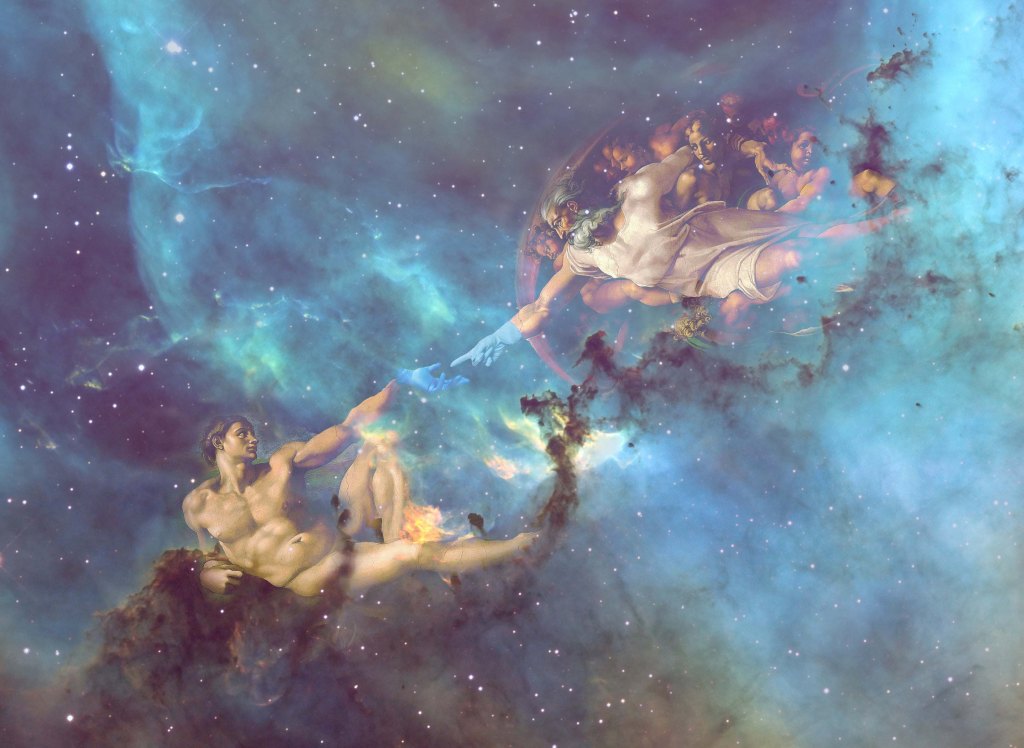
The first law of thermodynamics states that energy cannot be created or destroyed—it merely changes form. But what about the universe itself? If it emerged just before the Big Bang, where did it come from? Here, we encounter a cosmic paradox akin to the age-old question: “If God created the universe, where did God come from?”
Leap of Faith
Whether we invoke God or the primordial singularity, both explanations require a leap of faith. The complexity of either proposition is staggering. If we ask the question “Where did God come from?”, it’s not really reducing the problem in a way that we would have any alternative to that. It’s just rephrasing the essence of what there is.
Beyond the Big Bang: Alternative Models
1. Steady-state Universe
Overview:
- Proposed by Sir James Hopwood Jeans in 1928 and further developed by Hermann Bondi, Fred Hoyle, and Thomas Gold in the late 1940s.
- In the Steady-State model:
- The universe is continually expanding but maintains the same overall density.
- Matter is continuously created, and old astronomical objects are replaced by new ones.
Addressing Big Bang Problems:
- Horizon Problem:
- The uniformity of the cosmic microwave background radiation across vast distances challenges the Big Bang’s explanation.
- Steady-State posits that the universe has always existed, avoiding the need for a singular beginning.
- Flatness Problem:
- The near-flatness of the universe contradicts expectations from the Big Bang.
- Steady-State doesn’t require fine-tuning to maintain flatness.
- Monopole Problem:
- The absence of magnetic monopoles in the observable universe remains unexplained.
- Steady-State doesn’t predict their existence.
2. Ekpyrotic Universe
Overview:
- The Ekpyrotic model suggests that our universe resulted from a collision of two three-dimensional worlds in a hidden fourth dimension.
- It doesn’t entirely conflict with the Big Bang theory and aligns with its events after a certain time.
Addressing Big Bang Problems:
- Horizon Problem:
- Ekpyrotic scenarios propose that the collision of branes (higher-dimensional objects) can explain the uniformity of the cosmic microwave background.
- This collision generates the hot, dense state required for the subsequent expansion.
- Flatness Problem:
- The cyclic nature of Ekpyrotic models allows for a dynamically flat universe without fine-tuning.
3. Klein-Alfvén Cosmology
Overview:
- Developed by Hannes Alfvén and Oskar Klein in the 1960s and 1970s.
- Key features:
- Matter and antimatter exist in equal quantities at very large scales.
- The universe is eternal, not bounded by the Big Bang.
- Expansion results from matter-antimatter annihilation, not cosmic inflation.
Addressing Big Bang Problems:
- Horizon Problem:
- Klein-Alfvén proposes an eternal universe, eliminating the need for a cosmic singularity.
- The uniformity arises from continuous processes rather than an initial explosion.
- Flatness Problem:
- The cellular structure of space in Klein-Alfvén cosmology naturally accounts for flatness.
- Monopole Problem:
- The absence of magnetic monopoles is consistent with this model.
While these alternative cosmologies offer fresh perspectives, it’s essential to recognize their speculative nature. Without empirical evidence, they remain intriguing hypotheses. As we continue our cosmic quest, let curiosity guide us, even beyond the boundaries of the Big Bang.
Conclusion: The Cosmic Riddle Persists
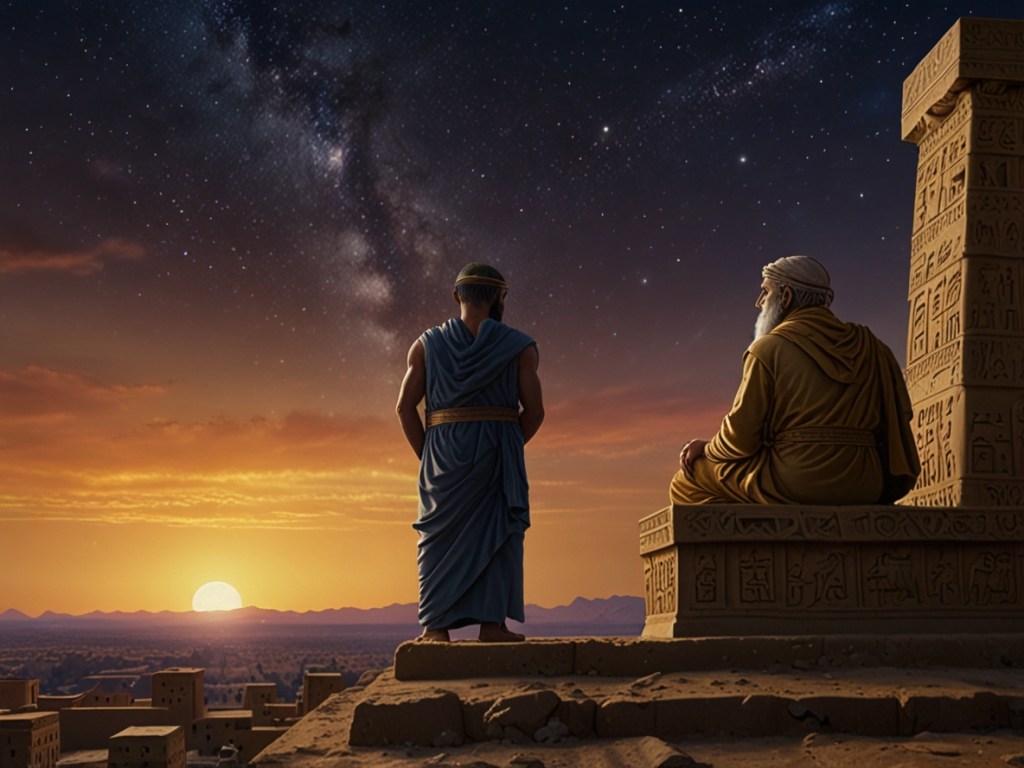
The quest to unravel the origin of the universe has spanned millennia, transcending cultures, civilizations, and scientific paradigms. From the ancient Babylonians to modern cosmologists, the question persists: How did it all begin? Let us explore why, despite our remarkable progress, we remain no closer to the cosmic genesis than our ancient predecessors.
The Babylonian Gaze
In the shadow of the ziggurats, the Babylonians gazed at the night sky, mapping constellations and weaving myths. Their cosmology was a blend of celestial observations, religious beliefs, and poetic narratives. Yet, their inquiries into the universe’s origin were constrained by limited tools and a lack of empirical data. They could only speculate, attributing creation to gods and cosmic battles.
Our Modern Odyssey
Fast-forward to the present—a time of telescopes, particle accelerators, and cosmic microwave background radiation. We’ve made astonishing strides in understanding the universe’s inner workings:
- General Relativity: Einstein’s elegant equations describe gravity’s curvature, the expansion of space, and the cosmic dance of galaxies. We can predict orbits, explain black holes, and map cosmic structures.
- Quantum Mechanics: In the subatomic realm, particles waltz with uncertainty. Quantum field theory unifies forces, and the Standard Model paints a vivid portrait of particles and interactions.
- Cosmic Microwave Background: Detected in 1965, this faint glow reveals the universe’s infancy—a snapshot of when it was a mere 380,000 years old. It confirms the Big Bang’s hot, dense phase.
- Nucleosynthesis: We’ve traced the cosmic recipe: hydrogen, helium, and a dash of lithium. Stellar furnaces forged these elements, echoing the primordial fire.
The Cosmic Silence
Yet, for all our triumphs, the veil over the universe’s birth remains unlifted. Here’s why:
The Singularity Enigma
- The Big Bang theory posits an initial singularity—an infinitesimal point of infinite density. But here, our equations falter. Physics breaks down, and time itself loses meaning. We glimpse the edge of our understanding.
The Missing Link
- We’ve deciphered cosmic evolution post-Big Bang, but what ignited that cosmic spark? Was it a quantum fluctuation, a cosmic collision, or something beyond our grasp?
The Multiverse Hypothesis
- Enter the multiverse—an audacious idea. Perhaps our universe is but one bubble in a vast cosmic foam. Yet, evidence eludes us. We tread on theoretical ground.
The Limits of Empiricism
- Our cosmic canvas is finite. We observe what lies within—galaxies, quasars, dark matter. But the cosmic loom that wove it all—the grand tapestry of creation—remains hidden.
The Humbling Truth
As we peer into the cosmic abyss, we confront humility. Our knowledge is a candle flickering against cosmic darkness. We’ve mastered the “what” but stumble at the “why.” The Babylonians, too, pondered the same mysteries, albeit with different myths.
So, let us continue our cosmic odyssey. Perhaps one day, our equations will sing the universe’s birth hymn. Until then, we remain stargazers, seekers, and dreamers—closer, yet infinitely distant from the cosmic cradle.
 Horizon Perspective News
Leave a comment